


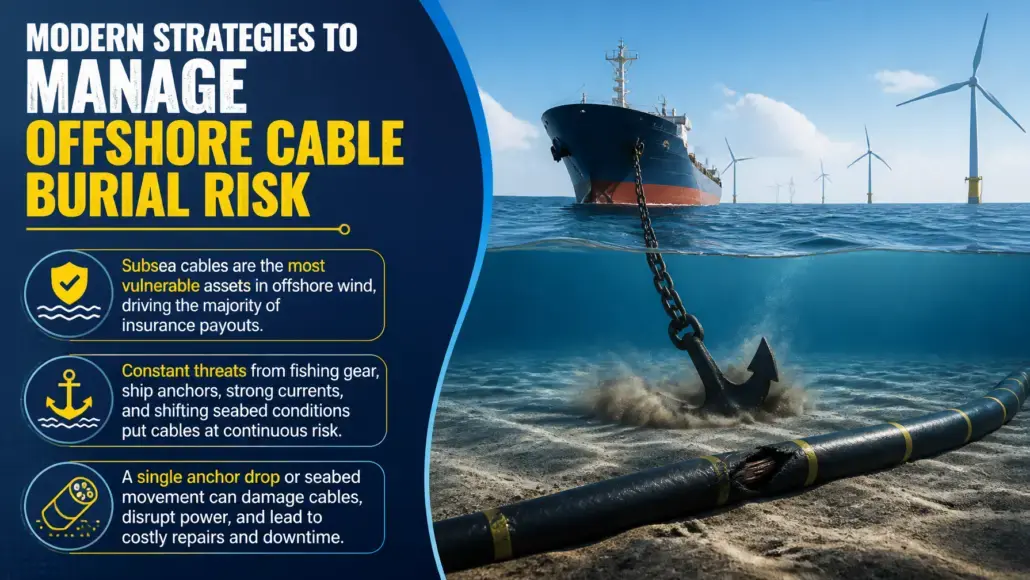
Subsea power cables are the most vulnerable physical assets in an offshore wind farm. Over eighty percent of all offshore wind insurance payouts stem from cable damage, even though subsea cables account for less than a tenth of total project capital expenditure. Once laid on the seafloor, export and inter-array cables face continuous exposure to commercial fishing gear, heavy ship anchors, aggressive tidal currents, and mobile sand waves. A single dropped anchor from a commercial bulk carrier or an impact from heavy bottom-trawl doors can sever armored conductors, causing power generation outages and millions of dollars in marine repair bills.
Managing offshore cable burial risk requires engineering teams to determine optimal burial depths and select secondary protection measures based on rigorous site-specific geotechnical investigations. Burying cables too shallow leaves them vulnerable to external aggression and hydrodynamic exposure. Conversely, attempting excessive burial depth in hard soils or fractured rock increases offshore installation costs exponentially, slows vessel progress, and risks thermal overheating of electrical conductors due to high soil thermal resistivity.
PowerGen Advancement notes that as offshore wind farms expand into crowded coastal shipping lanes and geotechnically complex seabeds, static burial rules of thumb are being replaced by dynamic, quantitative risk assessments and engineered seabed stabilization techniques. Mitigating offshore cable burial risk early in project design prevents catastrophic cable failures during commercial operations.
Quantitative Cable Burial Risk Assessment Methodologies
Modern subsea engineering relies on the Cable Burial Risk Assessment methodology, developed to establish evidence-based Depth of Lowering targets. Rather than mandating a uniform burial depth across an entire export corridor, this approach models localized threat profiles along each discrete segment of the subsea cable route.
The assessment integrates historical maritime traffic patterns with detailed geophysical and geotechnical surveys to quantify specific risks:
- Automated Identification System tracking data to evaluate shipping density, vessel tonnages, navigation patterns, and emergency anchor penetration depths along congested navigation channels.
- Commercial fishing activity maps detailing bottom-trawling gear weights, trawl board penetration depths, beam trawler operations, and scallop dredging intensity.
- Geophysical survey data capturing bathymetry, side-scan sonar reflections, and sub-bottom profiler acoustics to identify boulder fields, shallow gas pockets, and bedrock outcrops.
- Geotechnical seabed sampling using downhole cone penetration testing and vibrocores to determine soil shear strength, sand grain size distribution, and sediment layering.
- Hydrodynamic morphodynamic modeling to track mobile sand wave migration, bedform wavelengths, and seasonal seabed erosion patterns over thirty-year operational horizons.
Fugro completed comprehensive geotechnical and geophysical survey campaigns in 2025 across multiple North Sea and North American offshore wind corridors. Utilizing autonomous underwater vehicles equipped with synthetic aperture sonar and high-resolution sub-bottom profilers, Fugro produced continuous 3D subsea soil models. These detailed stratigraphy datasets allow cable installation engineers to calibrate trenching tools precisely, reducing unachieved burial risks while establishing defensible Depth of Lowering targets.
Environmental considerations also play a significant role in determining appropriate seabed protection strategies. While rock placement provides robust physical armoring, marine regulators require developers to ensure that deposited stone materials do not disrupt sensitive benthic ecosystems or create artificial navigational hazards for local fishing vessels. Engineers carefully design rock berm slopes with gentle profiles that allow fishing gear to slide over the stones without snagging. Furthermore, sourcing clean, quarry-certified igneous or metamorphic stone prevents the introduction of fine sediments that could cloud water columns and harm marine flora and fauna.
Mechanical Trenching Methodologies and Soil Adaptations
Trenching into the seabed is the primary method for protecting subsea cables against external maritime interference. Selection of trenching methodology depends heavily on seabed composition, ranging from fluid muds and loose sands to over-consolidated clays, cobbles, and solid bedrock.
Marine contractors deploy three primary mechanical trenching techniques depending on subsea soil conditions:
- Jet trenching systems that use high-pressure water jets to fluidize cohesive silts and loose granular sands, allowing the heavy cable to sink naturally to target burial depth under gravity.
- Mechanical chain cutters and rock-wheel trenchers equipped with carbide cutting teeth to cut clean slots through hard clays, cemented sands, and soft rock formations.
- Pre-cut or simultaneous cable plows pulled along the seabed by heavy offshore support vessels to carve clean trenches in consolidated soils and dense glacial tills.
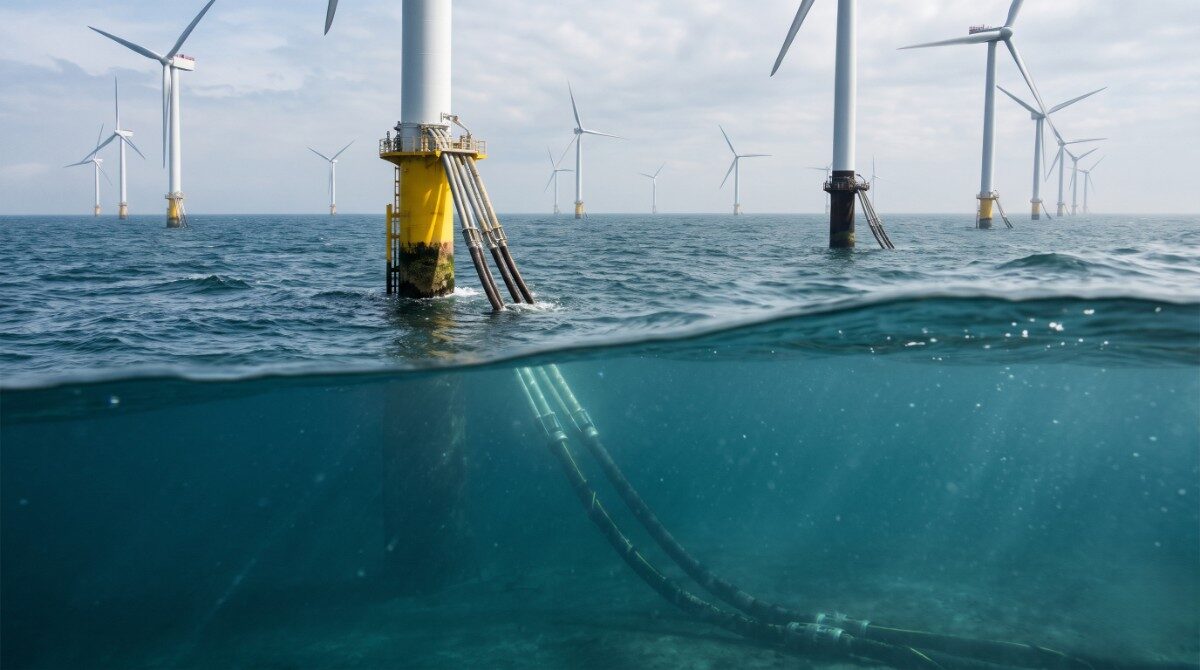
Where soils vary rapidly along a route, contractors utilize versatile remotely operated trenching vehicles capable of switching between jetting and mechanical cutting modes. Boskalis deployed next-generation subsea trenchers across several European offshore projects in 2025, operating multi-mode subsea vehicles that adjust jetting nozzle pressures in real time based on downhole resistance sensors. This adaptive capability maintains consistent burial depths even when traversing sudden transitions between soft seabed sediments and dense boulder clay.
DNV updated its recommended practice DNV-RP-0360 in 2025, titled Subsea Power Cable Burial and Protection. The document provides revised safety guidelines for assessing cable burial feasibility, evaluating thermal de-rating caused by deep burial, and validating post-installation trenching depth using specialized electromagnetic tone-tracking technologies. Proper thermal modeling is critical because excessive burial in insulating sediments can trap electrical heat, accelerating insulation degradation and reducing the cable’s current-carrying capacity.
Secondary Seabed Protection and Rock Placement Strategies
In complex geological environments, achieving target burial depth through trenching alone is not always feasible. Exposed bedrock, mobile megaripples, existing pipeline crossings, and rocky seabed zones prevent mechanical cutters from achieving required lowering depths. In these locations, developers must install secondary physical protection systems over the cable to control offshore cable burial risk.
Targeted rock placement represents the most widely deployed secondary protection strategy. Specialized fall-pipe vessels position crushed rock over the cable with surgical accuracy using dynamic positioning and underwater acoustic positioning beacons. The engineered rock berm serves a dual function: it shields the cable against anchor strikes and fishing gear while dampening bottom currents to prevent seabed scouring.
Van Oord and DEME Group advanced precision fall-pipe rock placement operations during their 2025 offshore campaigns. Modern fall-pipe vessels utilize automated acoustic guidance systems and remotely operated vehicles at the fall-pipe exit to construct graded rock berms with millimeter precision. By layering smaller filter stones over the cable before depositing larger armoring rock, contractors protect cable sheaths from mechanical puncture while ensuring hydrodynamic stability under five-hundred-year storm wave actions.
Where rock placement is constrained by water depth or navigational clearance, contractors install articulated cast-iron shells, concrete mattresses, or grout bags:
- Articulated split-pipe systems provide localized mechanical shielding at offshore foundation entry points, protecting cables from cyclic bending and abrasion where they emerge from J-tubes into open water.
- Concrete mattresses provide stable ballasting and abrasion protection across pipeline crossings and high-current channels.
- Pre-filled grout bags stabilize irregular rocky surfaces and bridge gaps where cables span natural seabed depressions.
Safeguarding subsea power transmission preserves the electrical lifeline that connects offshore generating assets to consumers onshore. However, asset reliability requires equal engineering vigilance above the waterline. While subsea teams focus on seabed geohazards, topside engineers must continuously monitor structural stresses on the rotating machinery, where wind turbine blade load monitoring using embedded sensors provides the critical real-time structural data necessary to protect multi-megawatt turbines from catastrophic aerodynamic fatigue.
Electromagnetic shielding and thermal dissipation represent additional technical criteria evaluated during cable burial engineering. High-voltage alternating current cables generate weak electromagnetic fields that can be detected by electro-sensitive marine species such as elasmobranchs. Adequate burial depth attenuates electromagnetic field strength at the seabed surface, addressing environmental licensing requirements. Concurrently, precise geotechnical thermal resistivity testing ensures that buried cables dissipate internal electrical heat into surrounding sediments without inducing localized drying of cohesive clays, which could lead to thermal runaway and premature cable insulation failure.
Post-Installation Survey and Lifecycle Integrity Management
Cable protection is not a one-time operation completed during wind farm construction. Ocean currents, shifting sandbanks, and seasonal storms continuously reshape the seabed, creating dynamic sediment transport that can strip protective sediment layers and leave buried cables exposed on the seafloor.
Subsea operators perform recurring acoustic bathymetric surveys and electromagnetic depth-of-burial inspections throughout the asset’s operating lifecycle. When surveys identify sediment scouring or unburied cable loops, marine maintenance spreads are dispatched to execute remedial rock dumping or secondary sandbag placement. Integrating acoustic survey data into asset digital twin platforms enables proactive risk management, ensuring that submarine transmission assets remain secure throughout their multi-decade design life.
References
- “Subsea Grid Integration and Cable Reliability 2025” – International Energy Agency
- “Subsea Power Cable Burial and Protection DNV-RP-0360” – DNV
- “Autonomous Geotechnical Survey Solutions for Offshore Infrastructure” – Fugro
- “Next-Generation Subsea Trenching and Cable Installation Review” – Boskalis
- “Precision Rock Placement and Scour Protection in Offshore Wind” – DEME Group
- “Marine Seabed Protection and Infrastructure Stabilization” – Van Oord