















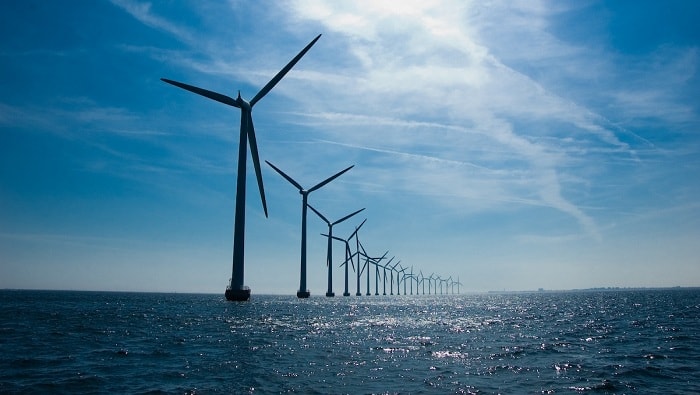






Turbine rotors have entered a structural regime where blade dimensions rival commercial aircraft wings. Modern fifteen-to-twenty-megawatt offshore wind turbines deploy blades exceeding one hundred and fifteen meters in length, sweeping an atmospheric area larger than seven football pitches. Operating across this massive vertical swept area exposes flexible composite structures to intense wind shear, atmospheric boundary layer turbulence, directional veer, and sudden aerodynamic gusts.
As blades rotate through changing air masses, they experience continuous cyclic bending in both flapwise and edgewise directions. Flapwise loads, driven by aerodynamic thrust perpendicular to the rotor plane, push the blade tip toward the support tower, risking catastrophic blade-tower strikes during extreme storm gusts. Edgewise loads, driven primarily by gravity and rotational inertia, subject the blade root and trailing edge bond lines to millions of tension-compression cycles every year.
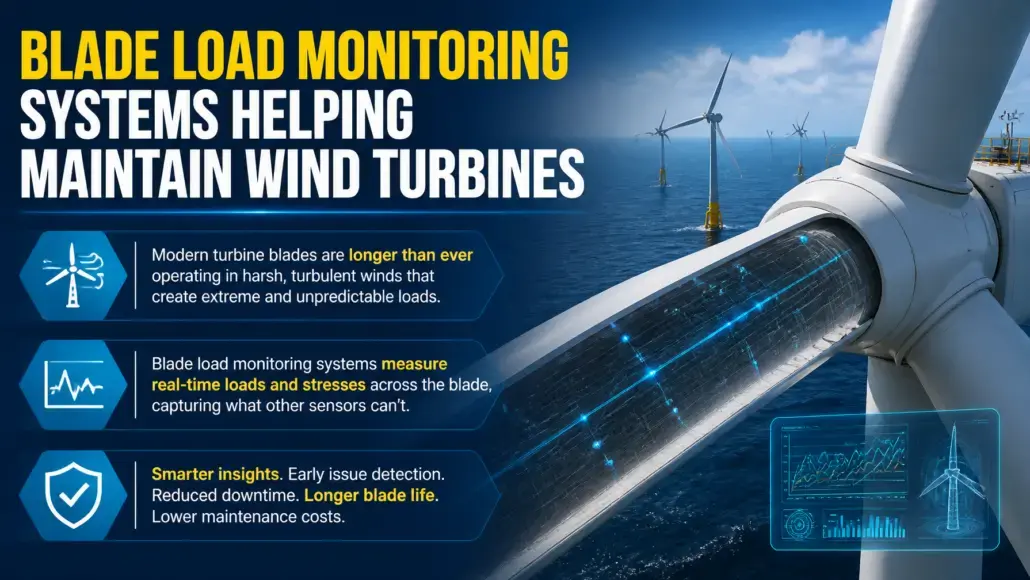
Wind turbine original equipment manufacturers recognize that passively over-engineering composite structures with extra glass and carbon fiber adds excessive deadweight, increasing raw material costs and exacerbating fatigue loads on main bearings, pitch drives, and yaw mechanisms. Blade load monitoring systems have transitioned from optional research tools into critical active control systems. PowerGen Advancement observes that by embedding intelligent sensor arrays directly into the composite laminate during blade manufacturing, operators measure real-time aerodynamic strains, enabling smart control algorithms to mitigate structural loads actively.
Sensor Architectures and Fiber Optic Technologies
Operating electronics inside a rotating wind turbine blade presents severe environmental challenges. Blades act as giant lightning attractors in open offshore waters, with lightning strikes channeling hundreds of kiloamperes of electrical current through internal down-conductors. Conventional electronic copper-wire strain gauges installed in this environment are highly prone to electromagnetic interference and electrostatic burnout.
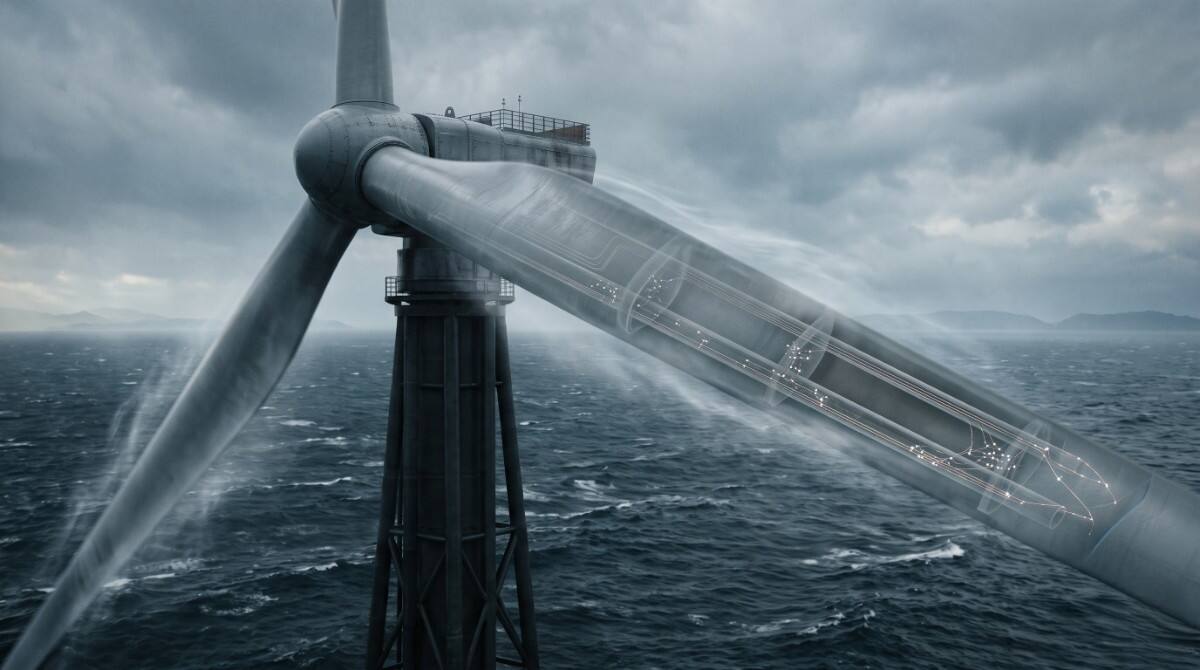
Optical sensing technology, particularly Fiber Bragg Grating sensors, has emerged as the global industry benchmark for blade load telemetry. Fiber optic strands manufactured from chemically inert silica glass are completely immune to electromagnetic interference and lightning surges. Multiple Fiber Bragg Grating sensor nodes can be multiplexed along a single optical fiber strand, allowing dozens of measurement points to be monitored through a single interrogator unit mounted in the rotating hub.
Fiber optic blade monitoring architectures deliver critical structural data across key blade regions:
- Blade root sensors positioned ninety degrees apart around the circular root laminate to measure flapwise and edgewise bending moments with high precision.
- Spar cap strain arrays embedded into the carbon or glass fiber load-carrying spar caps along the mid-span to detect compressive buckling and tensile elongation.
- Outboard deflection sensors positioned toward the blade tip to track dynamic flapwise deflections and ensure safe clearances between blade tips and the steel tower.
- Trailing edge bond line monitors that measure shear strain and identify micro-cracks before structural delamination propagates into full blade failure.
Moog Inc. expanded its portfolio in 2025 with certified fiber-optic blade load sensing systems engineered specifically for multi-megawatt offshore platforms. The system incorporates high-frequency optical interrogators that sample Fiber Bragg Grating arrays at rates exceeding one hundred hertz. By continuously monitoring strain profiles under fluctuating turbulence, the sensor platform provides high-fidelity load data directly to the wind turbine main automation controller.
Lightning protection represents an extraordinary technical challenge for embedded instrumentation in offshore blades. Direct lightning strikes generate immense electric fields and rapid voltage transients that instantly destroy standard electrical sensors. Optical strain sensors overcome this vulnerability because glass fibers are non-conductive and do not provide an electrical path for lightning energy. However, optical fibers must still be installed with specialized mechanical routing that isolates them from high-voltage discharge channels connecting lightning receptor pucks to the root grounding ring. Careful structural integration ensures that lightning current dissipates harmlessly without damaging optical telemetry cables.
Integration with Individual Pitch Control Systems
The true operational value of blade load monitoring systems emerges when sensor data integrates directly with the turbine pitch control architecture. Conventional wind turbines utilize collective pitch control, pitching all three blades simultaneously to regulate rotor speed and power output above rated wind speeds. However, collective pitch cannot mitigate asymmetrical aerodynamic loads caused by vertical wind shear or localized gusts across the rotor plane.
Individual pitch control utilizes real-time bending moment data from embedded blade sensors to adjust the pitch angle of each blade independently during every single revolution. As a blade rotates into higher wind speeds at the top of the rotor arc, the pitch drive rotates the blade slightly to shed aerodynamic lift. Conversely, as the blade sweeps through the lower, slower wind layer near the sea surface, the controller increases the angle of attack to equalize aerodynamic thrust.
Vestas Wind Systems deployed advanced individual pitch control algorithms driven by optical blade load sensors across its V236-15.0 MW offshore platform campaigns in 2025. Field validation data demonstrated that continuous individual blade pitching mitigates cyclic flapwise fatigue loads by twenty to thirty percent, while reducing peak asymmetric moments on the main shaft and yaw bearing by up to twenty-five percent. This substantial load reduction allows engineers to optimize structural mass, extending the operational life of the drivetrain and tower.
Modern load management systems provide several key operational advantages:
- Active gust mitigation that rapidly feathers blades during extreme wind events, preventing peak load excursions from exceeding structural yield limits.
- Real-time ice detection and aerodynamic imbalance identification by analyzing abnormal changes in blade mass distribution and natural vibration frequencies.
- Automated blade life tracking that calculates cumulative fatigue consumption, allowing wind farm operators to adjust power production strategies based on asset health.
- Drivetrain vibration dampening that harmonizes aerodynamic thrust fluctuations with generator torque control to minimize mechanical wear.
Siemens Gamesa Renewable Energy integrated embedded optical sensing arrays across its next-generation offshore turbine rotor portfolio in 2025. Their engineering framework utilizes edge-computing processors inside the hub to perform fast Fourier transform analysis on incoming blade strain data, instantly separating aerodynamic turbulence signals from underlying structural degradation.
DNV published updated certification guidelines in 2025 under standard DNV-ST-0437 for rotor blade structural monitoring and load measurement. The framework validates optical sensor longevity, establish calibration drift tolerances over twenty-year operational periods, and standardizes how load monitoring data can be credited during project refinancing and structural life extension assessments.
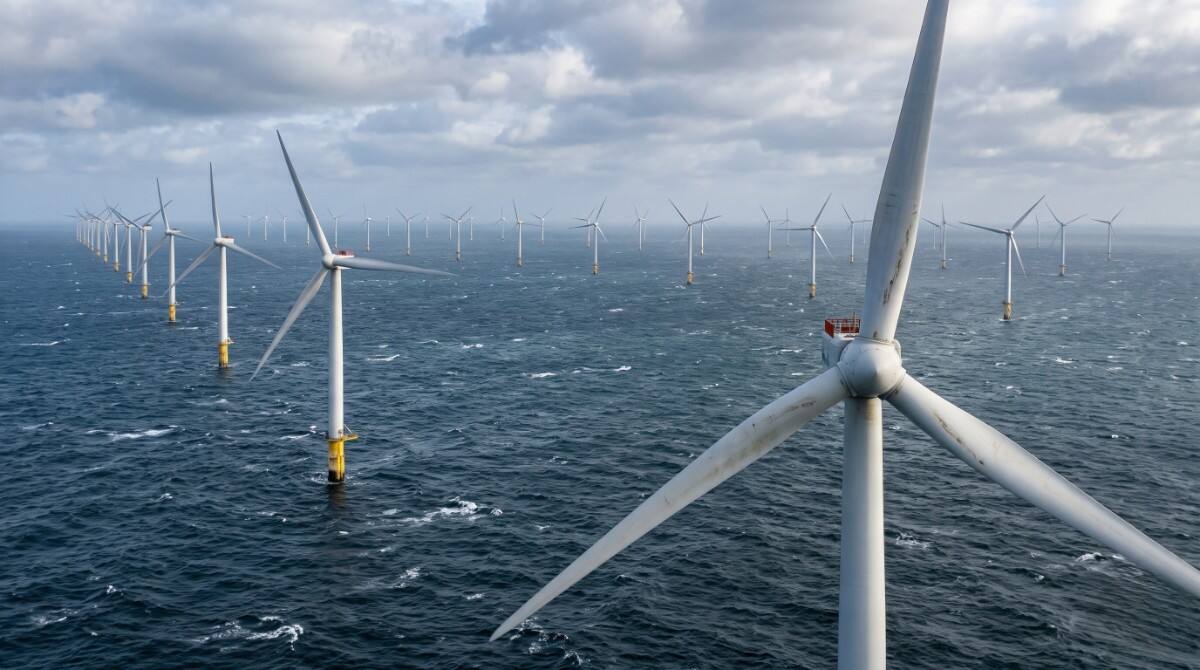
Active aerodynamic load regulation produces benefits that extend far beyond the rotor and nacelle. By dampening extreme thrust peaks and asymmetric gyroscopic moments at the rotor, individual pitch control systems significantly reduce dynamic overturning loads transmitted down the tower into the foundation. This structural relief is particularly vital for deepwater floating platforms, where controlling topside thrust directly governs the mooring line tension requirements and anchor holding capacities needed for floating offshore wind mooring systems for deepwater projects.
Aerodynamic stall and aeroelastic flutter introduce dangerous dynamic instabilities that embedded sensors are uniquely capable of detecting. When wind flow detaches from the suction side of a blade during turbulent crosswinds, the blade experiences severe buffeting and localized vibrations that can trigger rapid structural fatigue. High-speed optical strain arrays track the propagation of unsteady aerodynamic loads across the chord length in real time. By identifying the onset of stall-induced vibrations, turbine automation systems can pitch the blades fractionally to re-establish laminar airflow, preventing dangerous aeroelastic flutter and protecting the structural laminate from cyclical fatigue damage.
Edge Computing and Predictive Fleet Maintenance
As offshore wind farms deploy larger rotors farther offshore, transmission bandwidth limitations between remote turbines and coastal control centers make raw high-frequency data transmission impractical. Modern blade monitoring platforms address this challenge by embedding edge-computing processing units inside the rotating hub.
Edge processors run continuous machine learning models that analyze raw strain signatures locally, identifying high-frequency vibration shifts associated with internal spar delamination, core debonding, or leading-edge erosion. Rather than streaming gigabytes of raw sensor data across satellite networks, edge systems transmit compact health metrics and automated alerts to onshore operations teams.
Bachmann electronic expanded its edge-based structural health monitoring systems in 2025, deploying artificial intelligence algorithms capable of autonomous modal analysis. By tracking subtle shifts in blade natural eigenfrequencies across changing environmental temperatures and rotor speeds, the platform detects internal composite degradation months before visible surface cracks develop. Proactive detection enables wind farm operators to schedule targeted blade repairs during scheduled maintenance campaigns, avoiding catastrophic in-service failures and maximizing offshore renewable power generation.
Sensor calibration longevity over multi-decade offshore operating lifetimes is critical for commercial adoption. Once composite blades are cured in manufacturing molds and installed offshore, replacing embedded sensors is practically impossible. Optical fiber sensors demonstrate negligible calibration drift over twenty years because fiber Bragg gratings rely on permanent physical index modulations within the silica glass core rather than mechanical strain gauges bonded with degrading adhesives. PowerGen Advancement notes that by maintaining consistent measurement accuracy across decades of fluctuating temperatures and high dynamic strains, embedded optical networks provide reliable baseline data for lifetime structural health assessments.
References
- “Structural Monitoring of Wind Turbine Blades DNV-ST-0437” – DNV
- “Offshore Wind Turbine Blade Load Telemetry and Control Validation” – Vestas Wind Systems
- “Intelligent Rotor Systems and Advanced Pitch Control Technology” – Siemens Gamesa Renewable Energy
- “Optical Sensing Solutions for Multi-Megawatt Rotor Blades” – Moog Inc.
- “Edge Computing and Structural Health Monitoring for Offshore Wind” – Bachmann electronic
- “Advanced Rotor Dynamics and Structural Integrity in Commercial Wind” – GE Vernova