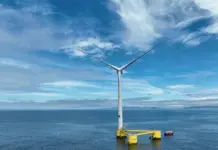

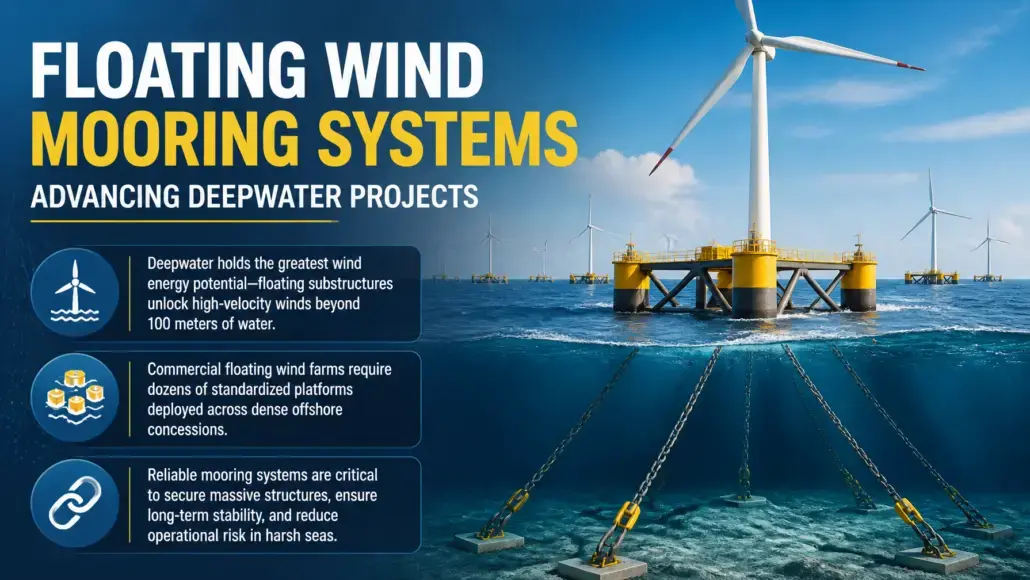
Water depths exceeding one hundred meters hold roughly eighty percent of the world’s offshore wind potential. Harnessing high-velocity winds across deep continental shelves requires replacing rigid bottom-fixed monopiles with floating substructures. Unlike conventional oil and gas floating production units that operate as single, capital-intensive assets, commercial floating wind farms require dozens of standardized platforms deployed across dense offshore concessions.
Securing these massive structures against dynamic wave action, turbulent wind shear, and strong ocean currents relies entirely on engineered stationkeeping. Floating wind mooring systems must restrict horizontal excursion to protect inter-array power cables while dampening rotational motions to maintain aerodynamic efficiency at the rotor. Achieving this mechanical balance becomes complex as turbine capacities scale toward fifteen and twenty megawatts, generating unprecedented overturning moments on semi-submersible, spar, and tension leg platforms.
The Global Wind Energy Council highlighted in its 2025 Global Offshore Wind Report that the worldwide pipeline for floating offshore projects has surpassed two hundred and sixty gigawatts. However, commercial viability hinges on lowering capital expenditure per megawatt. Mooring hardware, installation vessel campaigns, and seabed anchoring represent up to fifteen percent of total floating balance-of-plant costs. Engineering teams are transitioning from heavy steel chains to lighter, high-performance synthetic lines and shared anchoring layouts to reduce structural mass and simplify offshore logistics.
Structural Evolution from Heavy Chain to Engineered Synthetics
Traditional catenary mooring systems rely on heavy steel chain resting on the seabed to provide restoring force through gravity. In water depths between one hundred and five hundred meters, catenary configurations require massive line lengths, creating expansive mooring footprints that risk snagging commercial fishing gear and conflicting with dynamic electrical cables. The immense self-weight of thousands of meters of forged steel chain also penalizes floating platform buoyancy, requiring larger steel hulls and driving up fabrication expenses.
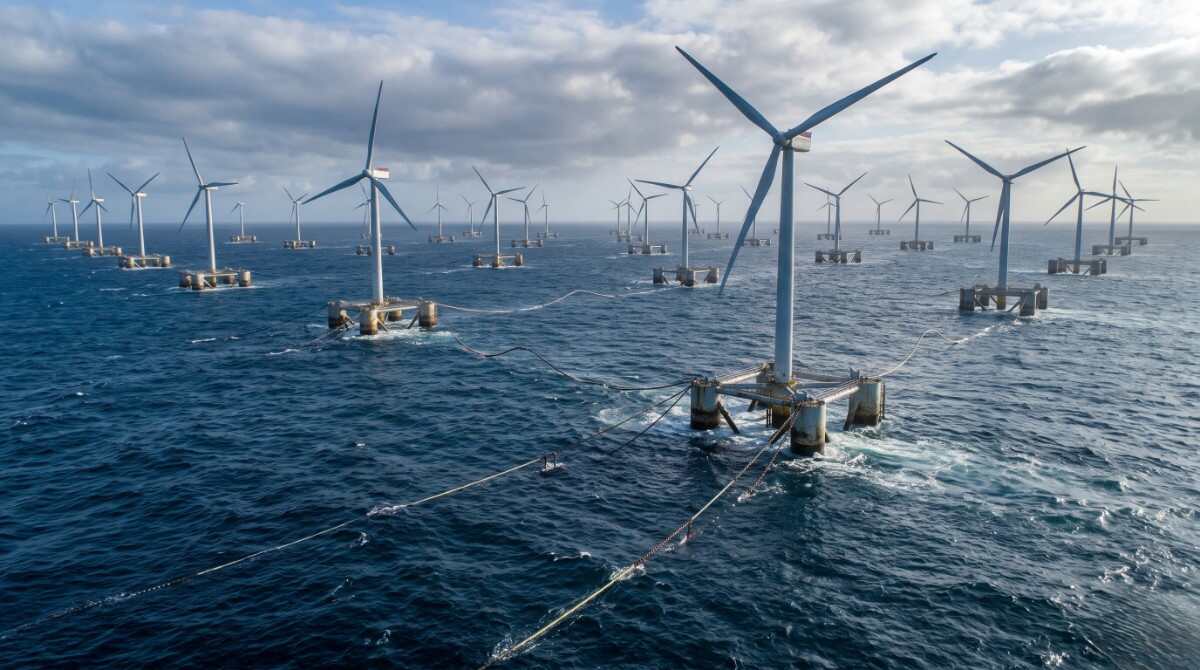
Taut-leg and semi-taut configurations using engineered synthetic ropes have emerged as the primary alternative for commercial deepwater projects. High-modulus polyethylene, polyester, and aramid fibers deliver tensile strength comparable to high-grade steel at a fraction of the submerged weight. Because synthetic ropes remain suspended throughout their operational life, they eliminate the abrasive seabed touchdown zone typical of catenary chains.
Synthetic fibers introduce distinct mechanical characteristics that offshore engineers must manage across twenty-five to thirty-year design lives:
- Non-linear axial stiffness that varies with mean load, dynamic strain amplitude, and environmental loading history.
- Viscoelastic creep behavior requiring scheduled pre-tensioning or automated hydraulic line adjustment systems.
- Susceptibility to internal particle ingress and axial compression fatigue under cyclical slack-line conditions.
- Complex tension-elongation properties that dictate precise hydrodynamic modeling under combined wave and aerodynamic loads.
Bridon-Bekaert Ropes Group expanded manufacturing capacity in 2025 for heavy-duty synthetic mooring lines engineered specifically for multi-megawatt floating turbines. Their specialized polyamide and polyester assemblies incorporate protective jackets and internal filters that prevent seabed sediment ingress while resisting cyclic axial compression. By pairing these synthetic lines with short chain segments at the fairlead and anchor interfaces, marine contractors achieve optimal restoring stiffness without overburdening floating platform buoyancy.
Seabed Geotechnics and Advanced Anchor Methodologies
Mooring line forces must ultimately transfer into the ocean floor without risking uplift or lateral displacement. Anchor selection depends on local seabed geology, water depth, line angle, and the magnitude of multidirectional storm loads. Deepwater sites often exhibit soft cohesive clays, dense sands, or stratified rock layers that prevent the use of standard drag-embedment flukes.
Suction caissons represent the benchmark anchoring solution for cohesive soils and dense silts. Fabricated as large open-ended steel cylinders, these caissons are lowered to the seafloor and penetrated using internal water evacuation, creating differential hydrostatic pressure that drives the cylinder to target depth. Suction piles provide high resistance to both horizontal and vertical loading, making them well suited for semi-taut synthetic systems where line angles reach forty-five degrees.
Where geotechnical surveys encounter rocky or highly layered subsea terrain, offshore contractors deploy driven or drilled-and-grouted pin piles. For ultra-deep environments or complex seabeds, helical screw anchors and dynamically penetrating anchors offer alternative installation pathways that eliminate the need for heavy subsea hydraulic hammers.
Shared anchoring frameworks represent another structural shift in commercial floating wind design. In a shared mooring array, adjacent floating turbines connect to common anchors placed between turbine rows. Industry trials overseen by the Carbon Trust in 2025 demonstrated that shared anchor systems can reduce total anchor count across a commercial array by thirty to forty percent:
- Capital expenditure savings through reduced steel fabrication and minimized subsea anchor hardware.
- Shorter offshore installation campaigns, decreasing the charter duration of specialized anchor-handling tug supply vessels.
- A more compact seabed footprint that minimizes environmental disturbance across benthic habitats.
- Complex load sharing dynamics that require advanced numerical simulation to account for simultaneous extreme loads from adjacent floating platforms.
Subsea7 and Aker Solutions advanced joint commercial engineering frameworks in 2025 for shared anchor clusters across deepwater Scottish and Celtic Sea leases. Their models show that while shared anchoring introduces multi-directional cyclic loading on individual caissons, advanced finite-element soil-structure interaction analysis enables safe structural sizing while delivering substantial balance-of-plant cost reductions.
Operational Monitoring and Autonomous Integrity Management
Maintaining long-term stationkeeping integrity across hundreds of mooring lines deployed in hostile marine environments requires moving beyond manual underwater inspection campaigns. Traditional visual inspections using remotely operated vehicles are time-consuming, weather-dependent, and costly. Deepwater operators are equipping mooring spreads with continuous digital condition monitoring systems.
Digital load cells integrated directly into platform fairleads measure line tension in real time, alerting onshore control rooms to sudden tension drops that indicate line slippage or partial failure. Subsea acoustic transponders and inertial measurement units attached along the synthetic rope profile record line inclination, vibration, and curvature. These continuous data streams feed into digital twin models that predict cumulative fatigue damage based on actual metocean exposure rather than conservative design assumptions.
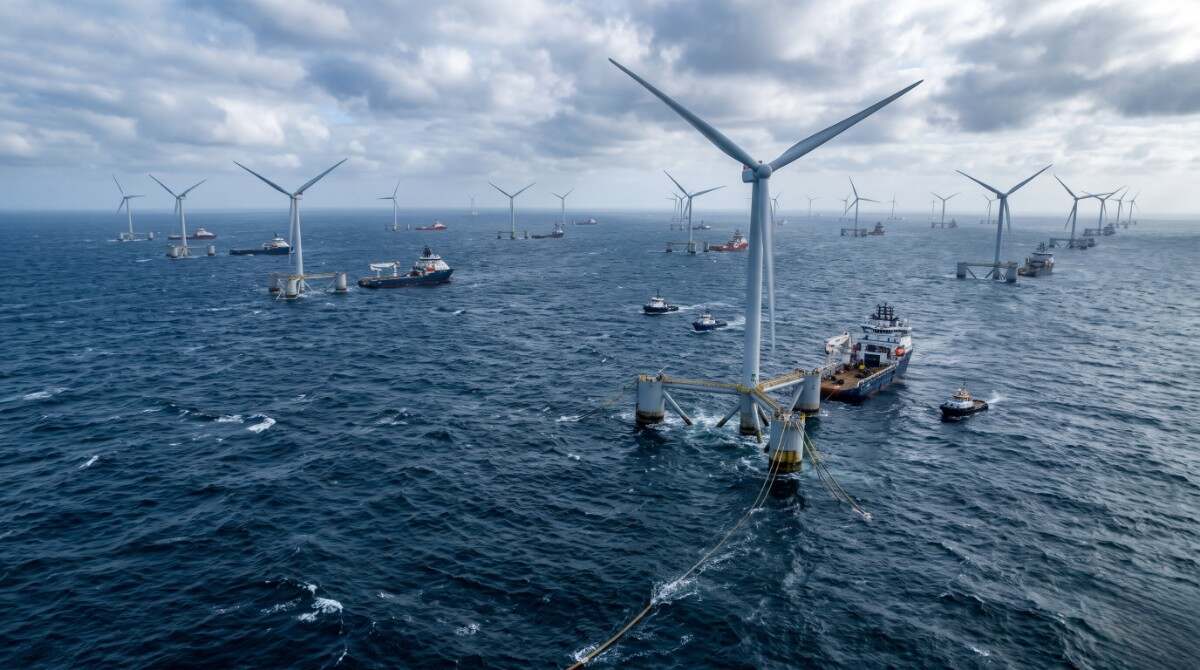
Equinor implemented automated mooring line tension monitoring protocols across its deepwater floating operations, applying lessons learned from the Hywind Tampen development. The system pairs subsea acoustic sensors with machine learning algorithms to detect anomalies in platform excursion and line damping. Early detection of line degradation allows marine engineers to schedule preventive maintenance during favorable summer weather windows, avoiding emergency offshore interventions during winter storm seasons.
DNV published updated design standard DNV-ST-0119 for floating wind mooring systems in 2025, providing updated safety factors for synthetic materials, shared anchors, and digital inspection methodologies. The standard establishes clear testing protocols for yarn-on-yarn abrasion, marine growth accumulation, and bio-fouling management, giving project financiers greater confidence in twenty-five-year operational asset lifetimes.
Securing floating platforms against extreme deepwater dynamics is only one half of the offshore engineering equation. Because floating substructures continuously heave, pitch, and surge under wave action, the high-voltage electrical infrastructure connecting them to the power grid cannot remain rigid. Platform motion places severe cyclic bending stress on the subsea conductors that export generated power, requiring specialized dynamic subsea cables for floating offshore wind farms engineered to endure millions of mechanical fatigue cycles without electrical failure.
Manufacturing and Global Supply Chain Readiness
Commercial scaling of floating wind requires substantial expansion across specialized manufacturing sectors. Heavy-lift anchor handling vessels equipped with dynamic positioning, high-capacity winches, and subsea crane systems remain in short supply globally. Concurrently, the global capacity to produce certified offshore synthetic mooring ropes must triple before the end of the decade to meet projected deployment schedules across Europe, the Asia-Pacific region, and the United States West Coast.
Industrial partnerships are forming across the maritime and textile sectors to standardize line components, connection shackles, and acoustic release mechanisms. PowerGen Advancement believes that by harmonizing component designs and establishing regional production hubs near deepwater assembly ports, the offshore industry is addressing supply bottlenecks and driving down the levelized cost of energy for deepwater floating power generation.
References
- “Global Offshore Wind Report 2025” – Global Wind Energy Council
- “Floating Wind Joint Industry Programme Mooring Study” – Carbon Trust
- “Design of Floating Wind Turbine Mooring Systems DNV-ST-0119” – DNV
- “Synthetic Mooring Solutions for Multi-Megawatt Floating Turbines” – Bridon-Bekaert Ropes Group
- “Deepwater Subsea Mooring and Anchoring Technical Review” – Subsea7
- “Hywind Tampen Operational Performance and Mooring Integrity Report” – Equinor
- “Floating Offshore Wind Balance of Plant Technical Analysis” – Aker Solutions