








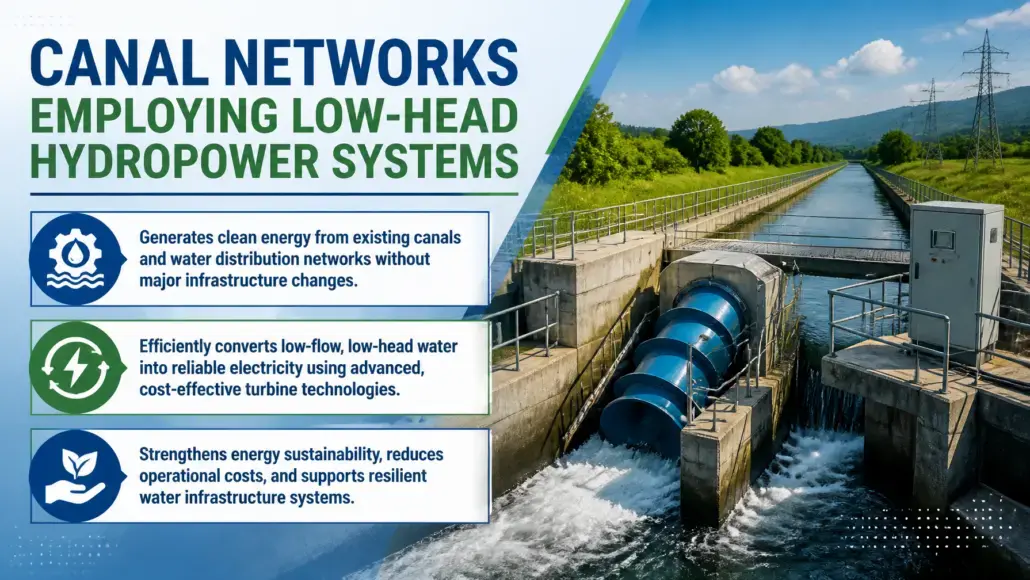
Modernizing global water infrastructure involves more than just improving distribution efficiency. It now includes the integration of renewable energy generation. PowerGen Advancement notes that low-head hydropower technologies for canals and water distribution network are gaining traction as a way to unlock energy from existing hydraulic structures. Unlike traditional hydropower that relies on high pressure and significant elevation changes, these technologies can generate electricity from water drops as small as two meters. This capability transforms irrigation canals and municipal water pipes into productive energy assets without the need for new dams.
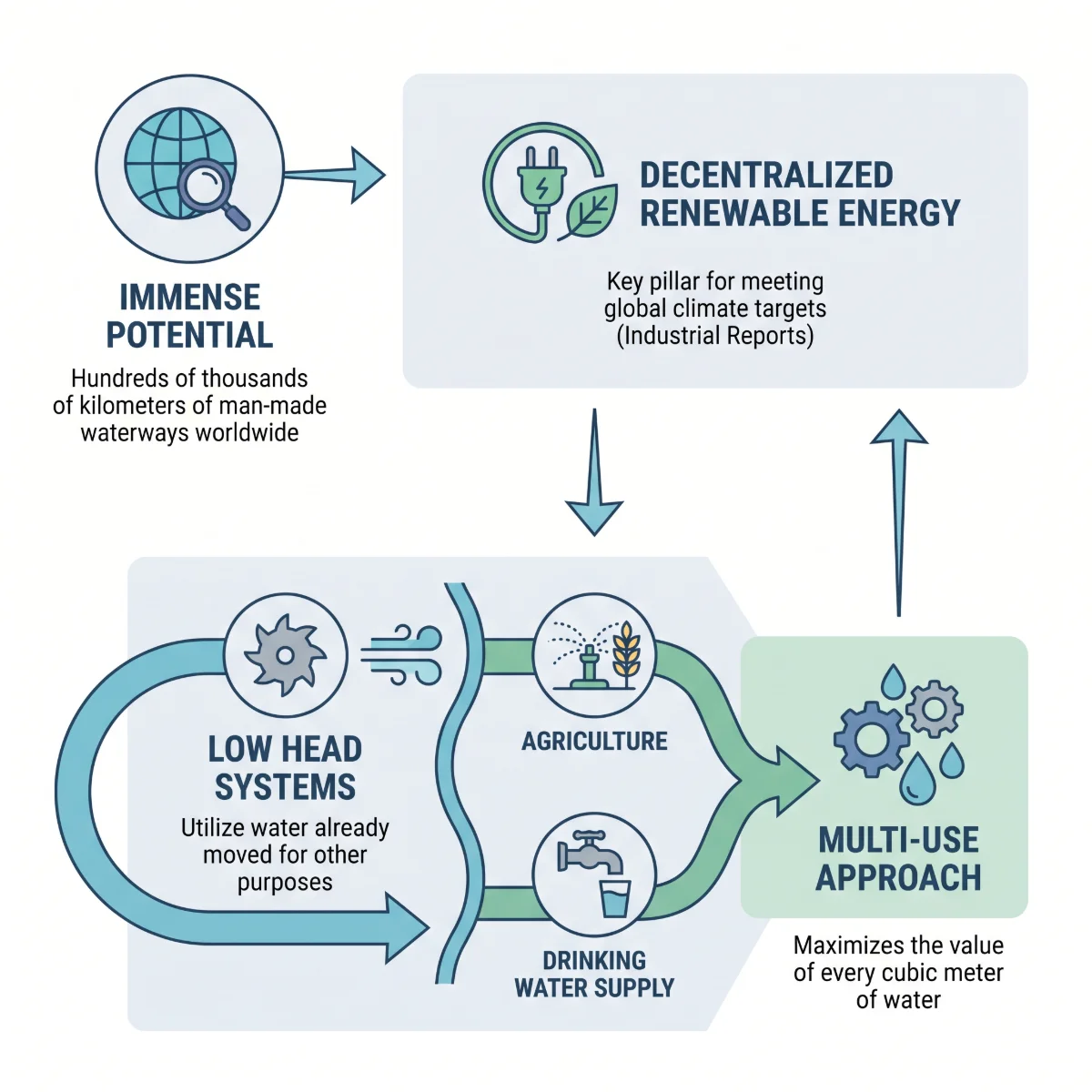
The potential for this sector is immense, especially considering the hundreds of thousands of kilometers of man made waterways worldwide.Industrial reports indicate that decentralized renewable energy is a key pillar for meeting global climate targets. Low-head hydropower systems are particularly attractive because they utilize water that is already being moved for other purposes, such as agriculture or drinking water supply. This multi use approach to water management maximizes the value of every cubic meter of water passing through the system.
Engineering Innovations in Low Head Energy Recovery
Traditional turbines are often inefficient at low heads because they require high velocity water to generate significant power. Recent breakthroughs in turbine design have addressed this challenge by optimizing blade geometry and using advanced materials. Vertical axis turbines and innovative screw designs allow for efficient power extraction even in slow moving or shallow water. These designs are often modular, which simplifies installation and reduces the cost of civil works.
One of the most significant advancements is the development of fish safe turbines. In natural or semi natural canals, protecting aquatic life is a regulatory and ethical requirement. Companies have engineered turbines with rounded leading edges and large openings to allow fish to pass through safely. These designs achieve high hydraulic efficiency while maintaining survival rates above 98 percent for most species. This balance of performance and ecology is essential for the widespread adoption of hydro technology in sensitive environments.
Managing these systems efficiently requires precise environmental data, where automated sediment monitoring solutions play a critical role in preventing turbine abrasion and maintaining long term performance. By monitoring the concentration of suspended solids in real time, operators can adjust flow rates or schedule maintenance before physical damage occurs. The integration of sensing technology ensures that low head installations remain operational for decades with minimal manual intervention.
Major Players and Commercial Deployments
Several global companies are leading the charge in the low-head hydropower market:
- Natel Energy: The US-based innovator Natel Energy is advancing fish-safe turbine engineering, pairing peer-reviewed fish passage protection with high-performance generation. Following rapid operational scaling through 2025, the company entered 2026 conducting a large-scale hydro design study alongside upcoming international installations.
- Emrgy: Specializing in modular hydro systems for shallow or slow-moving canal flows, Emrgy converts existing irrigation infrastructure and energy dissipation points into active generation sites. These plug-and-play turbine arrays enable water districts to transform standard waterways into clean energy assets that offset power expenses and open new revenue streams.
- Turbulent: The Belgium-based micro-hydro firm Turbulent utilizes low-head, vortex-inspired turbine designs ranging from 15 kW to 90 kW individually, while engineering multi-unit clusters for higher outputs. Emphasized in 2025 across natural rivers and man-made canals, Turbulent’s simple, resilient technology offers scalable, low-impact distributed generation suitable for diverse global environments.
Economic and Operational Benefits for Water Districts
-
Operational cost reduction & energy offsetting: Water transport is inherently energy-intensive, but integrating low-head hydropower across distribution networks enables a closed-loop system where the flow of water generates electricity to offset pumping costs, with surplus energy occasionally sold back to the grid for additional revenue.
-
Lower risk and streamlined deployment: Leveraging existing infrastructure significantly reduces the complexity of environmental impact assessments and shortens construction timelines compared to utility-scale hydro projects, while modular designs permit water districts to scale installations incrementally as operational gains are realized.
Integration with Modern Water Distribution Networks
Integrating hydropower into a water distribution network requires careful planning to avoid interfering with the primary function of the infrastructure. Pressure reducing valves (PRVs) are commonly used in municipal systems to manage water pressure and prevent pipe bursts. These valves dissipate energy as heat. By replacing or supplementing PRVs with micro hydro turbines, utilities can recover that lost energy while still maintaining the necessary pressure levels in the system.
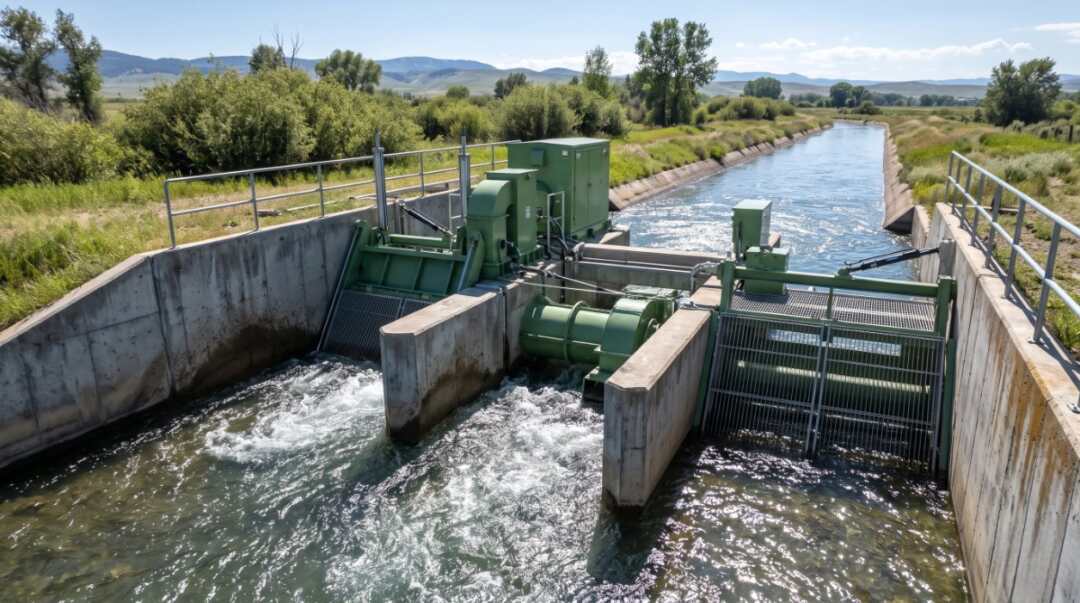
Digitalization is also playing a role in the integration process. Smart water networks use sensors and real time data to optimize flow and pressure. Modern low head turbines are equipped with digital controllers that can communicate with the utility’s central management system. This allows for precise control of power generation based on the current water demand and grid conditions. The synergy between water management and energy generation is a hallmark of the smart city of the future.
Recent statistics from the International Hydropower Association (IHA) 2025 Outlook show that annual new capacity additions reached 24.6 GW in 2024. While large projects still dominate the total figures, the number of small scale and micro hydro projects is growing at a faster rate. This trend reflects the shifting preference toward decentralized and low impact energy solutions. As the technology matures, we can expect low-head hydropower to become a standard component of any large scale water infrastructure project.
Regulatory Landscape and Future Potential
The regulatory environment for small scale hydropower is evolving to become more supportive. Many jurisdictions are introducing streamlined permitting processes for projects that use existing man made conduits. This reduces the administrative burden on developers and accelerates the transition to clean energy. However, challenges remain in areas where the legal framework for “behind the meter” generation is still unclear.
Looking ahead, PowerGen Advancement believes that the potential for low-head hydropower is vast. As global populations grow and urbanization increases, the demand for water and energy will only rise. Technologies that can address both needs simultaneously will be in high demand. We may see more creative applications, such as integrating hydro units into wastewater treatment plants or desalination facilities. The flexibility of low-head hydropower systems makes them adaptable to almost any environment where water flows.
Continued research into materials and manufacturing processes will likely drive down the cost of these systems even further. 3D printing, for example, could allow for the local production of turbine components, reducing shipping costs and supporting local economies. The combination of advanced engineering, supportive policy, and innovative financing will ensure that low-head hydropower remains a key part of the global renewable energy mix for years to come.
References
- “Renewables 2025” – International Energy Agency
- “2025 World Hydropower Outlook” – International Hydropower Association
- “FishSafe Engineering and Sustainable Hydropower News” – Natel Energy
- “First Turbine Array is Hydropower Game Changer” – Emrgy
- “Micro-hydro power plant projects” – Turbulent