















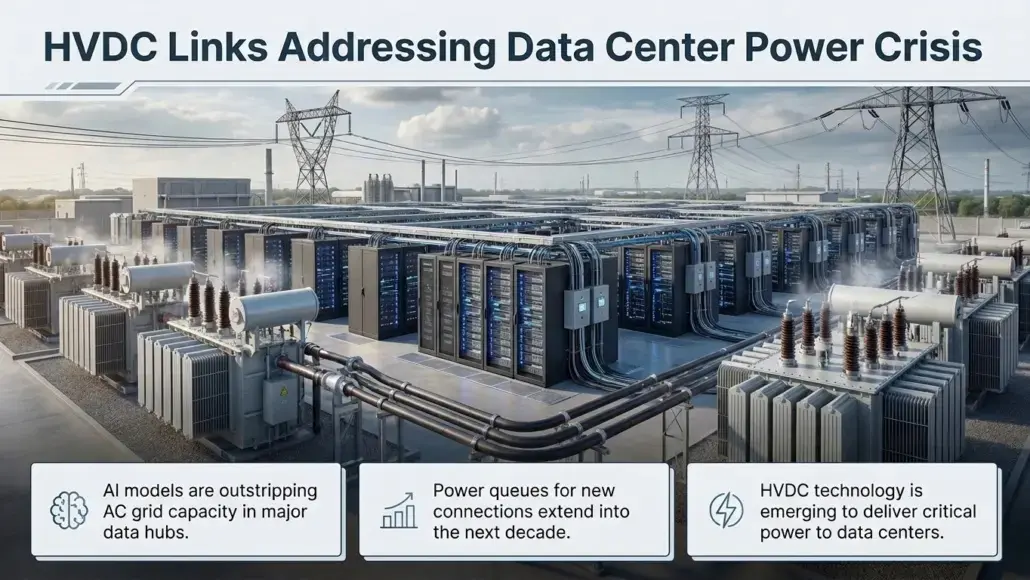
The global digital infrastructure is facing an existential threat: the sheer inability to deliver enough electricity to the locations where it is needed most. As artificial intelligence models scale to trillions of parameters, PowerGen Advancement notes that the power density of data centers has surged, outstripping the capacity of traditional alternating current (AC) grids. In major hubs like Northern Virginia, Dublin, and Singapore, the power queue for new connections now extends into the next decade. In this context, the implementation of high-voltage DC links solve data center power crisis challenges by enabling the efficient, long-distance transmission of massive energy loads while bypassing the bottlenecks of aging AC infrastructure.
The Limitation of the Traditional AC Grid
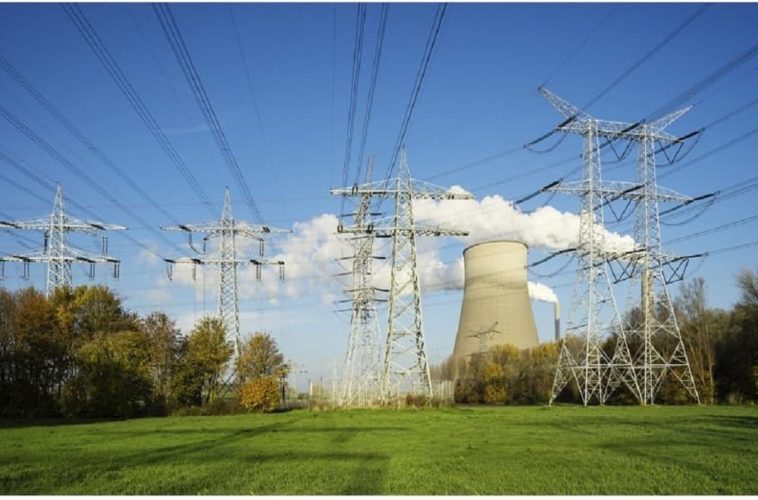
For over a century, Alternating Current (AC) has been the bedrock of global power distribution. Its ability to be easily stepped up or down in voltage via transformers made it ideal for moving power from centralized plants to distant cities. However, AC has significant drawbacks when it comes to the extreme demands of the AI era. As transmission lines become longer and more congested, the reactive power losses in AC lines increase, reducing the actual amount of usable energy that reaches the destination. Furthermore, AC grids are prone to stability issues and frequency synchronization challenges that become more acute as more intermittent renewable sources are added.
The Rise of the AI Power Bottleneck
Data centers are no longer just large buildings. They are industrial-scale power sinks. A single hyperscale campus can require upwards of 500 megawatts—equivalent to the power needs of a mid-sized city. Bringing this amount of power into a concentrated geographic area via traditional AC lines is physically difficult. The required transmission corridors are massive, and the electromagnetic interference can impact neighboring communities. This physical and regulatory gridlock has created a power crisis that threatens to stall the progress of AI. The strategic use of high-voltage DC links solve data center power crisis issues by providing a more compact and efficient way to tunnel massive amounts of energy through these congested zones.
HVDC: The Superhighway for Electricity
High-Voltage Direct Current (HVDC) is often described as the superhighway of the electrical grid. By converting power from AC to DC at the source and back to AC (or keeping it in DC) at the destination, HVDC allows for the transmission of power over hundreds of miles with significantly lower losses.
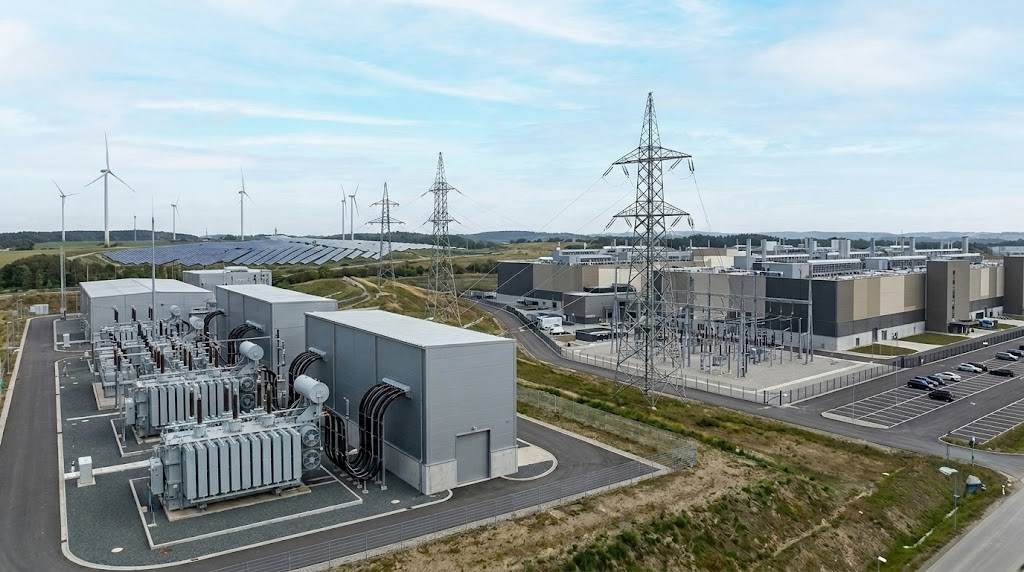
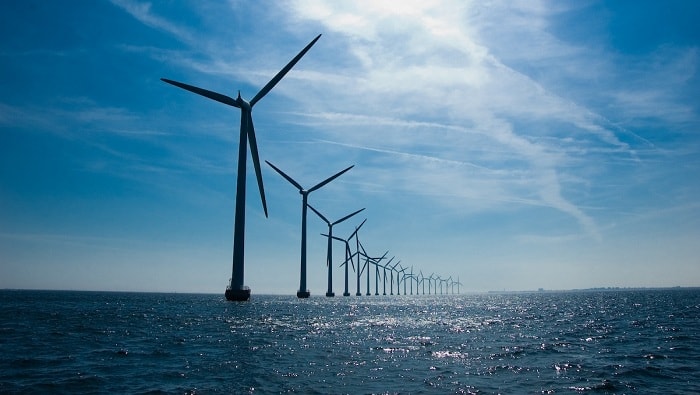
Unlike AC, DC does not suffer from the skin effect, where electricity only flows on the surface of a conductor. This means that a DC cable of the same size can carry up to three times more power than an AC cable. For a data center operator, this means they can tap into distant renewable energy sources—such as offshore wind farms or remote desert solar arrays—and bring that power directly to their facility with minimal waste.
Technical Advantages of DC for Data Centers
The move toward DC is not just about the long-distance transmission; it is also about the internal distribution within the data center itself. Modern servers, GPUs, and storage devices all operate on DC power. In a traditional facility, power is converted from AC to DC and back several times, with each step resulting in energy loss in the form of heat.
Eliminating Conversion Losses
By maintaining the power in a DC format from the high-voltage transmission link all the way down to the server rack, data centers can achieve significant efficiency gains. Estimates suggest that a DC-native architecture can reduce total energy consumption by 10% to 20% compared to a traditional AC design. This is not just a marginal improvement; in a 100MW facility, a 15% saving represents 15 megawatts of power that can be used for more GPUs rather than being wasted as heat. In this way, high-voltage DC links solve data center power crisis constraints not only by bringing more power in but by making better use of every kilowatt that arrives.
Superior Control and Grid Decoupling
HVDC links also provide a level of control that is impossible with AC. The power flow on a DC link can be precisely adjusted in milliseconds, allowing operators to react to changes in demand or grid conditions instantly. Furthermore, an HVDC link acts as a firewall between two AC networks. If the public utility grid experiences a frequency disturbance or a blackout, the DC link can isolate the data center from the chaos, maintaining a steady and clean supply of power. This inherent resilience is a critical requirement for the five nines reliability standards of the AI industry.
Overcoming the Infrastructure Hurdle
Despite the clear technical superiority, the deployment of HVDC has been slowed by high capital costs and a lack of standardized equipment. Building an HVDC converter station is a massive undertaking, often costing hundreds of millions of dollars.
The Role of Solid State Technology
The high cost of HVDC was historically due to the massive, expensive thyristor valves needed for conversion. However, the rise of wide-bandgap semiconductors, such as Silicon Carbide (SiC) and Gallium Nitride (GaN), is changing the economics.
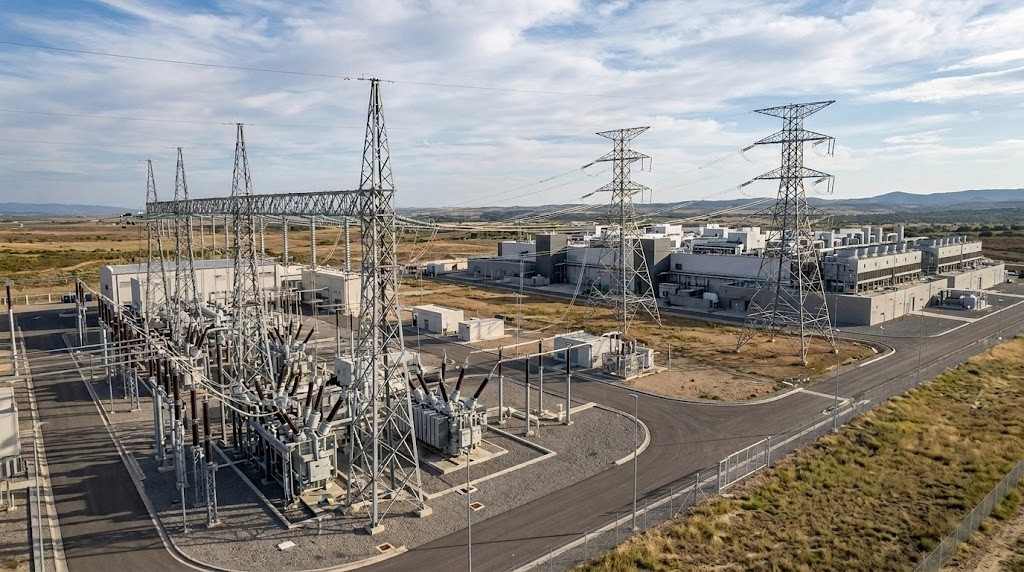
As high-voltage power reaches the facility, solid state transformers manage AI rack power density by efficiently converting DC energy for high-performance chips. These modern components are smaller, faster, and cheaper than their predecessors, making DC-based infrastructure viable for individual data center campuses rather than just massive cross-border projects. This technological evolution is the key to scaling the solution globally.
Urban Tunneling and Underground DC
One of the biggest challenges for data center expansion is finding space for new power lines in urban areas. AC lines require wide right-of-way clearings due to the electromagnetic fields they generate. DC cables, by contrast, can be buried underground in much tighter spaces and even bundled together. This allows for urban tunneling, where high-capacity DC links are snaked through existing utility ducts or along rail lines to reach land-locked data center sites. By bypassing the need for new overhead towers, high-voltage DC links solve data center power crisis bottlenecks in the world’s most crowded cities.
Economic Impacts and Market Shifts
The shift toward HVDC is creating a new competitive landscape for both data center providers and energy companies. Those who can secure DC power connections first will have a massive time-to-market advantage.
Decoupling Compute from the Local Grid
HVDC allows for the decoupling of compute resources from the local grid capacity. A company can build a massive AI cluster in a region with poor local infrastructure, provided they can run a DC link to a high-capacity node elsewhere. This opens up new geographies for development, reducing the pressure on existing data center hubs and lowering land costs. We are seeing a new trend of power-anchored development, where data centers are built at the ends of major HVDC projects, such as those connecting the North Sea wind farms to mainland Europe.
Long-Term Energy Price Stability
By tapping into distant, abundant renewable resources via DC links, data center operators can negotiate long-term Power Purchase Agreements (PPAs) that are shielded from the volatility of local energy markets. While the upfront investment in a DC link is high, the lower transmission costs and higher efficiency result in a lower total cost of energy over the 20-30 year life of the facility. This financial predictability is essential for the multi-billion dollar capital investments required for AI infrastructure. High-voltage DC links solve data center power crisis concerns while simultaneously providing a path toward long-term financial sustainability.
Environmental Sustainability and Carbon Goals
The energy transition requires more than just building wind turbines; it requires a grid that can move that energy to consumers. HVDC is the essential link in the carbon-free chain.
Reducing the Transmission Carbon Footprint
The efficiency gains of HVDC translate directly into carbon savings. By reducing transmission losses, we reduce the total amount of generation needed to power the same computational workload. Furthermore, HVDC is the only viable technology for connecting large-scale offshore wind and remote solar to the global grid. Without these links, much of the world’s best renewable energy would remain stranded. By adopting this technology, the AI industry is not just solving its own power problems; it is acting as a catalyst for the global energy transition.
Enabling 24/7 Carbon-Free AI
The ultimate goal for many tech giants is to operate on carbon-free energy every hour of the day. Achieving this is only possible if you can pull from a diverse set of energy sources across large geographic areas. An HVDC-linked data center can draw solar power from the south during the day and wind power from the north at night, maintaining a constant green supply. This geographic diversity, enabled by DC transmission, is the foundation of a truly sustainable AI future.
Grid-Scale HVDC and In-Facility Direct Current Converge to Shatter AI Power Bottlenecks
As hyperscale computing campuses outstrip local utility capacity and confront years-long AC grid queues, electrical engineering titans are replacing legacy alternating current paths with high-capacity direct-current infrastructure from regional transmission lines down to the GPU rack. Hitachi Energy validated the viability of high-capacity DC transmission into space-constrained hubs by commissioning a 1,000 MW urban HVDC link using underground corridors, while concurrently deploying 800 VDC grid-to-chip architectures for AI factories. Internally, Schneider Electric partnered with NVIDIA to engineer 800 VDC power architectures and sidecars delivering up to 1.2 MW per compute rack, eliminating redundant AC-to-DC conversion stages that generate excessive heat. Complementing these micro- and macro-level deployments, ABB launched its Infinitus direct-current portfolio to establish end-to-end DC data center distribution, delivering up to 20% in energy savings and isolating mission-critical AI workloads from broader AC grid volatility.
The New Backbone of Intelligence
The power crisis facing the data center industry is a signal that our existing infrastructure has reached its limit. We cannot power the intelligence of the future with the technology of the past. PowerGen Advancement believes that high-voltage DC links can solve data center power crisis issues by providing the capacity, efficiency, and control required by the AI era.
As we move toward a world where AI is integrated into every aspect of society, the underlying power network must be invisible, resilient, and boundless. The transition to a DC-based backbone is a massive undertaking, but it is one that is already underway. From the undersea cables of the Atlantic to the underground ducts of our cities, a new web of high-voltage DC is being woven to support the weight of our digital ambitions. In the history of infrastructure, this shift will be seen as the moment we finally unlocked the true potential of the electronic age.
References
-
Schneider Electric SE — Schneider Electric Highlights Innovation in 800 VDC Power Systems in support of NVIDIA’s next generation GPUs
-
ABB Ltd. — ABB’s new direct current portfolio aims to rewire AI data center energy infrastructure
-
Hitachi Energy Ltd. — Hitachi and Adani switch on HVDC city center infeed for more than 20 million people in Mumbai