
























Crystalline silicon photovoltaics has anchored the global renewable energy transition for decades, yet the core semiconductor material now approaches an immutable thermodynamic threshold. The theoretical Shockley-Queisser limit caps single-junction silicon solar cell efficiency at roughly twenty-nine point four percent. Leading commercial production lines utilizing advanced n-type passivated contact architectures already reach cell efficiencies between twenty-five and twenty-six percent, leaving diminishing returns for incremental process optimization. PowerGen Advancement observes that overcoming this performance ceiling requires a fundamental shift in device architecture, prompting global manufacturers to develop multi-junction architectures where tandem solar cells efficiency breaks through the barriers of single-absorber physics.
By stacking two distinct light-absorbing semiconductors with complementary bandgaps atop one another, tandem modules harvest the solar spectrum far more efficiently than any single material can achieve alone. The wide-bandgap top cell captures high-energy blue and ultraviolet photons, converting them into electric power while minimizing thermalization waste. Photons with lower energy pass unimpeded through the top layer into the narrow-bandgap bottom silicon cell, where red and near-infrared wavelengths are absorbed. This spectral division elevates the theoretical efficiency limit of dual-junction devices to more than forty-three percent, establishing a transformative technology pathway for utility project developers and corporate energy buyers.
Spectral Optimization and Multi-Junction Engineering
Thermalization represents the single largest thermodynamic loss mechanism in conventional photovoltaic devices. When a high-energy photon strikes a single-junction silicon absorber with an energy bandgap of one point one two electron volts, all energy exceeding that bandgap converts into thermal heat rather than electric current. Tandem solar cells efficiency mitigates this energetic waste by pairing silicon with an upper perovskite thin film tuned to a bandgap of approximately one point six eight electron volts.

The commercial execution of this dual-junction stack hinges on the interface connecting the two devices. In a monolithic two-terminal tandem configuration, the top perovskite cell is grown or coated directly upon the bottom silicon wafer, creating a single integrated two-terminal device that drops into standard module assembly lines without requiring extra external electrical connections. The intermediate recombination layer must deliver extreme optical transparency alongside near-zero electrical contact resistance to allow uninhibited electron-hole recombination between the upper and lower circuits.
- Two-terminal monolithic stacks utilize transparent conductive oxide recombination layers, such as indium tin oxide or nanocrystalline silicon, to ensure low electrical resistance between sub-cells.
- Conformal vacuum and solution deposition technologies allow wide-bandgap perovskite layers to coat microscopically textured silicon wafers without forming electrical shunts.
- Refractive index grading through multi-layer dielectric antireflection coatings minimizes parasitic light reflection at front surfaces and internal material interfaces.
- Optimized tunnel junction band alignments prevent unwanted potential barriers that would otherwise cause substantial voltage drops during high-current operation.
- Four-terminal mechanically stacked designs decouple electrical circuits entirely, eliminating current-matching constraints while adding manufacturing complexity and interconnection cost.
Two-terminal architectures dominate industrial roadmaps because they require only two electrical leads during panel encapsulation, preserving standard module manufacturing tooling. However, connecting sub-cells in electrical series enforces a strict current-matching requirement. The current generated by the entire tandem stack is dictated by whichever sub-cell produces fewer charge carriers. Consequently, any optical imbalance or localized film defect directly constrains the overall power output of the device.
Current Matching and Real-World Spectral Variations
Maintaining current balance under fluctuating outdoor conditions represents a formidable engineering challenge for commercial tandem deployment. Solar radiation spectra shift continuously throughout the day. Early morning and late afternoon sunlight exhibits longer atmospheric paths that scatter blue photons, enriching the spectrum in red wavelengths. Conversely, overcast skies alter the ratio of direct to diffuse light, changing the spectral distribution that reaches ground-mounted arrays.
If the top cell absorbs fewer photons due to blue light attenuation, it becomes the limiting factor in a two-terminal series connection, choking the current flow generated by the bottom silicon cell. Module designers optimize perovskite film thicknesses and bandgaps around standard reference spectra while utilizing advanced optical modeling to prevent chronic current bottlenecks in regional installations. Tuning the perovskite absorber to slightly over-generate current under nominal noon conditions helps maintain higher aggregate daily generation as spectral variations occur throughout morning and twilight hours.
Surface texturing adds another layer of fabrication complexity. Standard silicon wafers feature chemical random-pyramid textures measuring several micrometers in height to trap incoming light. Depositing a sub-micron perovskite layer uniformly across these microscopic peaks and valleys without leaving exposed pyramid tips or thick pooling valleys demands precise control of vapor deposition or hybrid solvent-vapor processes. Defective coverage creates pinholes that ruin device open-circuit voltage, whereas over-planarizing the silicon surface severely undermines internal light trapping.
Production Milestones and Tier 1 Pilot Programs
Global photovoltaic manufacturers with massive industrial footprints are actively progressing tandem technology from specialized research centers to pilot fabrication lines. These corporations possess the capital resources, supply chain relationships, and engineering personnel needed to build high-volume processing lines capable of producing millions of tandem cells annually.
- LONGi Green Energy Technology reached a certified cell efficiency of thirty-four point eight five percent in 2025 for its silicon-perovskite tandem devices, scaling automated pilot deposition tooling to evaluate wafer-level yield stability.
- Hanwha Qcells directed more than one hundred million dollars into pilot production equipment across its European and Korean research facilities, qualifying tandem cell durability under extended thermal cycling and damp-heat testing.
- JinkoSolar advanced proprietary tunnel junction designs on high-performance n-type silicon base wafers, demonstrating low contact resistivity and robust interface adhesion under simulated mechanical stress.
- Trina Solar conducted prototype module evaluations using large-format two-hundred-and-ten millimeter wafers, optimizing laser isolation scribes and low-temperature busbar ribbons to prevent mechanical cell cracking.
- Canadian Solar evaluated specialized cross-linked polyolefin encapsulants engineered to shield tandem cell interfaces from chemical degradation and moisture ingress during prolonged field deployment.
These investments indicate that major manufacturers consider tandem technology a commercially viable evolutionary path rather than an experimental curiosity. Pilot production lines are systematically identifying equipment bottlenecks, validating chemical precursor supply chains, and refining optical inspection protocols.
Balance-of-System Economics and Project Financing
The business justification for commercializing tandem solar technology centers on balance-of-system cost reduction. In utility-scale solar construction, non-module expenditures including land acquisition, civil grading, structural tracking steel, foundation piling, high-voltage cabling, labor, and inverters comprise up to sixty percent of total capital expenditure. Raising module conversion efficiency from twenty-two percent to thirty percent delivers compounding financial benefits across the entire project footprint.
A thirty percent efficient tandem module generates thirty-six percent more electricity from the exact same surface area as a conventional twenty-two percent panel. This density allows developers to reduce the total number of installed modules, tracker rows, electrical combiner boxes, and cable runs required to deliver a target plant capacity. Project developers can install larger electrical capacities on constrained plots of land, unlocking substantial grid interconnection values that were previously inaccessible under lower module efficiencies.
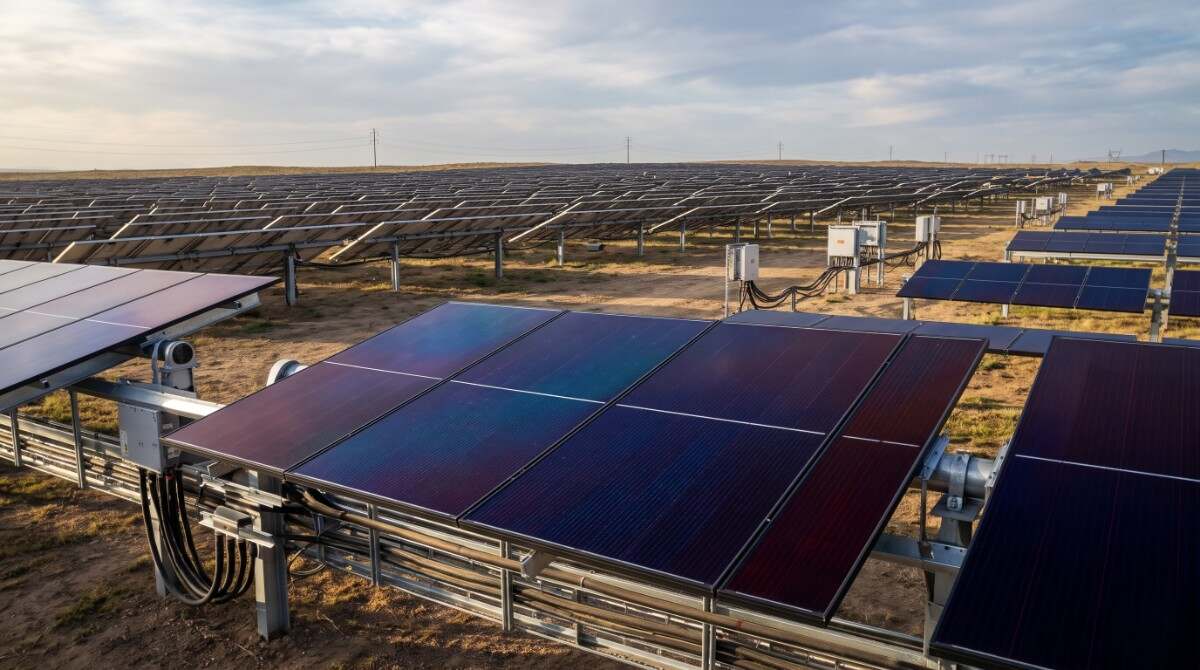
For a one-hundred-megawatt utility installation, boosting module efficiency through tandem technology eliminates hundreds of acres of leased land, thousands of steel foundation piles, and weeks of mechanical assembly labor. These operational savings compensate for the initial manufacturing cost premium of tandem modules, driving down the overall levelized cost of electricity. Furthermore, single-axis tracker algorithms can be optimized to balance both direct irradiance and ground albedo reflection, ensuring both sub-cells receive balanced illumination across diverse seasonal soil conditions.
Achieving non-recourse debt financing requires demonstrating that tandem modules will endure twenty-five years of outdoor exposure without unpredictable output decline. Because the bottom cell in a monolithic tandem stack must deliver exceptionally high open-circuit voltages while tolerating secondary thermal processing, module designers increasingly choose n-type architectures like heterojunction solar module as the premier platform for commercial tandem deployment.
Field Performance and Bankability Roadmaps
Commercial adoption curves will ultimately be determined by long-term outdoor power yield data rather than indoor flash-tester certifications. Testing organizations and independent engineering firms are monitoring prototype tandem installations across diverse climatic zones, ranging from arid desert environments with intense solar radiation to humid maritime environments with elevated moisture exposure.
Initial field observations indicate that tandem modules demonstrate superior energy capture in hot climates due to favorable temperature coefficients. As ambient temperatures rise, single-junction silicon modules experience significant voltage drops that impair midday output. Wide-bandgap perovskite top layers exhibit lower temperature sensitivity, enabling tandem modules to maintain higher energy yields during peak solar hours when electricity wholesale prices are often highest.
Industry-wide adoption hinges on finalizing standardized testing protocols that accurately measure multi-junction performance under fluctuating natural illumination. Testing institutions are establishing standardized solar simulators equipped with independently adjustable light engines to measure spectral response curves without inducing measurement artifacts. As global manufacturers resolve current-matching tolerances and validate barrier packaging, PowerGen Advancement believes that tandem architectures are positioned to lead the next major generation of utility-scale photovoltaic infrastructure.
References
- “Perovskite-Silicon Tandem Solar Cells Exceeding Thirty-Four Percent Efficiency” – LONGi Green Energy Technology
- “Industrialization Roadmaps and Durability Testing for Tandem Photovoltaics” – Hanwha Qcells
- “Next-Generation High-Efficiency Multi-Junction Cell Architectures” – JinkoSolar Holding Co.
- “Large-Area Tandem Module Integration and Laser Patterning Developments” – Trina Solar
- “Advanced Packaging and Degradation Analysis for Multi-Junction Modules” – Canadian Solar
- “Multi-Junction Photovoltaic Device Physics and Spectral Performance Metrics” – Fraunhofer Institute for Solar Energy Systems ISE
- “Future Photovoltaic Technology Trends and Levelized Electricity Cost Projections” – International Energy Agency