









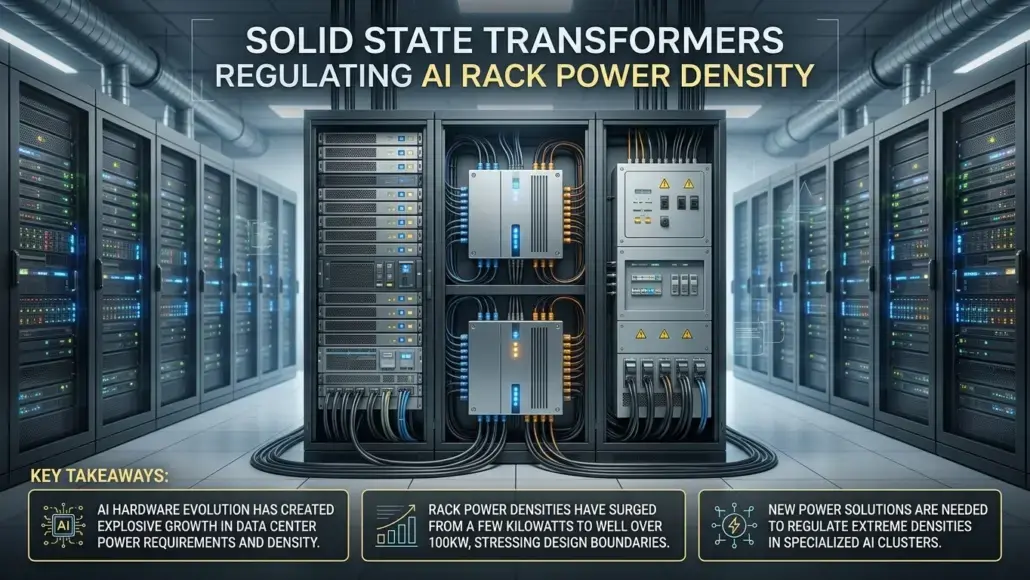
The relentless evolution of artificial intelligence has pushed the boundaries of traditional data center design to their breaking point. As AI models grow in scale, the hardware required to process them has become increasingly power-hungry, leading to an explosion in rack power density. In just a few years, we have seen average rack densities jump from 10 kilowatts to over 100 kilowatts, with some specialized AI clusters approaching 300 kilowatts per rack. PowerGen Advancement notes that this shift has rendered traditional electromagnetic transformers obsolete, as they are too large, heavy, and rigid to be placed close to the servers. In this new era, solid state transformers manage AI rack power density by utilizing advanced power electronics to provide compact, efficient, and highly controllable voltage conversion exactly where it is needed.
The Limitations of Traditional Transformers
For over a century, the iron-core electromagnetic transformer has been the primary tool for changing voltage levels. These devices are remarkably reliable and efficient at their designed task, but they are fundamentally limited by the physics of electromagnetism at low frequencies (50/60 Hz). Because the size of a transformer is inversely proportional to its operating frequency, traditional units are massive and heavy, often requiring their own dedicated rooms or outdoor pads. This physical footprint is a major liability in a data center where every square foot is needed for compute and cooling.
The Thermal and Spatial Challenge of AI Racks
AI hardware, specifically modern GPUs like NVIDIA’s Blackwell series, requires massive amounts of low-voltage DC current. Getting that power from the medium-voltage grid down to the chip involves multiple stages of conversion. In a traditional setup, the bulky transformers are located far from the racks, requiring thick copper busbars to carry the low-voltage, high-current electricity to the servers. These busbars are not only expensive but also suffer from significant resistive losses, generating additional heat that must be cooled. As densities rise, the physical space required for these busbars and the heat they generate become unmanageable. The implementation where solid state transformers manage AI rack power density addresses this by allowing the conversion to happen right at the rack level.
Why Digital Power Control is Necessary
AI workloads are inherently dynamic. A cluster might be idle one moment and drawing maximum power the next as a training epoch begins. Traditional transformers are passive devices; they cannot actively regulate their output or react to rapid changes in demand. This lack of control leads to voltage sags and surges that can damage sensitive AI hardware. Modern power systems need to be smart, capable of communicating with the servers and adjusting the power flow in real-time. Solid state technology provides this digital interface, transforming the power system from a dumb pipe into a programmable asset.
The Technology Behind Solid State Transformers
A Solid State Transformer (SST), also known as a power electronic transformer, replaces the heavy iron core and copper windings with high-frequency power electronics and a small high-frequency transformer. By operating at tens or hundreds of kilohertz instead of 60 Hz, the physical size of the magnetic components can be reduced by 90% or more.
Wide-Bandgap Semiconductors: SiC and GaN
The success of SST technology is tied to the recent breakthroughs in wide-bandgap (WBG) semiconductors, such as Silicon Carbide (SiC) and Gallium Nitride (GaN). Unlike traditional silicon-based transistors, WBG materials can operate at higher voltages, temperatures, and frequencies with much lower losses.
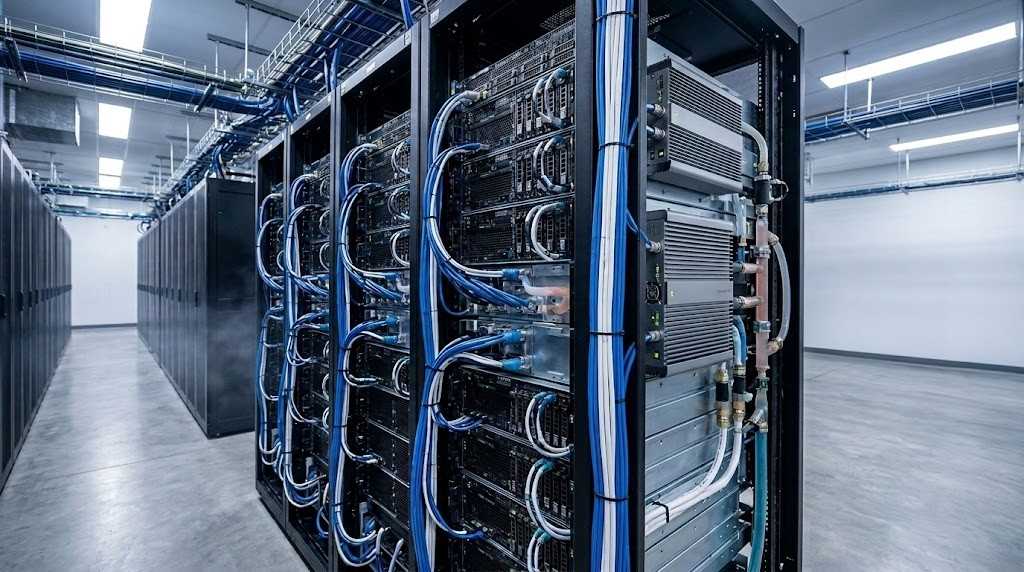
This allows for the creation of power converters that are both ultra-compact and ultra-efficient. By leveraging these materials, solid state transformers manage AI rack power density with a level of performance that was technically impossible only a decade ago. These components are the silicon hearts of the new power infrastructure.
Multi-Stage Conversion and DC-Native Design
A typical SST consists of three stages: a high-voltage AC-to-DC stage, a high-frequency DC-to-DC stage for isolation and voltage scaling, and a final DC-to-DC (or AC) output stage. For AI data centers, the ability to maintain a DC bus throughout the system is a game-changer. Since GPUs run on DC, staying in the DC domain eliminates the need for redundant conversion steps, further reducing energy waste. The SST acts as the intelligent gateway between the medium-voltage grid and the low-voltage DC power shelf of the AI rack, providing precise control over every watt consumed.
Advantages for High-Density AI Clusters
The primary benefit of moving to an SST-based architecture is the ability to pack more compute into a smaller space. By eliminating the need for large transformer rooms and thick busbars, data center operators can increase the number of racks per square foot, maximizing the ROI of their facility.
Integrated Power and Cooling Efficiency
When solid state transformers manage AI rack power density, they can be integrated directly into the liquid cooling loop of the rack. Because SSTs are so compact, they can be placed in the same chassis as the server nodes and share the same cold plates or immersion tanks. This integrated approach removes heat at the source, reducing the load on the facility-wide HVAC system. Furthermore, the high efficiency of SSTs (often exceeding 98%) means less total heat is generated in the first place, allowing for even tighter rack configurations.
Enhanced Power Quality and Fault Protection
SSTs provide superior power quality by actively filtering out harmonics and transients from the grid. They act as a buffer, ensuring that the AI hardware is shielded from grid instability. Additionally, the fast-switching nature of power electronics allows SSTs to detect and isolate electrical faults in microseconds—orders of magnitude faster than traditional circuit breakers. This prevents a failure in one rack from cascading throughout the entire row, a critical feature for maintaining the uptime of multi-billion dollar AI clusters.
Strategic and Economic Impacts
The shift toward solid state power distribution is reshaping the economics of data center construction and operation. While the upfront cost of an SST is higher than a traditional transformer, the total cost of ownership (TCO) is often lower when considering space savings and energy efficiency.
Reducing Infrastructure Lead Times
Traditional transformers are custom-built, heavy items with lead times that can stretch to two years in the current market. SSTs, by contrast, are modular and factory-produced. They can be shipped via standard logistics and installed by technicians rather than requiring heavy cranes and specialized civil engineering. This modularity allows data center operators to scale their power infrastructure in lockstep with their compute needs, reducing stranded capacity and accelerating time-to-market for new AI services.
Enabling the Next Generation of Chip Interconnects
Optimizing the power at the rack level is only half the battle. Reducing heat and energy at the chip level through optical interconnects help slash AI computing power loss. The precision and stability provided by SSTs are essential for these sensitive optical components, which require ultra-clean power to maintain signal integrity over high-speed data paths.
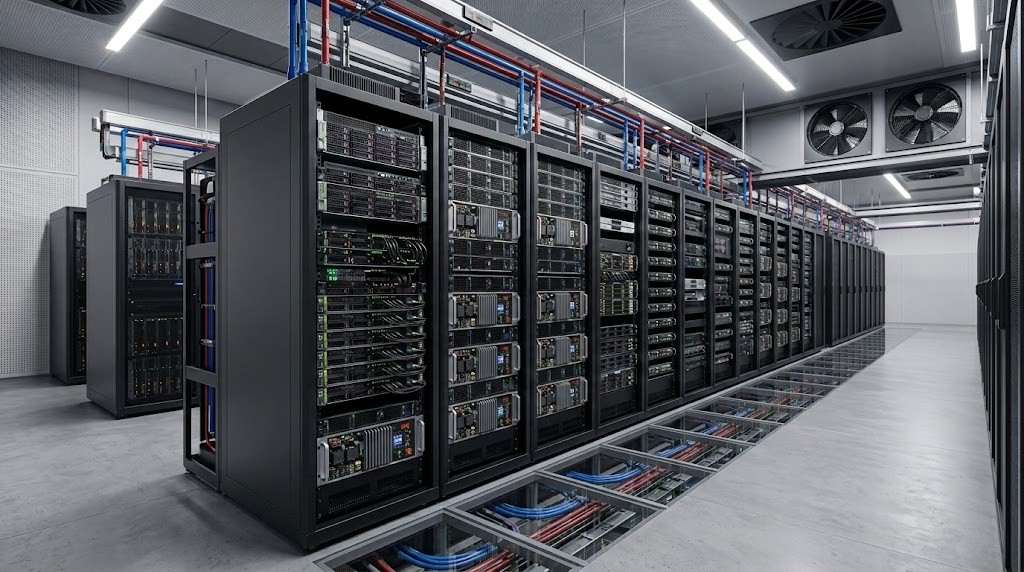
The synergy between solid state power and optical data transfer is the blueprint for the ultra-efficient AI data center of the future. By managing the macro-power with SSTs and the micro-power with optics, we can sustain the exponential growth of AI without an exponential growth in energy waste.
Challenges and Implementation Hurdles
Despite the clear technical advantages, the adoption of SSTs in the data center is still in the early stages. One of the main challenges is the lack of long-term reliability data compared to traditional transformers, which can last 40 years or more.
Reliability and Thermal Management of Electronics
Power electronics are inherently more complex than a piece of iron and copper. They are susceptible to thermal fatigue and electronic wear-out. Ensuring that an SST can survive for 10-15 years in a hot data center environment requires meticulous design and high-quality components. However, the modular nature of SSTs means that if a module fails, it can be hot-swapped in minutes without taking the entire rack offline, a feat impossible with traditional hardware.
Standardization and Regulatory Approval
The regulatory framework for power distribution was written for 60 Hz AC systems. Integrating high-frequency SSTs into the building codes and utility interconnect rules requires significant coordination with organizations like the IEEE and UL. As more pilot projects prove the safety and efficacy of the technology, these regulatory barriers are beginning to fall. The industry is currently working toward standardized power blocks that combine SSTs with battery storage and cooling, creating a plug-and-play solution for AI infrastructure.
Power Infrastructure Leaders Commercialize Solid-State Transformers to Conquer AI Rack Densities
To resolve the spatial, thermal, and resistive gridlocks created by triple-digit-kilowatt AI compute clusters, electrical infrastructure pioneers are displacing legacy 50/60 Hz electromagnetic transformers with high-frequency solid-state alternatives. ABB unveiled its Infinitus direct current portfolio, placing proprietary solid-state transformer technology at the core of a source-to-rack DC architecture that eliminates redundant conversion stages and maximizes white-space power density. Simultaneously, Siemens partnered with Maschinenfabrik Reinhausen to develop modular 36 kV solid-state transformers delivering continuous 800 VDC outputs directly to AI halls, radically shrinking the substation footprint. Reinforcing this silicon-driven paradigm, Eaton acquired Resilient Power Systems and partnered with Infineon to deploy wide-bandgap silicon carbide within its modular SST platforms, providing the agile, millisecond-level digital power control necessary to sustain hyperscale AI computing.
The Digital Heart of the Power Grid
The rise of high-density AI has forced a fundamental rethink of how we handle electricity. The era of the dumb iron-core transformer is coming to an end, replaced by the intelligent, agile, and compact solid state transformer. PowerGen Advancement believes that by providing the precision and power density required by modern silicon, solid state transformers manage AI rack power density and ensure that our infrastructure can keep pace with our imagination.
As we look toward a future where AI clusters consume gigawatts of power, the efficiency and control provided by SSTs will move from a competitive advantage to a basic necessity. This transition is a key part of the broader digitization of the energy grid—a shift that is essential for a sustainable and intelligent world. The investment in solid state power technology today is the foundation upon which the next generation of artificial intelligence will be built, providing a steady, efficient, and reliable stream of energy to the most advanced machines ever created by man.
Official Company Developments (Verified via Press Releases)
-
ABB
-
Development: ABB officially introduced Infinitus, an end-to-end direct current (DC) portfolio engineered for AI data center infrastructure. Centered on breakthrough solid-state transformer (SST) technology alongside DC power distribution and ultrafast solid-state protection, the architecture removes conversion steps from the white space, maximizes power density, and cuts physical footprint and energy losses across AI server halls.
-
Official Press Release: ABB’s new direct current portfolio aims to rewire AI data center energy infrastructure
-
-
Siemens (Parent / Smart Infrastructure Division for Siemens Energy ecosystem)
-
Development: Siemens joined forces with Maschinenfabrik Reinhausen to co-develop modular solid-state transformers for direct current power architectures in AI data centers. The modular SST connects directly to grid voltages up to 36 kV and outputs a stable 800 VDC to downstream rack-level power distribution, dramatically shrinking equipment footprint and boosting system availability compared to traditional iron-core setups.
-
Official Press Release: Siemens and Reinhausen are developing power solutions for AI data centers
-
-
Eaton
-
Development: Eaton completed the acquisition of Resilient Power Systems Inc. to accelerate the commercialization of modular solid-state transformer technology targeted at high-density data centers and energy storage. Expanding on this roadmap, Eaton and Infineon Technologies announced a strategic partnership leveraging silicon carbide (SiC) semiconductors to enhance the power density, efficiency, and system reliability of Eaton’s solid-state transformer platforms for 800 VDC AI architectures.
-
-
Delta Electronics
-
Development: Delta Electronics unveiled its comprehensive data center infrastructure suite featuring high-voltage direct current (HVDC) architectures and Solid-State Transformer (SST) platforms designed for AI data center deployments. The company’s modular SST systems convert medium-voltage AC grid power directly down to lower-voltage DC outputs with high-frequency switching, facilitating integration into 800 VDC and liquid-cooled AI cluster environments.
-
Power Infrastructure Leaders Commercialize Solid-State Transformers to Conquer AI Rack Densities
References
-
ABB Ltd. — ABB’s new direct current portfolio aims to rewire AI data center energy infrastructure
-
Siemens AG — Siemens and Reinhausen are developing power solutions for AI data centers
-
Eaton Corporation plc — Eaton completes acquisition of Resilient Power Systems Inc., strengthening power distribution offerings
-
Infineon Technologies AG & Eaton Corporation plc — Infineon and Eaton Leverage Silicon Carbide Technology to Advance Solid-state Transformers for 800 VDC AI Data Center Power Architectures
-
Delta Electronics, Inc. — Delta Presents Comprehensive Solutions for AI Data Center with Containerized Data Center & HVDC Power Solution at COMPUTEX