


















The electrical power grid is one of the most complex machines ever built, and its safe operation depends on the ability to detect and isolate faults within milliseconds. Traditionally, this has been achieved using deterministic logic based on current, voltage, and frequency thresholds. While these methods have served the industry well for over a century, the increasing complexity of modern grids characterized by bidirectional power flows and high levels of variable renewable energy is pushing traditional protection to its limits. This is where AI fault detection power systems come into play, offering a more sophisticated, data-driven approach that can recognize complex fault signatures that would baffle legacy systems.
Artificial Intelligence (AI), particularly machine learning and deep learning, has the unique ability to process vast amounts of high-frequency data and identify patterns that are not apparent through traditional mathematical models. In the context of power protection, AI can be trained on millions of historical fault records and simulation data to recognize the subtle precursors of a failure. This move from threshold-based logic to pattern-based intelligence allows for faster and more accurate fault detection, reducing the risk of equipment damage and preventing localized disturbances from cascading into widespread blackouts. The integration of AI fault detection power systems represents a significant leap forward in our ability to manage the dynamic grids of the future.
The Shift from Deterministic to Probabilistic Protection
Traditional protection relays operate on a simple “if-then” logic. If the current exceeds a certain value for a certain duration, the relay trips. This is a deterministic approach. However, in a smart grid with millions of solar inverters and battery storage systems, the “normal” state of the grid is constantly changing, and fault currents can be very low. AI fault detection power systems introduce a probabilistic element to the protection loop. Instead of just looking at the magnitude of the signal, AI looks at the “shape” and behavior of the waveform, calculating the probability that a specific event is a genuine fault rather than a harmless transient or a power swing.
This shift allows for much higher sensitivity without sacrificing security. For example, high-impedance faults, such as a power line touching a dry tree branch, are notoriously difficult for traditional relays to detect because they don’t draw enough current to trigger an overcurrent trip. An AI-based system, however, can be trained to recognize the unique harmonic distortion and “arcing” signatures associated with these events. By isolating these dangers early, AI fault detection power systems can prevent devastating wildfires and improve public safety in high-risk areas. This level of granular detection is simply not possible with legacy electromechanical or early digital technologies.
Machine Learning Architectures for Grid Protection
There are several types of machine learning architectures being applied to grid protection today. Artificial Neural Networks (ANNs) are perhaps the most common, used for their ability to map complex input-output relationships. Convolutional Neural Networks (CNNs) are particularly effective at analyzing the “images” of waveforms, treating the time-series data from current and voltage sensors as a visual pattern to be classified. These models can be deployed directly on the Intelligent Electronic Devices (IEDs) at the substation, allowing for “edge computing” where the fault analysis happens locally and instantaneously.
Support Vector Machines (SVMs) and Random Forests are also used for fault classification and location. These algorithms are excellent at distinguishing between different types of faults such as phase-to-ground versus phase-to-phase and can even estimate the distance to the fault with high precision. The beauty of AI fault detection power systems is that these models can be continuously updated and retrained as new data becomes available. As the grid evolves and new types of equipment are added, the AI can learn to adapt its detection logic, ensuring that the protection system never becomes obsolete. This continuous learning cycle is a fundamental advantage of AI over traditional static protection schemes.
Predictive Maintenance and Asset Health Monitoring
Beyond instantaneous fault detection, AI is also revolutionizing the way utilities maintain their assets. Predictive maintenance is a key benefit of AI fault detection power systems, where the goal is to identify and fix a problem before it leads to an actual failure. By monitoring the real-time condition of transformers, circuit breakers, and underground cables, AI can detect the subtle signs of insulation degradation or mechanical wear. This allows utilities to move away from “run-to-failure” or time-based maintenance models toward a condition-based approach, which is far more efficient and cost-effective.
For instance, AI can analyze the dissolved gas levels in transformer oil or the vibration patterns of a large generator to predict the remaining useful life of the component. If the AI detects an abnormal trend, it can automatically trigger a maintenance request, allowing crews to replace a failing part during a scheduled outage rather than responding to an emergency in the middle of a storm. This proactive management is a core component of AI fault detection power systems, significantly improving the overall reliability and longevity of the power infrastructure. It also allows utilities to optimize their capital expenditures, focusing their resources on the assets that are most at risk of failure.
Real-Time Analytics and Grid Visibility
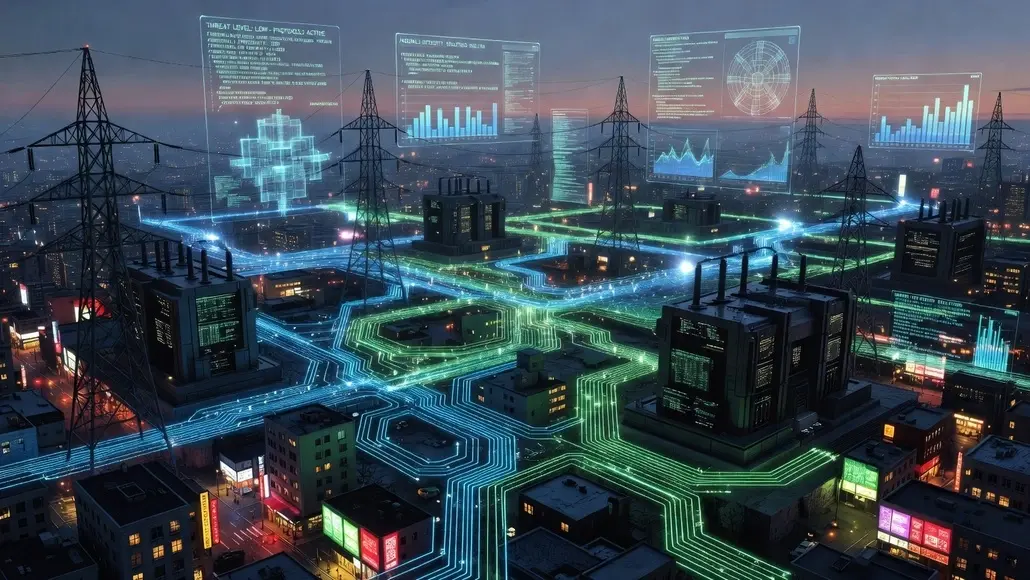
The integration of AI fault detection power systems is closely tied to the rise of big data in the utility sector. Modern grids are equipped with thousands of smart meters, PMUs, and IoT sensors that generate a constant stream of information. AI provides the tools needed to make sense of this data in real-time. By aggregating information from across the grid, AI can provide operators with a “situational awareness” that was previously impossible. This includes identifying areas of high stress, detecting unauthorized network activity, and optimizing the flow of power to minimize losses.
Advanced visualization tools, powered by AI, can present this information in an intuitive way, allowing human operators to make better decisions during a crisis. For example, during a major storm, the AI can prioritize which faults to clear first based on the number of customers affected and the criticality of the loads, such as hospitals or water treatment plants. This intelligent orchestration is what makes a grid truly “smart,” and it all starts with the foundational capability of AI fault detection power systems to provide high-quality, actionable data from every corner of the network.
Challenges in Implementing AI for Power Protection
Despite the clear benefits, the implementation of AI fault detection power systems is not without its challenges. One of the primary hurdles is the “black box” nature of many AI models. In a high-stakes environment like grid protection, engineers need to understand why a system made a specific decision, especially if it resulted in a major outage. To address this, there is a growing field of research dedicated to “Explainable AI” (XAI), which aims to make the decision-making process of neural networks more transparent and interpretable for human experts. Ensuring that AI systems are trustworthy and accountable is essential for their widespread adoption by conservative utility organizations.
Another challenge is the requirement for high-quality training data. AI models are only as good as the data they are trained on, and while utilities have plenty of data from normal operations, data from actual faults is relatively rare. This requires the use of sophisticated power system simulation tools to generate large datasets of “synthetic” faults to train the AI. Furthermore, there are significant cybersecurity concerns associated with AI fault detection power systems. If an attacker could “poison” the training data or manipulate the AI’s inputs, they could potentially trick the system into ignoring a real fault or causing a nuisance trip. Securing the AI pipeline is a critical task for the next generation of protection engineers.
The Role of Edge Computing and Low Latency
For AI to be effective in protection, it must operate with extreme speed. Sending data to a central cloud for analysis is often too slow for protection functions that must trigger in less than 50 milliseconds. This necessitates the use of “edge computing,” where AI models are executed directly on the hardware in the substation. This requires highly efficient algorithms and specialized hardware, such as Field-Programmable Gate Arrays (FPGAs) or specialized AI accelerators, that can perform billions of operations per second with very low power consumption.
As the technology matures, we can expect to see AI fault detection power systems become a standard feature in all new protection relays and IEDs. These devices will not only protect the grid but also act as intelligent sensors that provide a continuous stream of diagnostic data to the utility’s asset management system. This fusion of protection and analytics is the ultimate goal of the digital substation, creating a highly efficient and self-aware network that can handle the complexities of the 21st-century energy landscape.
Future Horizons in AI-Driven Grid Protection
Looking further ahead, we can envision a future where AI fault detection power systems are part of a fully autonomous “self-healing” grid. In this scenario, the AI would not only detect and isolate faults but also automatically reconfigure the network to restore power to affected areas within seconds. This would involve coordinating the output of thousands of distributed energy resources, managing voltage levels, and ensuring that the protection settings are automatically updated for the new grid topology. This level of automation will be necessary to manage a grid with 100% renewable energy, where the traditional methods of human-in-the-loop control will simply be too slow.
The integration of AI with other emerging technologies, such as digital twins and blockchain, will further enhance the capabilities of grid protection. A “digital twin” of the power system can be used to test new AI models in a virtual environment before they are deployed on the real grid, while blockchain can be used to ensure the integrity and traceability of the data used by the AI. As we continue to push the boundaries of what is possible, AI fault detection power systems will remain at the heart of our efforts to build a more resilient, sustainable, and intelligent energy future. The journey from simple relays to autonomous AI protection is just beginning, and the potential for innovation is limitless.