
















The global transition toward a more decentralized and intelligent electrical infrastructure has necessitated a fundamental reimagining of how we safeguard energy assets. For decades, the philosophy of power system protection was built upon a foundation of static settings and deterministic fault behaviors. However, as the grid evolves into a complex ecosystem of bidirectional power flows and intermittent renewable sources, the traditional methodologies are proving insufficient. Modern networks require a dynamic approach where protection systems are not merely reactive components but intelligent observers capable of adjusting to the fluctuating topology of the smart grid. This evolution is central to ensuring that the lights stay on while we transition to a greener and more resilient energy future.
The emergence of advanced power system protection represents a paradigm shift in utility operations. At its core, this evolution is driven by the integration of high-speed communication networks and sophisticated numerical relays that transcend the capabilities of their electromechanical predecessors. These digital devices offer a level of granularity in data acquisition that was previously unimaginable, allowing engineers to implement protection schemes that account for the real-time health of the network. This intelligence is vital for maintaining grid reliability, especially when dealing with the high penetration of distributed energy resources that can alter fault signatures in milliseconds. As we integrate more solar and wind, the traditional methods of overcurrent protection must be augmented with logic that understands the variable nature of inverter-based generation.
The Evolution of Digital Relaying and Intelligent Electronic Devices
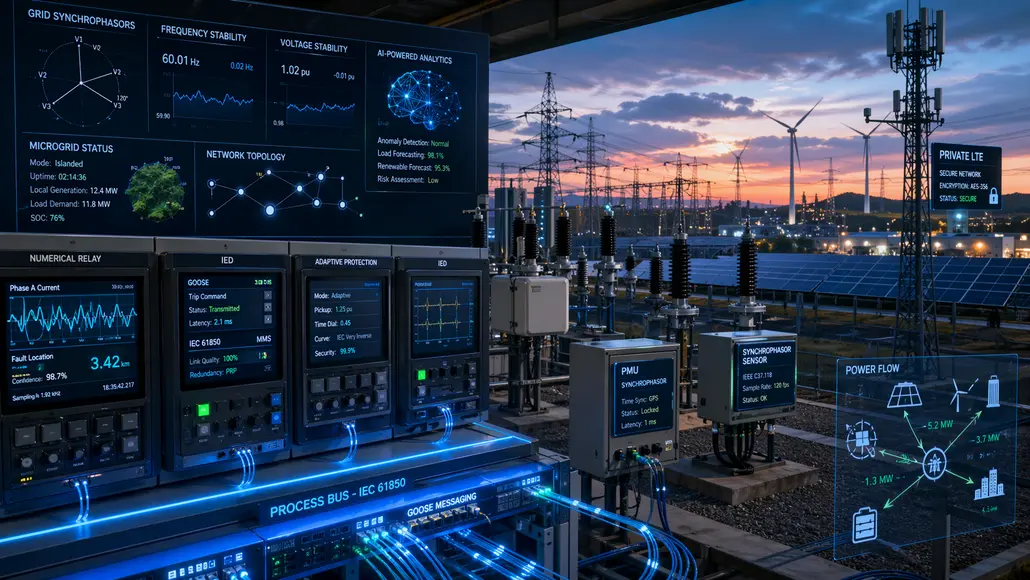
The transition from analog to digital protection was the first significant step in this journey. Modern Intelligent Electronic Devices, commonly referred to as IEDs, serve as the nervous system of the smart grid. Unlike legacy relays that functioned in isolation, IEDs are designed for interoperability, adhering to international standards such as IEC 61850. This standardization allows for the seamless exchange of data across different manufacturer platforms, creating a cohesive protection environment. These devices do more than just trip a circuit breaker; they gather extensive oscillography data, perform self-diagnostics, and provide sequence-of-events recording that is essential for post-disturbance analysis. The depth of data provided by these IEDs allows utility operators to look deep into the microscopic details of a fault, identifying transients that would have been invisible to earlier generations of technology.
Advanced power system protection relies heavily on the accuracy and speed of these IEDs. By processing signals at sampling rates that capture high-frequency transients, digital relays can distinguish between genuine faults and temporary system swings. This precision minimizes the risk of nuisance tripping, which is a major cause of localized blackouts. Furthermore, the ability of digital relays to communicate via fiber-optic process buses reduces the reliance on extensive copper wiring, thereby decreasing the physical footprint of substations while enhancing the immunity of the protection system to electromagnetic interference. The shift from copper to fiber is not just a change in material but a shift in reliability, as digital signals are less prone to degradation over distance and provide a more secure path for critical protection commands.
Adaptive Protection Schemes in Dynamic Environments
One of the most profound advancements in this field is the development of adaptive protection. In a traditional grid, protection settings were calculated based on the “worst-case” scenario for a fixed configuration. In a smart grid, however, the “worst case” changes as wind farms come online, batteries discharge, or microgrids disconnect from the main utility. Adaptive protection allows the relay to modify its settings in real-time based on the current state of the network. This ensures that the protection remains sensitive enough to detect low-level faults while remaining secure against high-load conditions. The flexibility of these settings is governed by complex algorithms that monitor the grid’s topology and adjust the trip curves accordingly, preventing “sympathetic tripping” in adjacent circuits.
Implementing these adaptive strategies requires a robust communication layer. The protection system must be aware of the status of every major switch and generator in its vicinity. If a large solar array is suddenly disconnected, the fault current levels in that section of the grid will drop significantly. An advanced power system protection relay will detect this change and automatically switch to a more sensitive setting group to ensure that any subsequent faults are still cleared rapidly. This level of autonomy is what differentiates a truly smart grid from a traditional one, providing a layer of resilience that can mitigate the cascading effects of unforeseen events. The intelligence is distributed, meaning that even if central control is lost, the local relays can make decisions based on the immediate environmental data.
Coordination Challenges and Solutions in Multi-Agent Systems
The coordination of protection devices becomes increasingly difficult as more distributed energy resources (DERs) are added to the distribution network. Traditionally, coordination followed a simple time-grading principle, but the presence of local generation can cause “mis-coordination” by contributing current that the upstream relays do not expect. To solve this, advanced power system protection utilizes multi-agent systems where each IED acts as an autonomous agent. These agents communicate with their neighbors to negotiate which device should trip first. By using Generic Object Oriented Substation Event (GOOSE) messaging, these negotiations happen in microseconds, ensuring that the fault is isolated with surgical precision.
This multi-agent approach also facilitates better management of microgrids. When a microgrid goes into “islanded” mode, the fault currents available are typically much lower than when it is connected to the main utility. A standard relay might never trip under these conditions. However, a multi-agent advanced power system protection scheme can instantly recognize the islanded state and switch to a differential protection logic that doesn’t depend on high current levels. This ensures that safety is maintained for both utility personnel and the equipment within the microgrid, regardless of the grid’s configuration.
Real-Time Monitoring and Fault Detection Enhancements
The integration of real-time monitoring systems into the protection framework has transformed how utilities manage grid health. By leveraging Phasor Measurement Units (PMUs), protection engineers can now view the grid’s operational state with microsecond-level synchronization. This global view is critical for detecting wide-area disturbances that local relays might miss. Advanced power system protection now incorporates these synchrophasor measurements to identify power oscillations and voltage instability before they lead to a system-wide collapse. The ability to see the “phase angle” of the voltage across continental distances provides a direct measurement of the stress on the power system, allowing for predictive actions to be taken before a catastrophic failure occurs.
Enhanced fault detection strategies are also moving beyond simple overcurrent or distance logic. Modern algorithms utilize wavelets and artificial intelligence to identify high-impedance faults, such as a downed power line resting on dry soil or a tree branch touching a conductor. These faults often don’t draw enough current to trigger traditional relays but pose significant fire and safety risks. By analyzing the unique harmonic signatures and frequency spectrum of these events, advanced power system protection can isolate the danger without disrupting the rest of the network, significantly improving both public safety and grid reliability. This level of sensitivity was previously impossible but is now a standard requirement for utilities operating in fire-prone regions.
Communication Requirements for Secure Operations
The efficacy of advanced power system protection is inextricably linked to the reliability of the underlying communication infrastructure. Whether using GOOSE messaging within a substation or wide-area communication links between distant sites, the latency and jitter of the network must be strictly controlled. Protection signals are time-critical; a delay of even a few milliseconds can be the difference between a routine fault clearing and catastrophic equipment failure. Consequently, utilities are increasingly investing in dedicated private LTE networks or redundant fiber loops to ensure that their protection data always has a clear and immediate path. The move toward software-defined networking (SDN) is also helping to prioritize protection traffic over less critical data streams.
Furthermore, as protection becomes more software-dependent, cybersecurity has moved to the forefront of the design process. An advanced power system protection scheme is only as strong as its weakest link in the digital chain. Protecting these systems involves multi-layered defense strategies, including encryption of communication protocols, strict access controls for IEDs, and continuous monitoring for unauthorized traffic. Ensuring that the grid can defend itself against both physical faults and cyber-intrusions is the ultimate goal of modern protection engineering. This involves not just securing the devices themselves but also ensuring the supply chain integrity of the firmware and software that runs on them.
The Role of Time Synchronization and Precision Timing
In a digital protection environment, time is a critical variable. Advanced power system protection requires that all devices have a perfectly synchronized “clock” to compare data from different locations accurately. This is usually achieved using the IEEE 1588 Precision Time Protocol (PTP), which can synchronize devices to within nanoseconds. Without this precision, differential protection schemes and synchrophasor measurements would be inaccurate, leading to false trips. Utilities are moving toward redundant timing sources, including GPS-independent clocks, to ensure that the system remains operational even if satellite signals are lost or jammed.
This focus on timing extends to the way data is sampled and processed. High-speed process buses carry “sampled values” from primary equipment to relays. If these packets of data arrive out of order or with inconsistent timing, the relay’s internal logic can fail. Therefore, the network architecture of the substation must be designed with strict Quality of Service (QoS) parameters. Advanced power system protection is as much about networking and timing as it is about electrical engineering, requiring a new breed of technician who understands both worlds.
Future Horizons in Protection Technology
Looking ahead, the role of advanced power system protection will only become more central as we move toward “net-zero” energy targets. The rise of inverter-based resources, such as solar and wind, presents a unique challenge because these devices do not provide the same levels of fault current as traditional rotating generators. This requires the development of “non-conventional” protection methods that rely on voltage signatures or traveling waves rather than just current magnitude. Research is currently underway to perfect traveling wave relays that can locate a fault within a few hundred feet by measuring the time it takes for a high-frequency pulse to reflect off the fault point. This technology allows for much faster clearing times, which is essential for maintaining the stability of low-inertia systems.
The integration of machine learning into the protection loop is another exciting frontier. By training algorithms on millions of historical fault records, we can create protection systems that learn to recognize the subtle precursors to equipment failure. This proactive approach moves us from “protection” to “prevention,” where the system can signal for maintenance before a fault even occurs. As these technologies mature, advanced power system protection will continue to be the silent guardian of our modern world, ensuring that the lights stay on even as the grid becomes more complex and diverse than ever before. The ultimate vision is a grid that can self-heal, reconfiguring itself in real-time to isolate faults and restore power to affected areas automatically.
Integrating Distributed Intelligence and Edge Computing
The next step in the evolution of advanced power system protection is the deployment of edge computing at the substation level. By processing data locally rather than sending it to a central control center, protection systems can react even faster. These “smart” substations can analyze vast amounts of data in real-time, identifying complex patterns that might indicate a developing wide-area disturbance. This decentralized intelligence is key to managing a grid with millions of active nodes, from rooftop solar panels to electric vehicle chargers.
As we look to the future, the interoperability of these systems will remain a top priority. The industry must continue to support open standards that allow for innovation while ensuring that the core protection functions remain robust and reliable. Advanced power system protection is the foundation upon which the entire smart grid is built, and its continued evolution is essential for a safe, sustainable, and reliable energy future. By embracing new technologies and methodologies, we can create a power network that is not only smarter but also more resilient to the challenges of the 21st century.