





















The transition toward a more sustainable future requires a fundamental shift in how industrial products are conceived, fabricated, and managed throughout their operational life, particularly within the lighting sector. For decades, the global economy has operated on a linear take make waste model, which has led to significant environmental degradation, heavy carbon emissions, and severe resource depletion.
However, the emergence of sustainable circular economy models offers a transformative alternative that prioritizes resource efficiency, material conservation, and long term ecological balance. In the realm of modern lighting, this means moving decisively away from disposable, sealed fixtures and toward systems designed intentionally for longevity, modular upgradeability, non destructive disassembly, and comprehensive material recovery. PowerGen Advancement notes that by integrating these circular principles, the lighting industry can drastically reduce electronic waste and minimize the environmental footprint of the entire material lifecycle.
Redefining Lighting Design through Circular Principles
At the heart of sustainable circular economy models is an uncompromising commitment to intentional, modular lighting design. Traditional lighting products were often manufactured as permanently glued or potted assemblies, making it virtually impossible to repair, remanufacture, or upgrade individual subassemblies without discarding the entire luminaire housing. Modern engineering approaches emphasize modularity, standardized mechanical interfaces, and toolless disassembly. This shift ensures that when an individual component, such as an LED driver, an optical lens, or a digital communication sensor, reaches the end of its functional life or becomes technologically obsolete, it can be swapped out quickly on site without necessitating the disposal of the structural aluminum chassis or wiring harness. This intense focus on resource efficiency not only extends the physical lifespan of the product across decades but also reduces the extraction demand for virgin raw materials, fostering a robust sustainability framework across the commercial power sector.
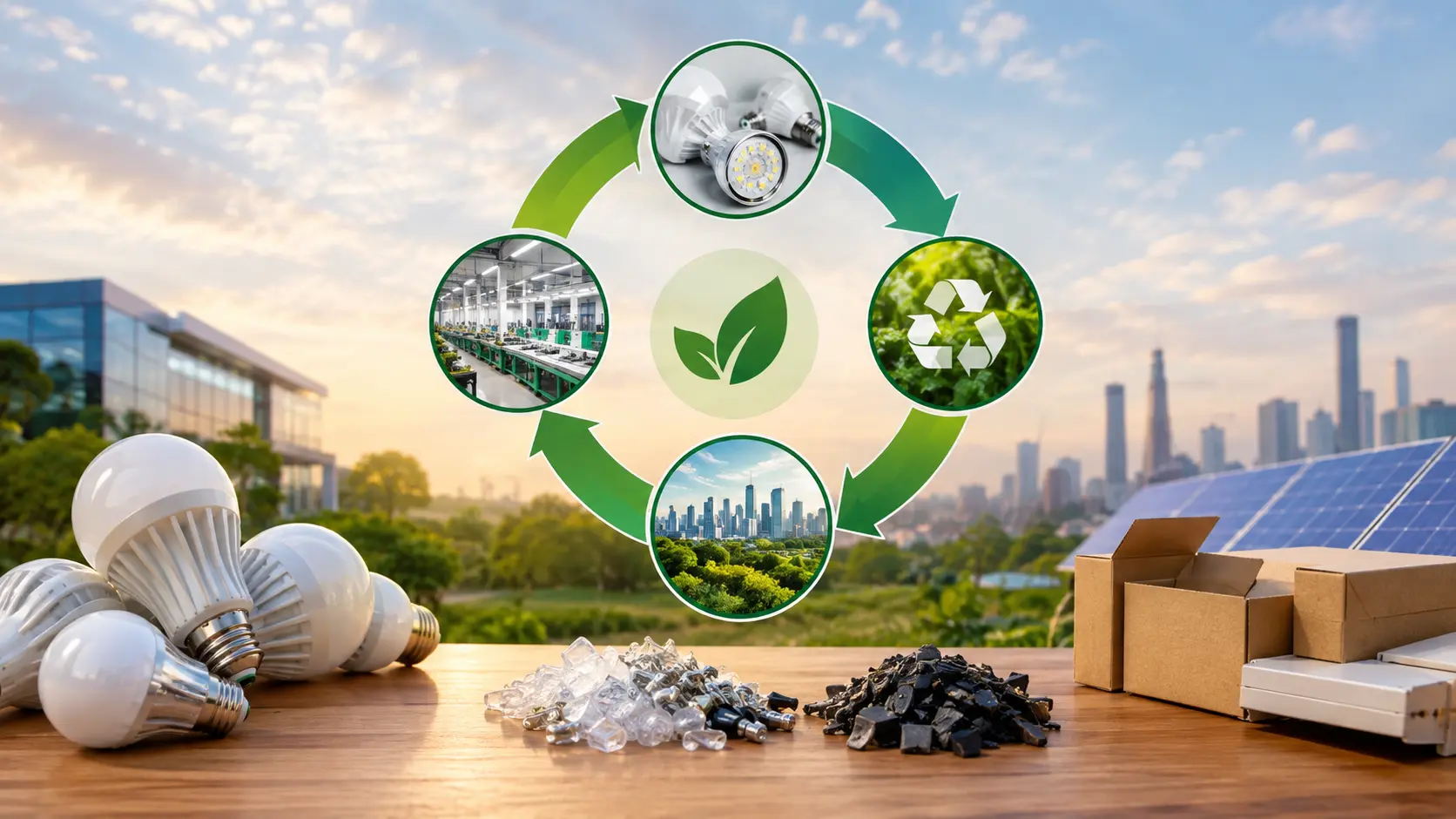
Designing for the circular economy also involves selecting materials that are non toxic and inherently easier to recycle or repurpose at end of life. By avoiding thermoset plastics, toxic flame retardants, complex composite adhesives, and hazardous solder alloys, manufacturers ensure that hardware contributes to clean power sector recycling when retired. Sustainable circular economy models advocate for a cradle to cradle approach, where every component represents an inventory of technical nutrients for future products. This shift requires a deep understanding of the material lifecycle, ensuring that the embodied energy invested in original manufacturing is preserved. As these practices become universal, the lighting sector will play a pivotal role in the global transition to an industrial zero waste economy.
The concept of design for disassembly requires rigorous engineering standards. Luminaires designed under circular principles utilize snap fits, standardized metric screws, and mechanical spring clips rather than irreversible chemical bonding agents. Optical lenses are molded from virgin or high grade recycled polycarbonates and polymethyl methacrylate that can be cleanly separated and ground into secondary resin pellets without degradation. Heat sinks, which constitute the largest single mass component in industrial luminaires, are cast or extruded from certified recycled aluminum alloys, demanding ninety five percent less energy to produce than primary virgin aluminum. By eliminating paint finishes that contain volatile organic compounds and adopting durable powder coatings or anodized surface finishes, manufacturers preserve the metallurgical purity of the scrap stream.
Boosting Resource Efficiency and Waste Reduction
The implementation of sustainable circular economy models is directly linked to substantial waste reduction across institutional supply chains. Millions of metric tons of electronic waste are generated globally each year, losing scarce metals and alloys to landfills. By adopting circular strategies, lighting enterprises capture this value through structured take back programs and certified factory remanufacturing. Resource efficiency reaches its peak when organizations transition toward Lighting as a Service models. Under this paradigm, the provider retains legal ownership of the hardware, assuming complete responsibility for maintenance and eventual decommissioning. The manufacturer is thus economically incentivized to build equipment exhibiting extraordinary durability and modular serviceability, aligning financial interests with ecological stewardship.
Furthermore, circular models encourage the progressive incorporation of post consumer recycled content within new luminaire housings. By establishing closed loop recycling systems, manufacturers can dramatically reduce the upstream environmental footprint associated with mineral mining, refining, and global maritime logistics. Sustainability in the lighting sector is no longer judged solely by luminous efficacy during the operational use phase, but rather by the aggregate embodied carbon footprint of the product from raw material extraction through manufacturing, logistics, utilization, and subsequent material recovery. Sustainable circular economy models provide the structural methodology required to harmonize these complex demands, guaranteeing that high resource efficiency is preserved across every tier of the supply chain. This comprehensive approach to waste reduction is vital for meeting the ecological constraints of a resource finite world and preserving critical natural ecosystems.
The Role of Power Sector Recycling and Material Recovery
A critical pillar of sustainable circular economy models is the development of advanced power sector recycling infrastructure capable of processing complex solid state electronics. Modern lighting hardware contains complex printed circuit boards, surface mount light emitting diodes, gold bond wires, copper traces, and rare earth phosphors including yttrium, cerium, and europium. When discarded into municipal solid waste streams, these elements pose hazardous environmental hazards while squandering scarce mineral resources. Circular economy principles dictate that these critical raw materials should be reclaimed using advanced hydrometallurgical refining processes and reintroduced into high value industrial manufacturing cycles. By establishing formal collaborations between fixture manufacturers, specialized electronic recyclers, and legislative bodies, society can establish an infrastructure network that sustains long term technological advancement without ecological degradation.

In addition to elemental material recovery, sustainable circular economy models elevate the economic prominence of industrial remanufacturing and component upcycling. Hundreds of thousands of heavy duty industrial and architectural luminaires removed during facility modernizations possess structurally pristine aluminum chassis that could remain in service for decades. Instead of expending energy to melt down these housings, certified remanufacturers clean, test, and rewire the existing enclosures with cutting edge solid state drivers and modern optical engines, returning the product to service with new product warranties at a fraction of the carbon footprint. This industrial practice maximizes resource efficiency while offering cost competitive, high performance lighting upgrades to budget constrained municipalities, school districts, and non profit entities. Through these multidimensional practices, circular lighting paradigms redefine industrial power operations into an international model of resource responsibility.
Strategic Implementation and Industry Transformation
Adopting sustainable circular economy models requires a profound cultural and structural transformation across all stakeholders in the industrial lighting value chain. The journey begins with educational initiatives that train mechanical and electrical engineers to treat end of life disposal as a design failure rather than an unavoidable commercial inevitability. When lighting brands prioritize modular architecture, repairable subassemblies, and closed loop material sourcing, they establish higher competitive standards that encourage entire supply networks to follow suit. Progressive governments also accelerate this transition by writing circular procurement criteria into public tenders, mandating minimum percentages of recycled materials, and instituting extended producer responsibility regulations that hold hardware manufacturers financially accountable for end of life management.
Ultimately, the global success of sustainable circular economy models will depend upon continuous engineering innovation, transparent material data accounting, and cross sector industrial collaboration. Whether through advances in bio based polymers, digital product passport tracing, or innovative service delivery contracts, the lighting industry possesses an exceptional opportunity to demonstrate how heavy electrical manufacturing can align with natural planetary boundaries. The rewards of this structural transition are indisputable, yielding smaller carbon footprints, secure mineral supply lines, and a resilient, resource efficient economic future. PowerGen Advancement believes that by establishing sustainable circular economy models as the governing foundation of modern lighting architecture, society chooses a path that honors ecological balance while continuing to deliver safe, efficient, and inspiring illumination for human progress.