



















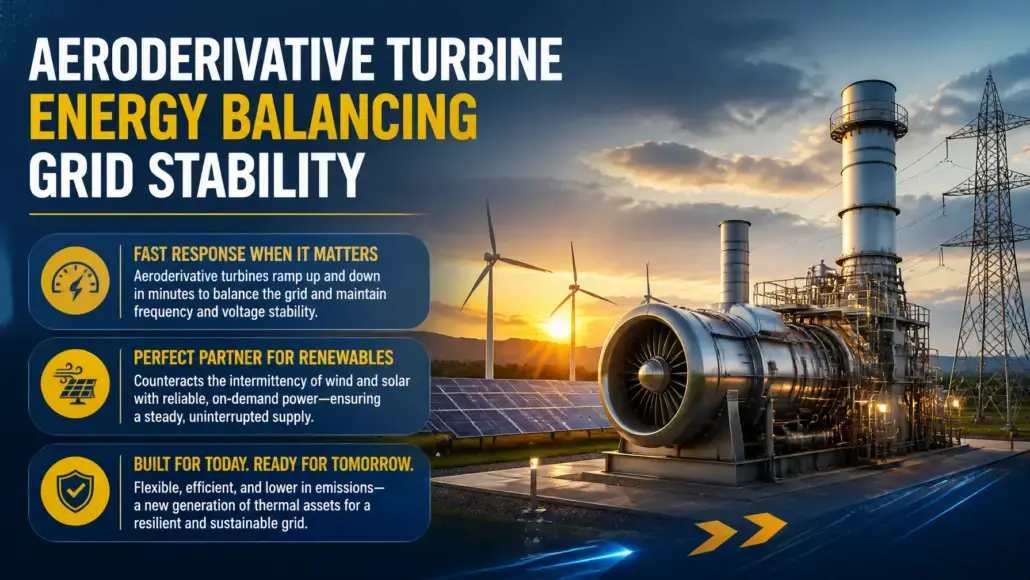
Modern electrical grids are undergoing a fundamental transformation as traditional baseload generation gives way to variable renewable energy sources like wind and solar. While this shift is essential for meeting global climate targets, it introduces significant operational challenges related to grid frequency and voltage stability.
The inherent intermittency of weather dependent power requires a new generation of fast reacting thermal assets that can ramp up and down in minutes. PowerGen Advancement observes that aeroderivative turbine energy has emerged as the primary solution for utilities seeking to maintain reliability without sacrificing the progress made in renewable deployment.
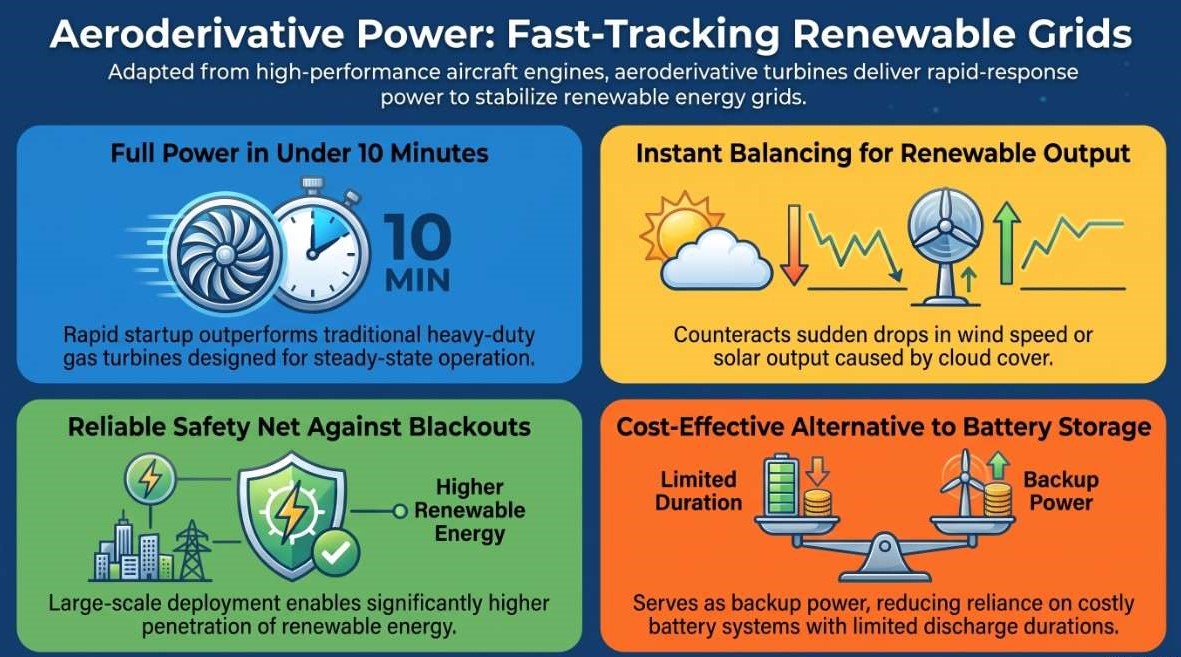
These units, which are adapted from high performance aircraft engines, offer a unique combination of rapid start times and high cycling capability:
- Fast Startup: Unlike heavy-duty gas turbines designed for steady-state operation, aeroderivative systems reach full power in under ten minutes.
- Grid Balancing: Rapid responsiveness allows grid operators to instantly counteract sudden drops in solar output from cloud cover or sudden drops in wind speed.
- Accelerated Renewable Integration: Deploying these turbines at scale offers a reliable safety net against blackouts, enabling higher penetration of renewable energy.
- Cost-Effective Alternative to Storage: Serves as a backup power source, reducing reliance on costly battery storage systems with limited discharge durations.
Technological Advancements in Aeroderivative Design
The engineering behind these systems has advanced rapidly in 2025 and 2026, focusing on higher efficiency and lower emissions during part load operation. Manufacturers like GE Vernova and Siemens Energy have introduced enhanced combustion systems that maintain stability even when the turbines are idling or running at low capacity. This is vital for aeroderivative turbine energy because these units often spend hours in standby mode, ready to respond to a grid signal at a moment’s notice.
One of the most significant developments in 2026 is the integration of advanced digital control systems that utilize machine learning to predict renewable fluctuations. By analyzing local weather patterns and real time grid data, these systems can pre warm turbines or adjust their output in anticipation of a supply gap. This proactive approach reduces the thermal stress on components and extends the life of the machinery, which is a major concern for units that cycle multiple times per day.
Market Dynamics and Global Deployment Trends
The demand for flexible power solutions has led to a surge in aeroderivative orders across North America, Europe, and Asia. According to Wood Mackenzie data from early 2026, the global market for these specialized turbines is expected to grow by over 6 percent annually through 2030. This growth is driven by the urgent need to retire aging coal plants and replace them with a combination of renewables and flexible gas generation.
In the United States, the pipeline for gas turbine orders reached nearly 45 gigawatts in 2025, with a significant portion allocated to aeroderivative models. Grid operators in regions like California and Texas are increasingly relying on these units to manage the evening ramp, when solar production disappears just as residential demand peaks. The versatility of these turbines also makes them attractive for industrial microgrids and remote mining operations that are trying to incorporate more green energy into their power mix.
Leading Corporate Initiatives and Project Successes
Several global energy leaders have announced major milestones in the deployment of flexible turbine technology during 2025 and 2026. These projects demonstrate the practical application of aeroderivative turbine energy in diverse geographic and economic contexts.
- GE Vernova secured a landmark contract in mid 2025 to supply its LM6000 units to a large utility in Western Australia. The project is designed specifically to balance one of the highest concentrations of rooftop solar in the world, providing critical inertia and frequency response.
- Siemens Energy launched its SGT-A65 enhanced series in early 2026, featuring a modular design that reduces installation time by 30 percent. This unit is being deployed in a series of fast track projects across Southeast Asia to support rapid industrialization alongside new wind farms.
- Wartsila expanded its footprint in the United States with a 200 megawatt project in the Midwest that pairs its modular engine technology with aeroderivative units to provide a hybrid balancing solution.
- Mitsubishi Power announced a new partnership in 2026 to integrate its small scale turbine technology with large scale battery storage, creating a comprehensive grid firming package for European transmission operators.
- Ansaldo Energia returned to the North American market in 2026 with a focus on flexible peaking units, securing an order for a new facility in Texas that will support the growing demand from AI data centers.
Addressing the Emissions Challenge through Fuel Flexibility
While natural gas remains the primary fuel for these turbines, the industry is moving quickly toward decarbonization through fuel blending. In 2026, the capability to burn high percentages of hydrogen has become a standard requirement for new aeroderivative installations. This allows utilities to install balancing capacity today while having a clear path to zero carbon operations in the future.
TotalEnergies and Shell have both participated in pilot programs throughout 2025 that test the performance of aeroderivative turbine energy units using bio methane and hydrogen mixtures. These trials have shown that with relatively minor modifications to the combustion liners, these turbines can maintain their high ramp rates and efficiency while significantly reducing their carbon footprint. Amine based carbon capture scaling is also being explored as a complementary technology for larger combined cycle plants that utilize aeroderivative components. The successful implementation of these balancing strategies often relies on the broader adoption of amine based carbon capture scaling to manage the remaining emissions from flexible gas assets.
Strategic Implications for Grid Operators and Investors
For investors and grid planners, the shift toward flexible generation represents both a challenge and an opportunity. The capital expenditure for aeroderivative turbine energy units is higher than that of simple cycle heavy duty units on a per kilowatt basis, but their operational value in a high renewable grid is far greater. The ability to provide ancillary services, such as spinning reserves and black start capability, creates additional revenue streams that can offset the initial investment.
Furthermore, the modular nature of these turbines allows for a scalable approach to grid expansion:
- Rapid deployment: Utilities can deploy aeroderivative clusters in 18 to 24 months, compared to the decade-long timeline required for massive centralized power plants.
- Critical speed to market: Fast deployment addresses modern grid pressures, where surging electricity demand outpaces transmission infrastructure construction.
Future Outlook for Aeroderivative Technology
As we look toward the end of the decade, PowerGen Advancement believes the evolution of aeroderivative turbine energy will likely be defined by deeper integration with the broader energy ecosystem. We expect to see more projects that combine these turbines with green hydrogen production facilities, where the turbines provide power during lulls and the electrolyzers soak up excess renewable energy during peaks.
The continuous refinement of materials and cooling technologies will also allow these units to operate at higher temperatures, further boosting their efficiency. As long as the world continues to add variable renewable energy to the mix, the need for the precision and power of aeroderivative systems will only grow, making them a cornerstone of the 21st century energy transition.
References
- IEA Electricity 2026 Report – International Energy Agency
- Global Gas Turbine Market Outlook 2026 – Wood Mackenzie
- LM6000 Product Specification and Market Update – GE Vernova
- SGT-A65 Launch Press Release – Siemens Energy
- Sustainability and Climate Progress Report 2026 – TotalEnergies