
























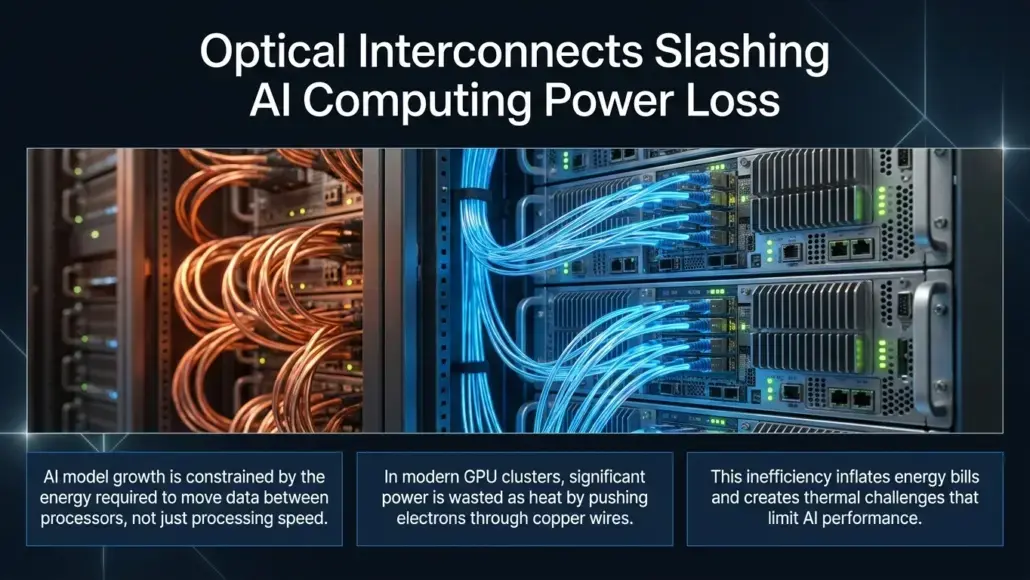
As artificial intelligence models grow in size and complexity, the physical limits of traditional electronic computing are being reached. The bottleneck is no longer just the speed of the processors themselves, but the energy required to move data between them. Powergen Advancement notes that in modern GPU clusters, a staggering amount of power is wasted as heat simply by pushing electrons through copper wires. This inefficiency not only inflates energy bills but also creates thermal challenges that limit the performance of AI systems. In this landscape, the emergence of optical interconnects slashing AI computing power loss by replacing traditional electrical paths with high-speed, low-energy light signals, ushering in a new era of ultra-efficient high-performance computing.
The Copper Wall: Why Electrons Are Failing AI
For decades, copper has been the reliable workhorse of the electronics industry. However, as data rates increase to support the trillions of parameters in modern AI models, copper hits a physical wall. Electrons traveling through a conductor encounter resistance, which generates heat. At high frequencies, this effect is exacerbated by the skin effect, where electrons crowd toward the surface of the wire, further increasing resistance and energy loss. To maintain signal integrity over even a few inches of copper, engineers must use massive amounts of power for amplification and equalization.
The Energy Crisis at the Chip Level
In a typical AI server, up to 30% of the total power consumed by a GPU is dedicated solely to I/O (Input/Output)—moving data to and from memory and other processors. As we scale from single chips to massive super-clusters, the energy cost of communication begins to dwarf the energy cost of actual computation. This I/O power tax is a major barrier to the development of next-generation AI models. If we continue to rely on copper, the power required for data movement will eventually consume the entire energy budget of the data center. The adoption of technology where optical interconnects slashing AI computing power loss is the only path forward for sustainable AI scaling.
Thermal Management and Compute Density
Heat is the enemy of performance. When copper interconnects generate excessive heat, they force GPUs to throttle their clock speeds to prevent damage. This creates a vicious cycle: we spend more energy on cooling, which limits the power available for compute, which slows down the AI training process. By switching to light, which generates virtually no heat as it travels, we can pack GPUs closer together and run them at higher speeds. This increase in compute density is essential for fitting the massive processing power required for AI into a manageable physical footprint.
The Breakthrough of Silicon Photonics
The transition from electrons to photons is made possible by silicon photonics—the integration of laser light and optical components onto standard silicon chips. This technology allows us to create optical engines that sit directly next to the GPU, converting electrical signals into light and back again at the speed of light.
Chip-to-Chip and Rack-to-Rack Connectivity
Optical interconnects slashing AI computing power loss by transforming how data moves at multiple scales. At the chip-to-chip level, optical wave-guides can replace thousands of tiny copper pins, allowing for massive bandwidth between a GPU and its HBM (High Bandwidth Memory).
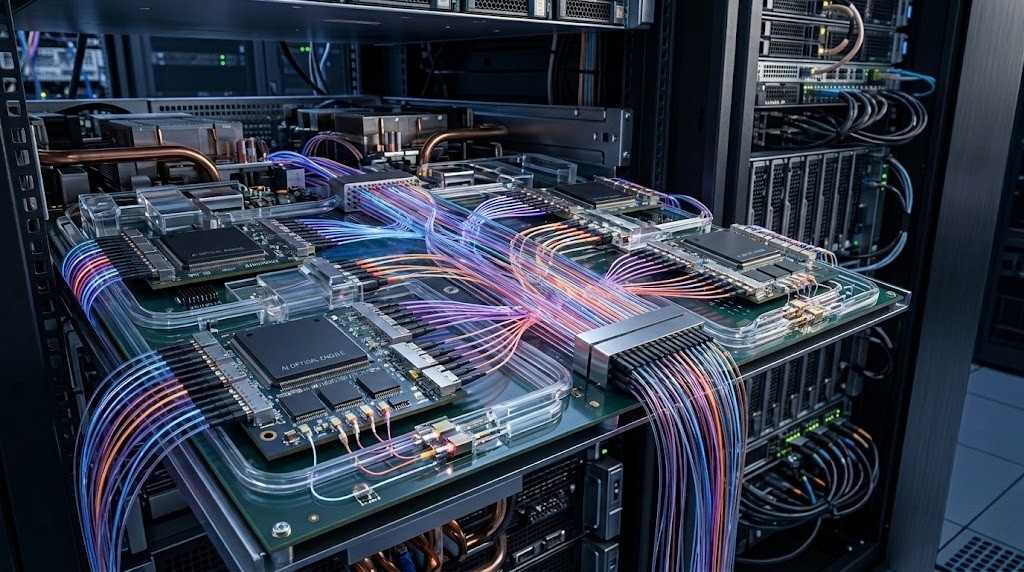
At the rack-to-rack level, fiber optic cables can replace thick, heavy copper Twinax cables. Unlike copper, which loses signal strength over just a few meters, light can travel through fiber for kilometers with almost zero loss. This allows for the creation of disaggregated data centers, where memory and compute can be located in different parts of the building while still behaving as if they are on the same chip.
Wavelength Division Multiplexing
One of the most powerful features of optical technology is Wavelength Division Multiplexing (WDM). This technique allows multiple streams of data to be sent simultaneously through a single fiber by using different colors (wavelengths) of light. A single optical fiber can carry the equivalent data of hundreds of copper wires, drastically reducing the physical complexity and weight of the data center’s cabling. By using WDM, optical interconnects slashing AI computing power loss while providing the massive bandwidth required for real-time AI inference and large-scale model training.
Advantages for the AI Ecosystem
The benefits of optical interconnects extend far beyond just saving electricity. They enable a fundamental redesign of AI architectures, moving away from rigid hierarchies to flexible, fluid pools of resources.
Lowering the Total Cost of Ownership
While the initial cost of optical components is currently higher than copper, the long-term TCO is significantly lower. The energy savings from reduced I/O power and lower cooling requirements add up to millions of dollars in savings over the life of an AI cluster. Furthermore, the increased reliability of optical signals—which are immune to electromagnetic interference (EMI)—reduces the amount of downtime caused by signal errors and re-transmissions. For an AI developer, this means faster training times and a more robust production environment.
Synergy with External Power Infrastructure
Reducing internal power loss complements the external efficiency gains achieved when high-voltage DC links solve data center power crisis challenges globally. By combining efficient high-voltage DC transmission with low-loss optical data paths, we create a double win for sustainability. Every watt saved at the chip level reduces the burden on the transmission grid, and every watt saved at the grid level reduces the carbon footprint of the AI model. This holistic approach to efficiency is the only way to meet the aggressive net-zero targets set by the tech industry.
Overcoming the Manufacturing and Integration Barriers
Despite the clear advantages, the shift to optics is a massive engineering challenge. Integrating lasers and delicate optical components into the harsh, high-heat environment of a GPU package requires extreme precision.
The Challenge of Laser Integration
Lasers are sensitive to heat, and GPUs are very hot. Finding a way to keep the laser cool while it is sitting millimeters away from a 700-watt processor is one of the biggest hurdles in silicon photonics.
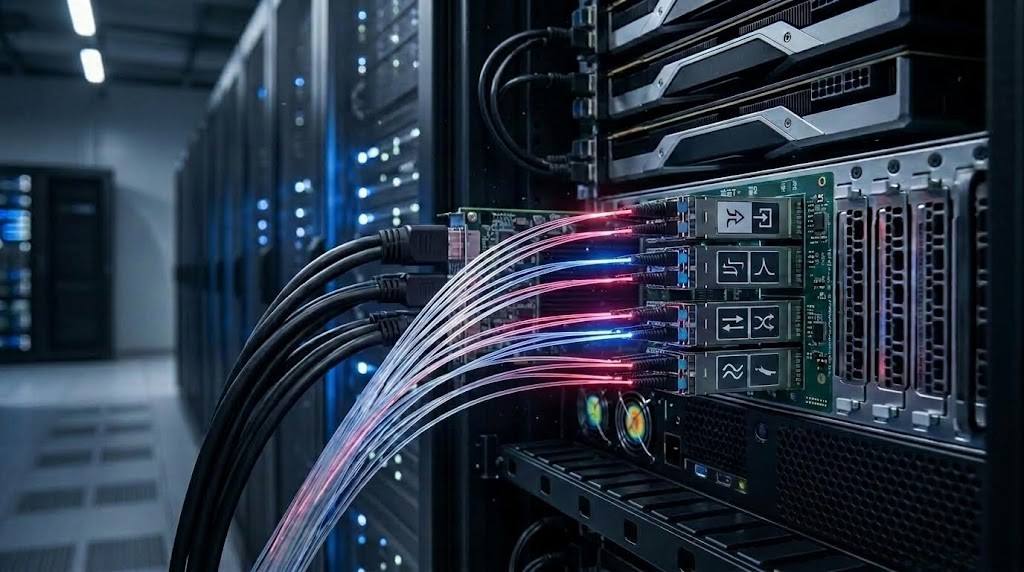
Some companies are solving this by using remote laser sources, where the laser is located in a separate, cooler part of the rack and its light is piped into the GPU via fiber. Others are developing new types of lasers that are inherently more heat-resistant. As these techniques mature, the deployment where optical interconnects slashing AI computing power loss will become standard across the industry.
Standardizing the Optical Interface
For optics to reach the mass market, the industry needs standardized interfaces that allow chips from different vendors to talk to each other. Groups like the Ultra Ethernet Consortium (UEC) and the CXL (Compute Express Link) consortium are working to define these standards. A unified optical ecosystem will allow data center operators to mix and match GPUs, memory, and storage from various manufacturers, fostering competition and driving down costs. This standardization is the final piece of the puzzle needed for the optical revolution in AI.
The Future Towards All-Optical Computing
Looking further ahead, we are moving toward a future of all-optical computing, where the actual calculations are performed using light rather than electrons.
Optical Neural Networks
Startups and research labs are already developing optical neural networks (ONNs) that use light interference patterns to perform matrix multiplications—the core operation of AI. Because light can perform these operations at the speed of light and with nearly zero energy, ONNs could be thousands of times more efficient than today’s best GPUs. In this future, optical interconnects slashing AI computing power loss not just between chips, but as the fundamental fabric of the processor itself.
The Role of AI in Designing Better Optics
Ironically, AI is being used to design the next generation of optical components. Machine learning algorithms can optimize the layout of optical waveguides and the design of nanophotonic structures to achieve levels of performance that human engineers could never reach. This self-reinforcing cycle—where AI helps build the very systems that will power the next version of AI—is accelerating the pace of innovation in the photonics industry.
Industry Titans Commercialize Co-Packaged Photonics to Shatter the Copper Barrier
To resolve the crippling power tax and thermal bottlenecks of copper interconnects, leading hardware providers are moving optical engines directly onto switch packages and server fabrics. Broadcom has advanced the industry’s optical roadmap with its third-generation Co-Packaged Optics (CPO) platform, leveraging 200G/lane silicon photonics to slashing the power required for high-bandwidth data movement across AI fabrics. Concurrently, NVIDIA introduced Spectrum-X silicon photonics switches with co-packaged optics delivering 1.6 Tbps per port, achieving up to 3.5x energy reductions across massive multi-GPU clusters. Backing these chip-level transitions, Corning launched its GlassWorks AI™ connectivity platform, deploying high-density optical cabling and precision fiber array solutions designed to seamlessly route light-based signals between processors and optical engines without thermal penalty.
Lighting the Path to Sustainable Intelligence
The era of copper-based computing is reaching its twilight. The demands of modern artificial intelligence have exposed the physical and energetic limits of electrons, forcing us to turn to the speed and efficiency of light. Optical interconnects slashing AI computing power loss and provide the bandwidth required to sustain the next decade of digital progress.
The transition to optics is more than just a component upgrade. It is a fundamental shift in how we build and think about computers. Powergen Advancement believes that by replacing heat-generating wires with cool, efficient light, we are clearing the path for AI models that are larger, faster, and more sustainable than ever before. As photons replace electrons as the primary carriers of information, the light-based data center will become the foundation of our intelligent civilization. The future of AI is not just about smarter algorithms; it is about the light that carries them, ensuring that our digital dreams do not come at the expense of our physical planet.
References
-
Broadcom Inc. — Broadcom Announces Third-Generation Co-Packaged Optics (CPO) Technology with 200G/lane Capability
-
NVIDIA Corporation — NVIDIA Announces Spectrum-X Photonics, Co-Packaged Optics Networking Switches to Scale AI Factories to Millions of GPUs
-
Coherent Corp. — Coherent Launches PhotonLink™ Integrated Optics Platform for AI Infrastructure
-
Marvell Technology, Inc. — Marvell Announces Acquisition of Polariton Technologies, Advancing Optical Performance Scaling to 3.2T and Beyond
-
Corning Incorporated — Corning Launches GlassWorks AI™ Solutions Portfolio at OFC 2026