























Wind turbine drivetrains operate under severe dynamic loads, high torque, and continuous variable-speed operation. As modern onshore and offshore turbines scale to rotor diameters exceeding 150 to 240 meters, the mechanical stress on main bearings, planetary gear stages, and composite blades intensifies significantly. Industry data published by the Global Wind Energy Council in 2025 indicates that major mechanical failures in drivetrains and rotating components account for more than thirty-five percent of unplanned operational expenditures across commercial wind assets. Replacing a damaged planetary gear stage or a fractured main shaft bearing requires specialized heavy-lift cranes or offshore jack-up vessels, leading to prolonged asset downtime and severe revenue losses.
Standard condition monitoring systems rely primarily on low-frequency vibration accelerometers and oil debris sensors. While effective at identifying advanced mechanical damage, these traditional tools often detect problems only after significant surface spalling, flaking, or metal deformation has already occurred. In many operating scenarios, vibration analysis provides an asset manager with merely a few weeks or days of warning before functional failure. To achieve true predictive maintenance, the wind industry is turning to acoustic emission condition monitoring, a non-destructive testing method that identifies microstructural degradation long before macroscopic flaws manifest.
Fundamentals of Acoustic Emission Phenomenon
Acoustic emission analysis detects transient elastic stress waves generated by rapid energy release within a material under mechanical stress. When internal microstructural events occur, such as dislocation movements, microcrack formation, or fiber breakage, the energy propagates through the component as high-frequency acoustic waves.
Key technical characteristics of this sensing method include:
- High-frequency operational bandwidth typically ranging from 50 kHz to 1 MHz, operating far above background ambient mechanical noise and structural vibration.
- Direct sensitivity to active dynamic processes rather than static geometric discontinuities.
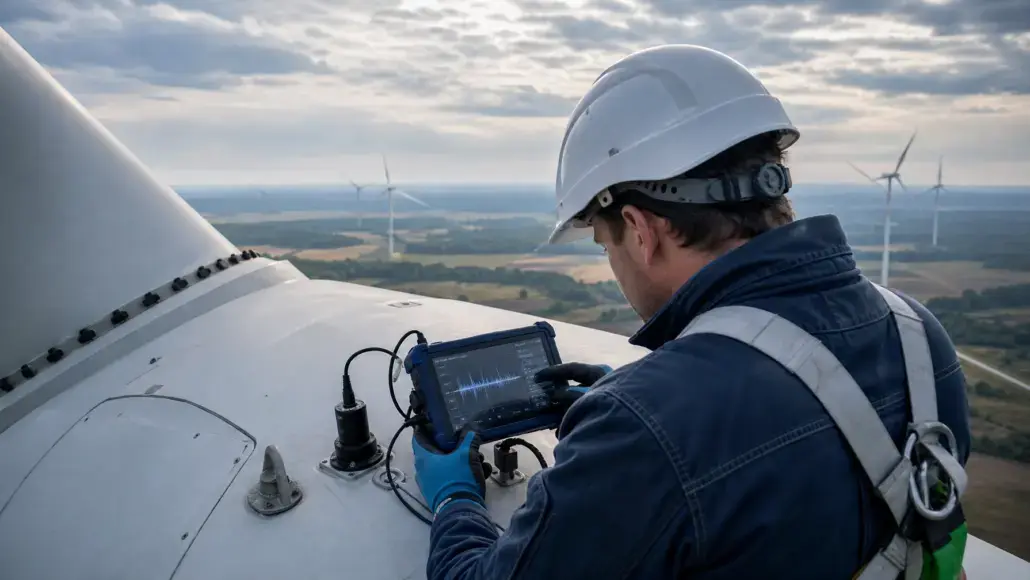
- Piezoelectric resonant sensors mounted directly to component surfaces to convert mechanical stress waves into electrical signals.
- Waveform parameter analysis tracking signal amplitude, rise time, duration, energy counts, and peak frequency spectra.
Because acoustic waves attenuate rapidly as they travel through metal and composite boundaries, acoustic emission sensors detect localized, highly concentrated microstructural changes. This physical property allows engineers to pinpoint the exact spatial origin of micro-cracking through sensor clustering and time-of-flight triangulation algorithms governed by international non-destructive standards such as ISO 22096.
Detecting Subsurface Drivetrain and Bearing Failures
The main bearing and low-speed planetary gear stages of wind turbines operate at rotational velocities between eight and twenty revolutions per minute. At these low rotational speeds, standard vibration monitoring struggles to generate sufficient kinetic energy to trigger reliable diagnostic alarms. Subsurface microstructural fatigue can progress unnoticed for months beneath bearing raceways.
A notorious failure mechanism in modern wind turbine drivetrains is white etching cracks. These brittle microstructural alterations develop beneath the surface of through-hardened and case-carburized bearing steels under cyclic rolling contact fatigue. As white etching cracks branch toward the surface, they eventually cause catastrophic raceway spalling.
Acoustic emission condition monitoring provides a distinct advantage by detecting the sub-surface acoustic energy bursts generated during the initial initiation and coalescence of these microcracks. Operators receive actionable warnings between three and nine months ahead of conventional vibration alarms. This extended diagnostic horizon transforms unscheduled emergency interventions into controlled, scheduled maintenance campaigns during calm weather windows.
Application Across Critical Structural Assemblies
Acoustic emission monitoring extends beyond steel gearbox assemblies to other mission-critical turbine components that endure severe cyclic fatigue:
- Composite rotor blades: Sensors positioned along internal shear webs and spar caps detect micro-delamination, matrix cracking, and adhesive bondline failures caused by aerodynamic flapwise bending and edge-wise shear.
- Generator bearings and windings: The high-frequency sensing bandwidth isolates electrical discharge machining pitting and insulation breakdown from mechanical rotational noise.
- Pitch and yaw slewing rings: Heavy oscillatory contact loads in pitch bearings produce acoustic energy signatures that identify raceway indentation, cage cracking, and poor lubrication states.
- Tower flanges and structural bolts: Acoustic sensors monitor stress-corrosion cracking and cyclic tension loss across primary structural fastener assemblies.
In composite blades, acoustic emission has proven particularly valuable for detecting leading-edge debonding and structural core delamination. Standard visual drone inspections only capture external surface erosion. Acoustic emission arrays embedded within blade root cavities record the internal stress waves released when fiberglass laminates experience cyclic shear separation under turbulent wind gusts.
Signal Processing, Edge Processing, and Noise Discrimination
Capturing high-frequency stress waves in an operating wind turbine requires sophisticated signal processing to separate genuine material degradation from ambient mechanical noise. Wind turbine nacelles contain multiple acoustic noise sources, including gear tooth meshing, hydraulic brake actuation, converter cooling fans, and generator electromagnetic hum.
To extract actionable fault signatures, modern acoustic emission systems deploy advanced filtering algorithms:
- Continuous megahertz sampling coupled with dynamic hardware thresholds that ignore steady-state mechanical background noise.
- Wavelet transform decomposition to isolate transient burst-type events from continuous friction signatures.
- Spectral centroid analysis to distinguish high-frequency crack propagation signals from lower-frequency mechanical rubbing.
- Time-domain parametric extraction calculating ring-down counts, peak amplitude, and duration for each recorded burst event.
The deployment of automated edge-computing processors on nacelle platforms has eliminated earlier data transmission bottlenecks associated with high-frequency acoustic sampling. Modern acoustic emission hardware processes continuous multi-megahertz data streams locally, converting raw waveforms into condensed parametric metrics before transmitting filtered diagnostic indicators to cloud-based supervisory control systems.
This edge-processing capability allows wind farm operators to integrate acoustic emission health indicators directly into digital twin models. Enterprise asset management platforms correlate real-time acoustic emission hit rates with supervisory control and data acquisition parameters, including wind speed, ambient temperature, pitch angles, and generator load. When an anomalous burst of acoustic activity coincides with specific torque thresholds, maintenance engineers receive automated notifications detailing the exact severity and location of the emerging defect.
Commercial Strategy and Asset Valuation
The integration of acoustic emission technology fundamentally alters the financial risk profile of wind farm operations. International Renewable Energy Agency operational benchmarks highlight that unscheduled offshore maintenance interventions carry logistics costs that can exceed five hundred thousand euros per event, driven by vessel charter day-rates and marine mobilization lead times.
By identifying drivetrain micro-defects at the earliest stages of material degradation, operators can implement operational derating strategies to extend component life until planned summer maintenance intervals. Dynamic curtailment reduces peak torque spikes across damaged gear teeth or bearings, preventing catastrophic tooth fracture and secondary collateral damage to adjacent housing structures.
Early detection of mechanical anomalies prevents catastrophic failures, yet asset owners must translate early component intervention schedules into accurate financial forecasts through Wind Farm Availability Modelling for Improved Revenue Forecasting.
The commercial value of this diagnostic precision extends into asset transaction markets and insurance underwriting. Institutional investors acquiring operating wind farms increasingly mandate comprehensive acoustic emission baseline assessments during technical due diligence. Identifying the presence or absence of subsurface bearing fatigue enables buyers to price mechanical warranty reserves accurately and negotiate asset purchase agreements based on verified mechanical integrity. Furthermore, major renewable energy underwriters offer reduced deductible structures for assets equipped with validated continuous acoustic emission monitoring, providing immediate bottom-line operational cost savings.