









Offshore wind turbines operate in one of the most chemically aggressive environments on Earth. Submerged steel monopiles, transition pieces, jacket jackets, and floating substructures endure continuous exposure to high-salinity seawater, dissolved oxygen, biological fouling, and severe cyclic wave loading. WindEurope reported that European offshore wind installations reached 39 GW by the end of 2025, with next-generation turbines deployed in deeper waters and harsher marine basins. Because foundation replacement is economically prohibitive, asset owners require foundation structures to survive design lives of thirty to thirty-five years without structural failure.
Protecting these massive steel assets requires sophisticated offshore wind corrosion protection strategies. When protective barriers fail offshore, the logistics of inspecting, blasting, and recoating steel in open ocean conditions can cost fifty to one hundred times more than initial yard fabrication. Furthermore, unmitigated corrosion accelerates mechanical fatigue, leading to microcrack propagation under heavy cyclic aerodynamic and hydrodynamic stresses. Mitigating these risks involves a coordinated defense combining advanced industrial barrier coatings, thermal metallization, and active cathodic protection systems.
Distinct Marine Exposure Zones and Degradation Mechanisms
Corrosion engineering for offshore wind divides the turbine foundation into four distinct environmental exposure zones, each governed by specific degradation mechanisms under standards such as ISO 12944-9 and DNV-RP-0416:
- Atmospheric zone: Located above the wave crests, this zone experiences saline sea spray, airborne salt aerosols, intense ultraviolet radiation, and thermal cycling.
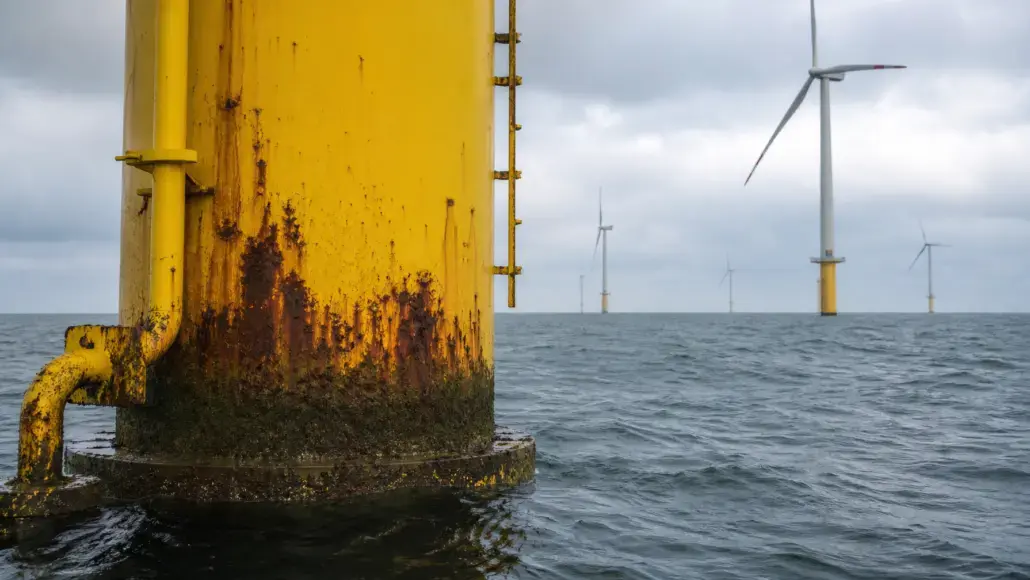
- Splash and tidal zone: Spanning the intertidal range and wave wash area, this zone represents the most corrosive marine environment due to continuous oxygen replenishment, alternating wetting and drying, wave impact, and mechanical abrasion from marine debris or ice.
- Submerged zone: Continuously immersed in seawater, steel in this zone suffers electrochemical corrosion driven by salinity, water temperature, flow velocity, and marine biofouling.
- Seabed and buried zone: Steel driven beneath the mudline experiences low oxygen availability but remains vulnerable to microbial induced corrosion caused by sulfate-reducing bacteria.
The splash zone presents the most acute engineering challenge. Liquid paint coatings in this region must endure severe mechanical impact from crew transfer vessel bumpers and floating debris while resisting chemical breakdown. A failure in the splash zone can result in localized pitting corrosion exceeding one millimeter of steel wall loss per year, directly compromising structural fatigue life.
Advanced Barrier Coatings and Thermal Spray Aluminum
Primary defense against atmospheric and splash zone corrosion relies on heavy-duty barrier coating systems. Modern offshore coating specifications utilize solvent-free multi-component epoxy formulations and glass-flake reinforced coatings applied in multiple coats with dry film thicknesses exceeding 1,000 to 1,500 micrometers. Automated robotic blasting systems achieve surface cleanliness standards of Sa 2.5 per ISO 8501-1, generating precise angular surface profiles between 75 and 100 micrometers to guarantee optimal mechanical adhesion.
To achieve maintenance-free longevity exceeding twenty-five years, developers increasingly specify thermal spray aluminum across transition pieces and critical splash zone elevations:
- Arc-sprayed metallic aluminum or aluminum-magnesium alloys applied directly to blast-cleaned steel substrates.
- Dense mechanical bonding providing exceptional resistance to impact, gouging, and under-film corrosion creep.
- Built-in galvanic protection that sacrifices aluminum locally to protect exposed steel if the coating suffers mechanical impact gouges.
- Application of low-viscosity silicone or epoxy sealers that penetrate metallic porosity, preventing moisture entrapment.
Thermal spray aluminum significantly reduces operational lifecycle costs compared to conventional multi-coat epoxy systems. While initial application requires tighter temperature and humidity controls during yard fabrication, the resulting metallic surface eliminates the need for expensive offshore coating repairs throughout the asset lifecycle.
Cathodic Protection: Sacrificial Anodes Versus Impressed Current
For submerged and buried foundation surfaces, barrier coatings must be supplemented with cathodic protection. Cathodic protection works by polarizing the steel structure to a negative electrical potential where iron oxidation cannot thermodynamically occur.
Asset owners choose between two established cathodic protection methodologies:
- Sacrificial Anode Cathodic Protection: Zinc-aluminum-indium alloy anodes welded directly to the monopile or jacket exterior. These anodes corrode preferentially to protect the surrounding steel without requiring external electrical power.
- Impressed Current Cathodic Protection: Non-consumable mixed metal oxide titanium anodes powered by direct-current rectifiers mounted inside the transition piece.
- Automated potential monitoring arrays: Reference electrodes embedded along the foundation that continuously measure protective potential levels to prevent over-protection or under-protection.
- Dynamic current regulation: Rectifier systems that adjust electrical current output in real time based on changing seawater temperature, salinity, and tidal velocity.
While sacrificial anodes have historically dominated due to their operational simplicity, impressed current cathodic protection has gained substantial market share on multi-megawatt foundations. Sacrificial anodes add tens of metric tons of deadweight to large monopiles, increasing steel fabrication expenses and transport logistics. Furthermore, environmental regulators in certain marine jurisdictions have raised concerns regarding heavy metal leaching from dissolving sacrificial alloys. Impressed current systems reduce total foundation mass by up to eighty percent while eliminating metal discharge into marine ecosystems.
Managing Internal Monopile Corrosion Risks
A critical vulnerability that emerged across early offshore wind farms was unanticipated internal corrosion inside unsealed monopiles. Early designs assumed that sealing internal compartments would rapidly deplete trapped oxygen, stopping corrosion naturally. However, seawater ingress through bottom vents or unsealed cable entry holes created anaerobic, stagnant water columns.
Stagnant internal environments foster rapid growth of sulfate-reducing bacteria, generating corrosive hydrogen sulfide gas that attacks unpainted steel and electrical power cables. To address this risk, modern engineering standards mandate active internal management:
- Installing dedicated internal impressed current cathodic protection systems or compact sacrificial anode racks inside flooded monopile cavities.
- Continuous monitoring of internal dissolved oxygen concentrations, pH levels, and hydrogen gas accumulation.
- Mechanical airtight sealing systems and dehumidification units in accessible dry compartments above the internal water line.
- Application of protective epoxy slurry coatings across internal steel floors where sediment and stagnant water collect.
Just as marine wind assets require specialized structural protection against ocean salinity, onshore installations subject to violent shear and complex terrain flow vectors require Wind Farm Layout Optimisation for Complex Terrain to prevent uneven structural fatigue across the turbine fleet.
Digital Health Monitoring and Life Extension Strategies
Corrosion protection has transitioned from static engineering design into active structural health monitoring. Asset managers install autonomous electrochemical sensor packages across submerged foundations, measuring steel polarization potentials, coating degradation rates, and electrical resistance. Remote crawler robots and small remotely operated vehicles equipped with ultrasonic thickness testing probes perform subsea wall measurements without requiring commercial dive teams.
These digital corrosion sensors transmit data through turbine supervisory networks, feeding real-time integrity metrics into asset management platforms. Maintenance teams can detect anode exhaustion or local coating delamination years before structural steel loss occurs. By coupling empirical corrosion data with fatigue models under standards such as DNV-ST-0126, operators can demonstrate structural integrity to certification authorities, facilitating five to ten-year operational life extensions that substantially improve asset returns.