

















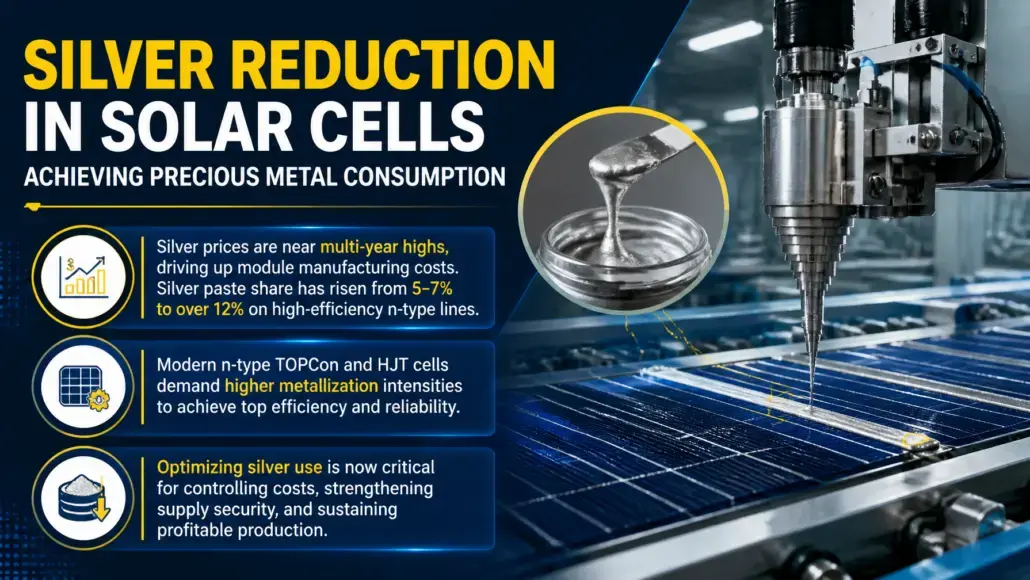
Industrial solar cell production lines face an escalating cost bottleneck as silver prices fluctuate near multi-year highs while cell architectures transition toward higher metallisation intensities. Silver paste historically represented five to seven percent of total module manufacturing expenditure, but that share climbed above twelve percent on high-efficiency n-type production lines. Because modern n-type tunnel oxide passivated contact and silicon heterojunction architectures require metallisation on both front and rear surfaces, controlling silver consumption has shifted from an operational efficiency objective to a core prerequisite for commercial viability.
Manufacturers produced more than six hundred gigawatts of photovoltaic modules globally in 2025, consuming roughly twenty percent of total global industrial silver supply according to data compiled by the International Energy Agency Photovoltaic Power Systems Programme. Without decisive interventions, the rapid market expansion of heterojunction and interdigitated back-contact technologies would outstrip global silver refining capacity. Consequently, tier-one manufacturers and research institutions are deploying new paste chemistries, narrower screen openings, and copper electroplating to achieve systemic solar cell metallisation silver reduction across commercial lines.
The Material Bottleneck in Advanced N-Type Architectures
The photovoltaic sector experienced a decisive technology transition away from p-type passivated emitter and rear cell designs toward n-type architectures. While n-type tunnel oxide passivated contact designs deliver commercial efficiencies exceeding twenty-five percent, their processing requires significantly higher silver laydown. A standard p-type cell utilized aluminium paste on the rear surface and silver exclusively on the front grid, consuming approximately ten to twelve milligrams of silver per watt. In contrast, early commercial n-type tunnel oxide passivated contact cells required sixteen to eighteen milligrams per watt to achieve adequate contact resistance.
Silicon heterojunction technology presented an even more severe material hurdle. Because heterojunction cells use temperature-sensitive amorphous silicon passivation layers, metallisation must occur using low-temperature silver pastes cured below two hundred degrees Celsius. These low-temperature pastes exhibit lower electrical conductivity than high-temperature fired pastes, forcing producers to deposit wider fingers and consume upwards of twenty milligrams per watt during initial production rollouts.
This metallurgical reality created an unsustainable cost curve. When industrial silver surpassed thirty-five dollars per troy ounce, paste costs threatened to erase the margin advantages gained through higher cell conversion efficiencies. Production directors responded by attacking the problem through two parallel pathways: optimizing existing screen printing equipment to deposit narrower lines, and engineering non-precious metal alternatives capable of direct integration into automated high-throughput lines.
Fine-Line Screen Printing and Ultra-Narrow Mesh Advancements
Screen printing remains the dominant deposition technique across the global solar manufacturing sector, accounting for over ninety-five percent of industrial output. Rather than replacing capital-intensive screen printers, equipment vendors and paste suppliers introduced ultra-fine mesh screens combined with advanced rheology pastes to reduce laydown volumes.
Screen manufacturers developed tungsten wire and ultra-high-tensile stainless steel meshes with wire diameters reduced to eleven micrometres. These meshes permit screen openings as narrow as thirteen to fifteen micrometres, down from standard thirty-micrometre openings common several years ago. Printing narrower metal fingers reduces shading losses on the cell surface while cutting the volume of conductive paste deposited per finger.
- Tungsten mesh screens enable finger widths below fifteen micrometres with high aspect ratios, maintaining conductivity while cutting silver mass.
- Knotless mesh patterning eliminates intersection bumps in printed lines, preventing local paste build-ups and paste wastage.
- High-solids silver pastes incorporate engineered organic binder systems that ensure clean screen release at continuous printing speeds above eighty wafers per minute.
- Laser-patterned polyimide stencils provide alternative deposition channels that deliver precise, flat-topped finger profiles with minimal edge bleed.
JinkoSolar Holding Co., Ltd. demonstrated the scale of this optimization across its manufacturing base in 2025. By implementing knotless mesh printing and refined paste formulations on its high-efficiency tunnel oxide passivated contact lines, JinkoSolar reduced silver consumption on commercial fifty-gigawatt production lines. This achievement proved that conventional screen printing could still deliver double-digit percentage reductions in precious metal consumption without sacrificing line throughput.
Silver-Coated Copper and Base Metal Substitution
While fine-line printing extends the life of traditional silver pastes, partial and full metal substitution represents the decisive long-term technical frontier. Silver-coated copper paste has emerged as the leading transitional material, particularly for low-temperature heterojunction cell manufacturing where paste curing temperatures prevent copper oxidation.
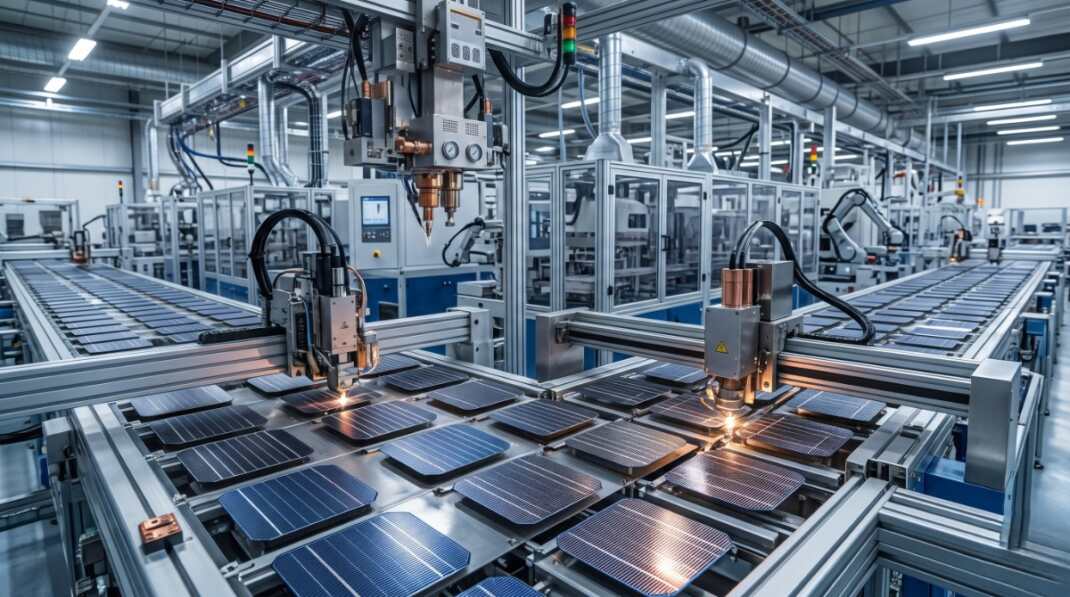
In these formulations, copper microparticles are encased in a continuous silver shell. The outer silver layer provides chemical passivation, prevents copper migration into the silicon bulk, and maintains low contact resistance. The copper core carries bulk electrical current at a fraction of raw material cost. Industrial formulations typically balance silver content at twenty to forty percent by weight, with copper constituting the remainder.
LONGi Green Energy Technology Co., Ltd. pursued an aggressive metallisation overhaul across its hybrid passivated back contact cell platforms. LONGi commercialized contact designs that restrict silver usage strictly to sensitive junction interfaces while utilizing aluminium and copper alloys for primary collection grids on the rear surface. By keeping electrical contacts on the shadowed rear side, LONGi achieved commercial back-contact cell efficiencies above twenty-six percent while driving precious metal intensity down toward five milligrams per watt.
Copper Electroplating in High-Volume Industrial Manufacturing
The ultimate technical objective for solar cell metallisation silver reduction is complete silver elimination through direct copper electroplating. Copper offers bulk electrical conductivity nearly equal to silver at roughly one percent of the metal price. Over the past two years, specialized equipment makers solved throughput and adhesion barriers by developing horizontal, high-speed chemical plating systems integrated with picosecond laser patterning.
Shanghai Aiko Solar Energy Co., Ltd., operating commercially as AIKO Solar, brought pure copper metallisation to commercial scale across its all-back-contact production facilities. AIKO eliminated silver entirely from its front-side and rear-side collection grids, relying instead on proprietary laser-patterned chemical electroplating. Operating multi-gigawatt lines with zero silver consumption insulated AIKO from precious metal market volatility while setting module conversion efficiency records above twenty-four percent on full-format commercial modules.
European machinery pioneer Meyer Burger Technology AG advanced copper electroplating technology through deployments focused on heterojunction applications. Meyer Burger integrated specialized copper-plated contact fingers with low-stress cell interconnection ribbons, demonstrating that plated copper contacts withstand thermal cycling between minus forty degrees Celsius and eighty-five degrees Celsius without micro-crack formation or contact peeling.
Fraunhofer Institute for Solar Energy Systems ISE published comprehensive reliability findings in 2025 documenting that properly encapsulated copper-plated heterojunction and passivated contact cells experience annual degradation rates below zero point thirty-five percent, matching conventional silver-paste baselines. These qualification benchmarks provided insurance underwriters and project financiers with the actuarial confidence required to approve non-silver modules for utility-scale debt financing.
Advanced metallisation techniques also play a crucial role when configuring modules for high-albedo installations, where engineers deploy bifacial solar modules optimizing rear-side energy yield to capture both direct sunlight and reflected ground radiation across high-performance project sites.
Industrial Scaling and Capital Expenditure Economics
The transition toward silver-lean and silver-free metallisation reshapes the capital expenditure landscape for cell producers. Upgrading screen printing lines with tungsten mesh screens requires minimal capital deployment, making it the immediate choice for existing multi-gigawatt facilities. Conversely, transitioning to full copper electroplating requires dedicated chemical wet benches, effluent treatment infrastructure, and laser patterning systems, representing an initial capital investment of approximately four to six million dollars per gigawatt of cell capacity.
PowerGen Advancement notes that as chemical recycling systems mature and laser patterning tools achieve wafer-per-hour parity with screen printers, copper electroplating will steadily expand across next-generation tandem and back-contact manufacturing hubs.
References
- International Energy Agency Photovoltaic Power Systems Programme
- Fraunhofer Institute for Solar Energy Systems ISE
- JinkoSolar Holding Co., Ltd.
- LONGi Green Energy Technology Co., Ltd.
- Meyer Burger Technology AG