



















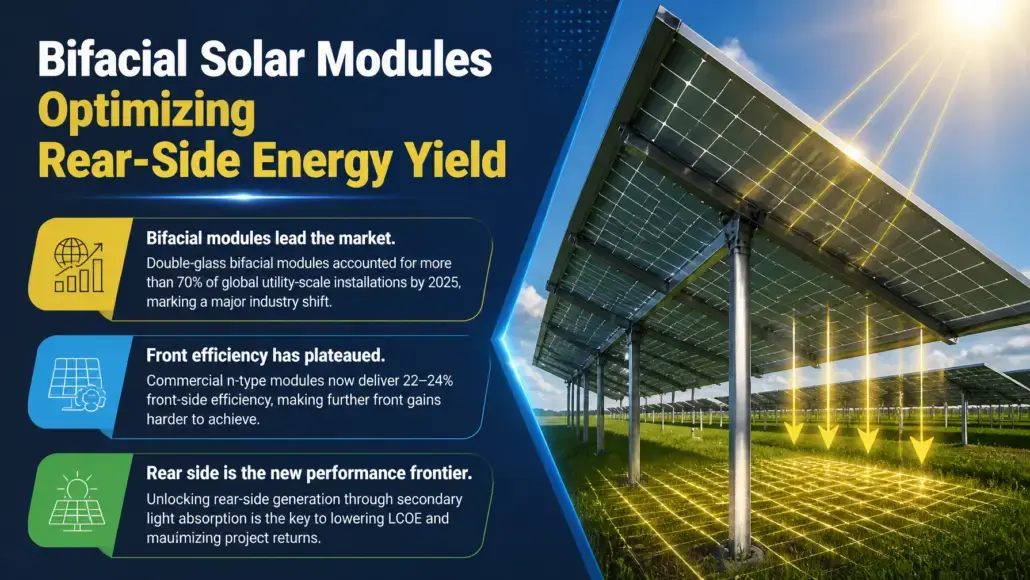
Utility-scale photovoltaic generation underwent a structural transformation as double-glass bifacial modules captured more than seventy percent of global utility installations by 2025. While front-side conversion efficiencies for commercial n-type modules stabilized between twenty-two and twenty-four percent, project developers recognized that the primary lever for lowering levelized cost of electricity lies on the module rear. Under ideal field conditions, secondary light absorption boosts total energy yield by five to twenty-five percent without requiring additional silicon acreage.
Capturing those gains is not as straightforward as replacing monofacial panels with glass-glass equivalents. Rear-side irradiance relies on diffuse sky radiation, inter-row ground reflections, and direct light bouncing off nearby infrastructure. Without rigorous balance-of-system engineering, self-shading from torque tubes, low surface reflectivity, and sub-optimal mounting elevations can extinguish expected production gains. PowerGen Advancement observes that maximizing bifacial solar module demands a holistic engineering methodology that integrates tracker geometry, albedo management, electrical architecture, and real-time backtracking algorithms.
Bifaciality Factor and Cell Architecture Dynamics
The baseline potential of any dual-sided installation depends on the cell bifaciality factor, defined as the ratio of rear-side conversion efficiency to front-side efficiency under standard test conditions. Historical p-type passivated emitter and rear cell modules achieved bifaciality ratings of only sixty-five to seventy percent due to rear aluminium grid patterns that obstructed light absorption.
Modern n-type architectures significantly elevated these physical limits:
- Tunnel oxide passivated contact cells achieve bifaciality ratings of eighty to eighty-five percent because their ultra-thin passivating contacts allow symmetrical light transmission.
- Silicon heterojunction cells deliver bifaciality factors between eighty-eight and ninety-five percent, as both front and rear surfaces share identical amorphous silicon layers and transparent conductive oxides.
- Interdigitated back-contact modules, while traditionally front-facing, now incorporate textured rear surfaces that achieve bifaciality ratings between seventy and eighty percent.
Canadian Solar Inc. accelerated commercial deployment of these high-bifaciality designs through its TOPBiHiKu series. Operating with n-type cells that feature up to eighty-five percent bifaciality rating, these modules deliver front power ratings exceeding seven hundred watts while capturing secondary generation across desert utility projects. Canadian Solar demonstrated that higher bifaciality narrows the performance spread between front-only production models and outdoor operating conditions, allowing financial models to bank on predictable rear gains.
Ground Clearance and Height Optimization Mechanics
Ground clearance represents the single most influential mechanical variable determining rear-side irradiance uniformity. When a module sits too close to the ground, reflected light concentrates in a narrow band directly beneath the panel edge, leaving the centre of the rear glass in deep shadow. This creates sharp current mismatches across internal cell strings.
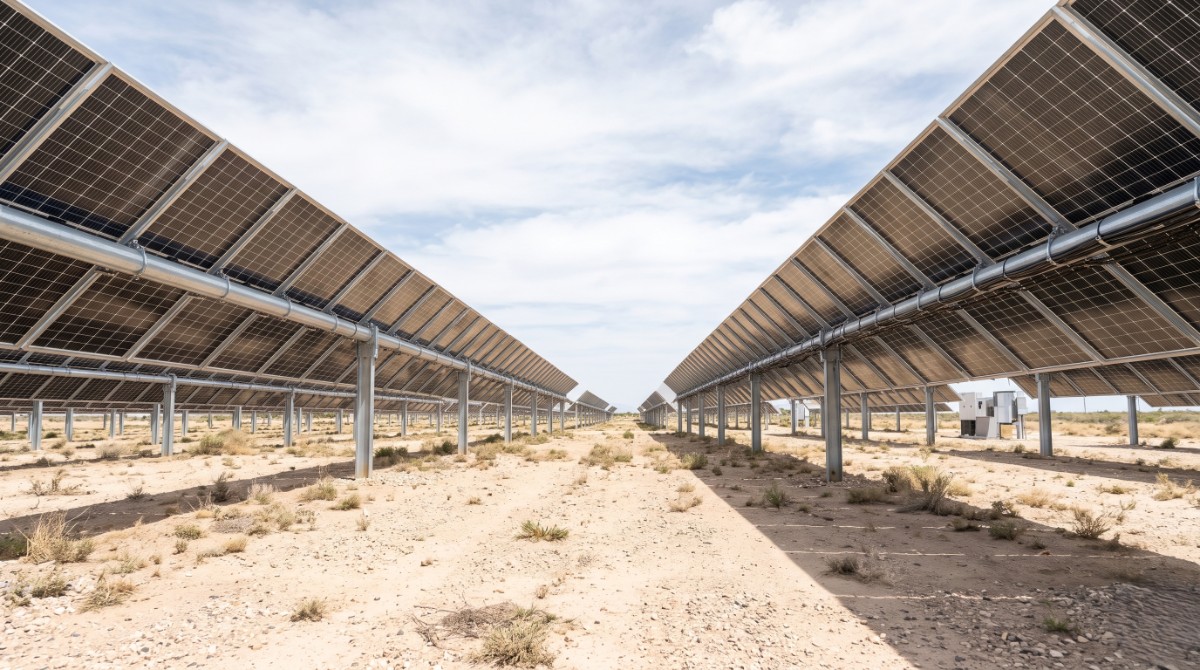
Elevating the torque tube increases the view factor, allowing reflected light from a wider ground area to reach the entire rear surface uniformly. Field tests conducted across utility installations indicate that raising minimum ground clearance from zero point five metres to one point five metres increases rear-side irradiance by up to twelve percent.
Elevating mounting structures introduces structural trade-offs that structural engineers must balance:
- Wind loading forces increase exponentially with height, demanding deeper pile foundations and heavier steel gauges.
- Maintenance crews require elevated reach equipment to perform inverter maintenance and mechanical inspections.
- Installation capital expenditure increases by three to five percent, requiring the projected bifacial gain to offset upfront steel and civil costs.
Surface Albedo Enhancement and Material Economics
Albedo describes the fraction of global horizontal irradiance reflected by the ground surface back toward the sky and the rear side of the array. Natural ground covers exhibit starkly different reflectivity values that dictate rear generation potential:
- Green grass and agricultural vegetation typically reflect between fifteen and twenty percent of incident sunlight.
- Dry desert sand and bare soil provide albedo values between twenty and thirty percent.
- Light-coloured crushed limestone and white gravel elevate reflectivity to forty and forty-five percent.
- Compacted white geotextile membranes and specialized ground coatings can achieve albedo ratings exceeding sixty-five to seventy-five percent.
However, albedo enhancement requires ongoing operational evaluation. Dust accumulation, weed intrusion, and material degradation can reduce membrane reflectivity by twenty percent within six months if not maintained. Asset managers must compare the cost of regular vegetation control and membrane cleaning against the spot value of generated kilowatt-hours.
Balance of System Engineering and Torque Tube Shading
Even with high ground reflectivity and adequate elevation, structural racking elements can obstruct rear-side irradiance if not designed specifically for bifacial operation. Conventional single-axis tracker torque tubes positioned directly behind the centre of the module cast a continuous shadow across the rear glass, inducing persistent localized mismatch and triggering internal bypass diodes.
Electrical balance of system design must also adapt to rear current additions:
- String inverters and central inverter DC inputs must accommodate peak current surges that occur during high-albedo winter snow conditions.
- DC over-framing ratios must be recalibrated downward from typical one point four ratios to one point two ratios to prevent excessive inverter clipping.
- Direct-current cables, combiner boxes, and fuses must be routed along tracker purlins to avoid hanging beneath the modules where they cast linear shadows on rear cells.
Intelligent Backtracking and Spatial Optimization
Standard single-axis tracker algorithms historically rotated arrays to maximize direct beam irradiance on the front glass while executing backtracking at sunrise and sunset to prevent row-to-row shading. While this approach maximizes front-side production, it frequently sub-optimizes total system output on overcast days or during early morning hours when diffuse rear-side light dominates.
Optimizing ground cover ratio represents another crucial spatial consideration. Wider row spacing expands the unshaded ground area between tracker rows, allowing more direct sunlight to strike the ground and reflect back into the rear surfaces of adjacent rows. While widening row spacing reduces land utilization efficiency, it significantly increases bifacial gain per installed watt, creating an optimization problem that balances land lease costs against incremental energy capture.
Utility asset owners capitalizing on these rear-side gains are increasingly evaluating repowering ageing solar farms as an effective strategy to elevate generation on existing grid interconnections without expanding substation footprints.
Financial Modeling and Actuarial Certainty
Historically, utility solar debt providers discounted rear-side bifacial generation by up to fifty percent in bankability models due to uncertainty surrounding long-term albedo variability and rear soiling rates. Over the past twenty-four months, standardized testing under International Electrotechnical Commission standard 60904-1-2 established rigorous outdoor measurement protocols that eliminate underwriting ambiguity.
Independent engineering firms now provide high-confidence P50 and P90 yield estimates incorporating satellite-derived albedo datasets and validated view-factor ray-tracing models. Demonstrating verified bifacial performance lowers debt risk premiums, allowing developers to secure higher leverage and lower interest rates. PowerGen Advancement notes that as utility operators accumulate multi-year operational datasets confirming sustained rear-side production, bifacial systems have cemented their position as the benchmark architecture for global solar generation.
References
- International Energy Agency Photovoltaic Power Systems Programme
- Canadian Solar Inc.