




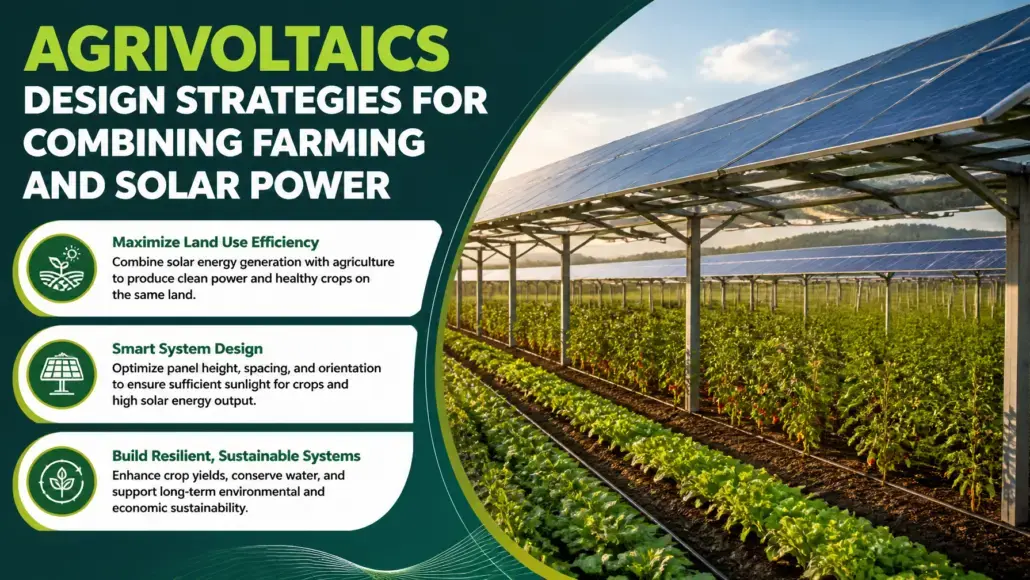
Competition between ground-mounted photovoltaic expansion and agricultural land conservation emerged as a central political and regulatory hurdle across major energy markets. As regional governments enact stricter zoning bans against converting fertile farmland into standard utility solar compounds, developers face diminishing access to flat, grid-connected acreage. This regulatory tension accelerated the commercial maturation of dual-use solar engineering, transforming farmland from a contentious battleground into a cooperative asset class.
Global operational agrivoltaics capacity surpassed fifteen gigawatts in 2025, according to operational project tracking by the International Energy Agency Photovoltaic Power Systems Programme. Successfully co-locating energy generation with commercial crop cultivation or livestock grazing requires abandoning conventional low-clearance racking conventions. Modern agrivoltaics farming and solar power installations rely on specialized spatial layouts, dynamic tracking algorithms, and microclimatic engineering designed to protect agricultural yields while delivering utility-grade electricity generation.
Agricultural Microclimate Engineering and Radiation Balancing
The fundamental design principle of agricultural photovoltaics is managing the light saturation point of specific crops. Plants do not absorb all sunlight falling on their leaves. Beyond a certain threshold of photosynthetically active radiation, excess solar energy induces heat stress, increases evapotranspiration, and causes photo-inhibition. By selectively filtering direct sunlight, overhead photovoltaic arrays create a protective microclimate that shields delicate crops from extreme thermal spikes.
Microclimate sensors deployed beneath agrivoltaic arrays document measurable agronomic benefits:
- Soil moisture retention increases by twenty to thirty percent during summer heatwaves, reducing irrigation water requirements.
- Ambient ground temperatures remain up to five degrees Celsius cooler during peak midday hours and two degrees warmer during nocturnal radiative frost events.
- Hail, torrential rain, and late spring frost damage are significantly mitigated by the physical canopy provided by overhead module rows.
- Wind speeds at the canopy level drop by up to forty percent, reducing physical wind stress and soil erosion.
Fraunhofer Institute for Solar Energy Systems ISE published comprehensive multi-year trial results in 2025 documenting that berry crops, apples, and leafy vegetables grown beneath elevated solar canopies produced yields equal to or higher than unprotected control plots during drought conditions. These agronomic findings provide project developers with the empirical data needed to negotiate cooperative land-sharing agreements with agricultural cooperatives and regional farming associations.
Structural Configurations and Overhead Clearance Mechanics
Engineering structural racking for agrivoltaic assets introduces substantial mechanical complexity. While conventional utility solar racking maintains a leading panel edge just zero point five metres above grade, agricultural operations require vertical clearances that accommodate standard tractors, harvesters, and spraying equipment.
System designers deploy two primary structural configurations depending on the targeted agricultural activity:
- Elevated overhead canopies feature clearance heights between three point five and five metres, supported by driven steel piles or concrete foundations that span wide crop rows.
- Vertical bifacial solar fences utilize dual-glass modules mounted vertically in an east-west orientation with row spacing between eight and fourteen metres, leaving wide lanes for standard agricultural tillage and grazing.
BayWa r.e. AG demonstrated the commercial scalability of elevated overhead structures across several European agri-PV fruit farms in 2025. BayWa r.e. constructed high-clearance overhead arrays spanning active raspberry and apple orchards in the Netherlands and Germany. By utilizing semi-transparent bifacial glass modules integrated into single-axis tracking tables elevated four point five metres above ground, BayWa r.e. eliminated the need for plastic protective tunnels while generating clean solar power that feeds directly into local rural distribution grids.
Dynamic Agricultural Tracking and Light Management Algorithms
Standard utility-scale tracking algorithms seek only to maximize electrical generation by pointing modules directly at the sun throughout the diurnal cycle. In an agrivoltaic facility, this rigid approach can starve underlying crops of essential photosynthetically active radiation during critical growth phases or induce excessive shading during damp mornings.
Modern agrivoltaic installations utilize intelligent, sensor-driven dynamic tracking algorithms that balance energy output against crop requirements:
- Sun-sharing mode tilts modules away from the direct sun angle during morning and late afternoon hours, allowing direct sunlight to reach underlying vegetation when photosynthesis efficiency is highest.
- Anti-hail and storm positioning commands modules into a steep ninety-degree angle or horizontal defensive canopy when radar weather networks detect incoming hail or severe gusts.
- Rain collection modes tilt modules symmetrically toward central drainage troughs, channeling rainwater into storage reservoirs or drip irrigation networks rather than creating localized soil erosion beneath drip lines.
- Tillage and harvest clearance mode rotates panels vertically or to maximum tilt when heavy machinery enters the rows, providing maximum lateral clearance for tractor cabs and booms.
Vertical Bifacial Arrays for Mechanized Field Crops
While elevated canopies excel above high-value horticultural and fruit crops, they remain cost-prohibitive for broadacre field crops such as wheat, barley, soy, and forage grass. For mechanized arable farming, vertical bifacial solar fences represent the most cost-effective engineering approach.
Vertical arrays mount double-glass modules perpendicular to the ground, oriented north-to-south so their bifacial faces capture direct sun from the east in the morning and from the west in the afternoon. This orientation produces a distinctive generation profile with twin production peaks matching morning and evening electricity demand curves, capturing higher wholesale electricity spot prices than south-facing assets that peak during midday price troughs.
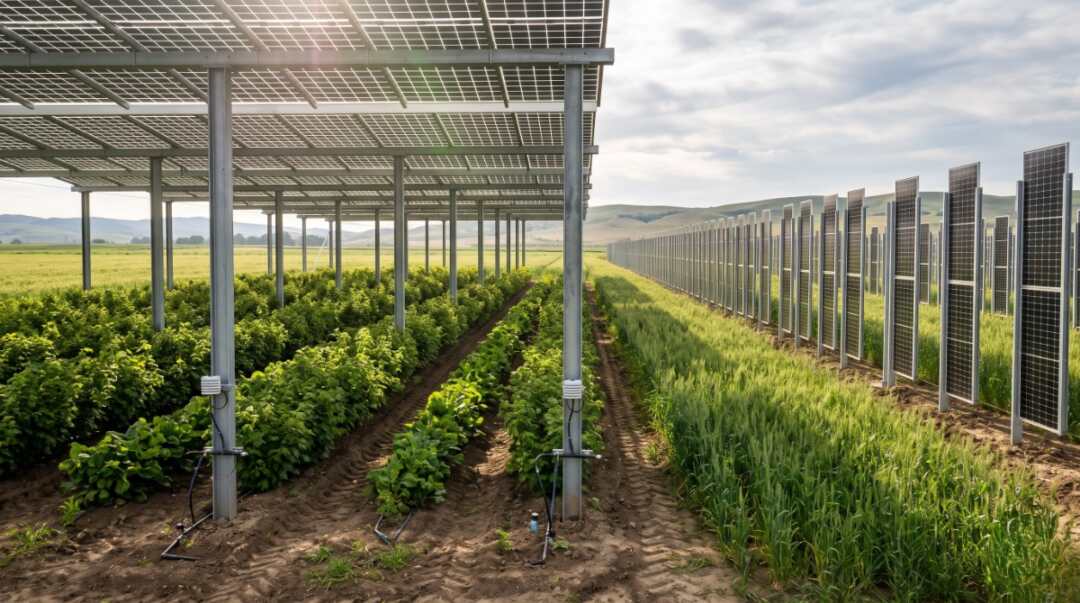
RWE AG expanded its vertical bifacial agrivoltaic portfolio in 2025, commissioning multi-megawatt demonstration facilities in western Germany. RWE configured vertical solar rows with twelve-metre inter-row spacing, permitting fifty-foot combine harvesters and seeders to operate normally across ninety percent of the agricultural field area. RWE demonstrated that vertical fences occupy less than ten percent of physical arable land while providing effective windbreaks that reduce soil moisture loss and prevent crop lodging during high-wind storms.
EDF Renewables deployed similar vertical bifacial configurations across southern European pastoral lands. EDF Renewables validated that vertical fences integrate seamlessly with sheep and cattle grazing, with vertical modules resisting animal rubbing while providing livestock with shaded shelter during extreme summer heatwaves.
Legal Frameworks, Grid Interconnections and Rural Acceptance
Navigating the regulatory landscape represents the decisive gating item for agrivoltaic project execution. Many national subsidy programs and land tax codes historically penalized landowners if agricultural plots generated electricity, revoking farm tax status or reclassifying properties as industrial zones.
Iberdrola S.A. led industry efforts to align agricultural development with regulatory standards across projects in Spain and Portugal. Working in partnership with regional agricultural ministries, Iberdrola established formalized dual-use agreements that guarantee local farming families retain primary land use rights and agricultural subsidies while receiving long-term lease royalties from energy generation. Iberdrola showed that engaging farmers as equity co-developers rather than displaced tenants speeds up permitting approvals and eliminates community opposition.
Dual-use spatial innovation is not restricted to rural acreage, as commercial developers increasingly apply similar multifunctional principles by incorporating Building-Integrated Photovoltaics for Commercial Developments directly into urban building skins.
Financial Modeling and Dual-Revenue Asset Optimization
Underwriting an agrivoltaic asset requires financial modeling that captures both electricity generation revenue and agricultural commercial output. Traditional project finance lenders evaluate solar facilities based on debt service coverage ratios derived exclusively from power purchase agreements. In an agrivoltaic asset, debt sizing must account for the operational continuity of the agricultural partner.
Institutional infrastructure funds now employ dual-revenue optimization frameworks:
- Power purchase agreements with industrial corporate off-takers provide baseline revenue that covers capital expenditure amortization and debt service obligations.
- Agricultural crop yields, protected from catastrophic climate events, provide steady secondary cash flows that insulate land-holding entities from commodity swings.
- Ecosystem service credits, including biodiversity enhancement and water conservation payments, offer emerging tertiary revenue streams in progressive regulatory jurisdictions.
PowerGen Advancement observes that by proving that agriculture and clean energy generation reinforce rather than exclude one another, agrivoltaic engineering provides the institutional blueprint for expanding solar capacity across densely populated continents.
References
- International Energy Agency
- Fraunhofer Institute for Solar Energy Systems ISE
- BayWa r.e. AG
- TotalEnergies SE
- RWE AG