




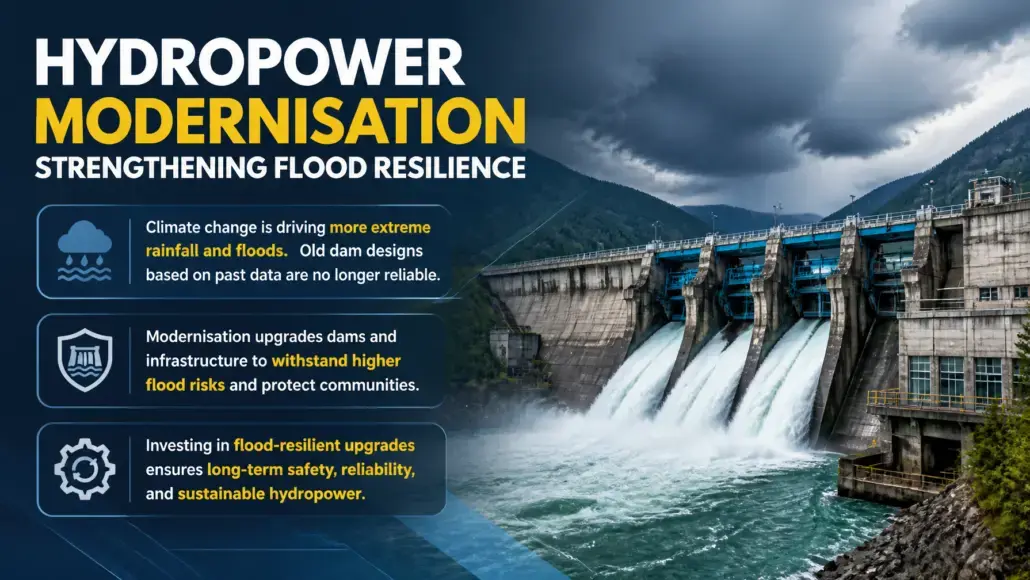
The global hydroelectric sector is facing an unprecedented challenge as climate change alters water patterns and increases the frequency of extreme weather events. Traditional dam designs were based on historical hydrological data that no longer accurately reflect the risks of the present day. As a result, hydropower plant modernisation strategies are now focusing heavily on flood resilience and structural safety. For aging facilities, these upgrades are not just about improving efficiency but about ensuring the very survival of the infrastructure and the safety of downstream communities.
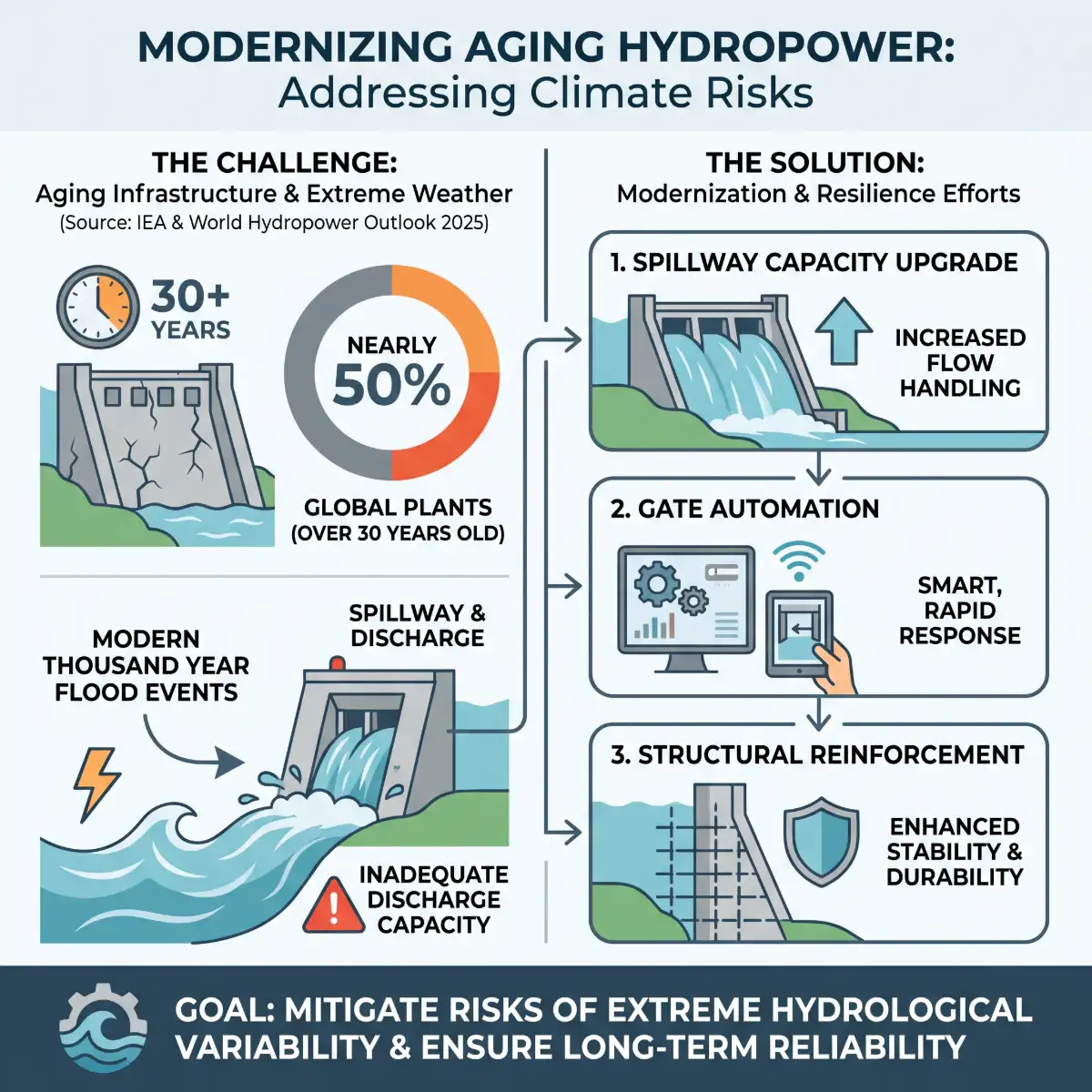
Recent data from the International Energy Agency (IEA) and the World Hydropower Outlook 2025 highlights that nearly half of the world’s hydropower plants are over 30 years old. These facilities often lack the discharge capacity needed to handle the massive inflows seen during modern thousand year flood events. Modernisation efforts are therefore targeting spillway capacity, gate automation, and structural reinforcement to mitigate the risks associated with extreme hydrological variability.
Engineering Approaches to Flood Resilience
One of the primary goals of hydropower plant modernisation strategies is the expansion of spillway capacity. A spillway is the safety valve of a dam, designed to release excess water safely during high flow periods. In many older plants, the original spillways are now undersized for current climate projections. Engineers are addressing this by constructing new auxiliary spillways or modifying existing ones to handle higher volumes. This work often involves complex civil engineering, including the use of advanced concrete composites and the installation of more robust radial or sluice gates.
In some vulnerable locations, developers are also considering modular hydropower systems for remote electricity generation as a way to diversify their energy portfolio and reduce the impact of a single point of failure during extreme weather. By distributing generation across multiple smaller, modular units, a utility can maintain some level of service even if a main plant is forced to shut down due to high water levels. This decentralized approach is an effective complement to large scale structural upgrades.
Digitalization is another key pillar of flood resilience. Modern plants are being equipped with real time monitoring systems that track upstream rainfall, soil moisture, and river levels. By integrating this data into advanced hydrological models, operators can predict flood peaks with much greater accuracy. This allows for proactive reservoir management, such as pre releasing water to create more storage space before a storm arrives. The ability to make data driven decisions in real time is a critical factor in preventing dam overtopping.
Major Company Initiatives and Financing
Large global energy companies are leading the way in implementing climate adaptation strategies:
- EDF: In 2025, the EDF signed a €500 million financing contract with the European Investment Bank (EIB) to modernize its electricity grid and hydropower infrastructure. The funding directly supports initiatives to safeguard France’s long-term security of supply while making the network substantially more resilient against extreme weather events.
- Vattenfall: Outlining a comprehensive 20-year roadmap in its 2025 Sustainability Report, Vattenfall is overhauling its entire domestic hydropower fleet to meet modern safety and environmental benchmarks. By reinforcing dams against heightened water pressures and expanding spillway capacities for peak flows, the company is fortifying a hydro network it considers vital to Sweden’s energy system and national security.
- Enel Green Power: Operating a massive global hydro portfolio, Enel Green Power is modernizing plant control systems and integrating satellite data with AI-driven models across Europe and South America. These digital tools enhance predictive flood management, allowing operators to dynamically optimize power generation while maintaining dam safety during severe hydrological stress to preserve long-term profitability in a shifting climate.
Economic and Regulatory Implications
The cost of hydropower plant modernisation strategies is significant, but the cost of failure is far higher. A single dam failure can lead to billions of dollars in property damage, loss of life, and environmental destruction that can take decades to recover. Insurance companies and financial institutions are increasingly requiring proof of flood resilience before providing coverage or capital for hydro projects. This is creating a strong financial incentive for operators to prioritize modernisation.
Regulatory bodies are also updating their safety standards to reflect the new realities of climate change. In many jurisdictions, dams are now required to pass a Probable Maximum Flood (PMF) test that is significantly more rigorous than previous standards. Modernisation projects must meet these new criteria to maintain their operating licenses. This regulatory pressure is driving a wave of investment in the sector, as operators rush to bring their facilities up to code.
Future Perspectives on Climate Adaptation
The need for hydropower plant modernisation strategies will only grow as the impacts of climate change become more pronounced. We can expect to see further innovations in materials and construction techniques, such as the use of carbon fiber for structural reinforcement and the development of more efficient, automated gate systems. PowerGen Advancement believes that the integration of climate science into engineering design will become a standard practice for all hydropower projects.
The transition to a climate resilient energy system is a massive undertaking, and hydropower is a central part of that transition. By modernizing our hydroelectric fleet to handle extreme flood risk, we are not just protecting a source of clean energy. We are protecting the water systems that support agriculture, industry, and life itself. The investments we make today in hydropower resilience will pay dividends for generations to come, ensuring a safer and more sustainable future for all.
References
- “Renewables 2025” – International Energy Agency
- “Renewable Capacity Statistics 2025” – International Renewable Energy Agency
- “EDF and the EIB announce signature of 500 million Euro financing contract” – European Investment Bank
- “Vattenfall Annual and Sustainability Report 2025” – Vattenfall
- “2025 World Hydropower Outlook” – International Hydropower Association