





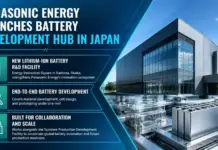











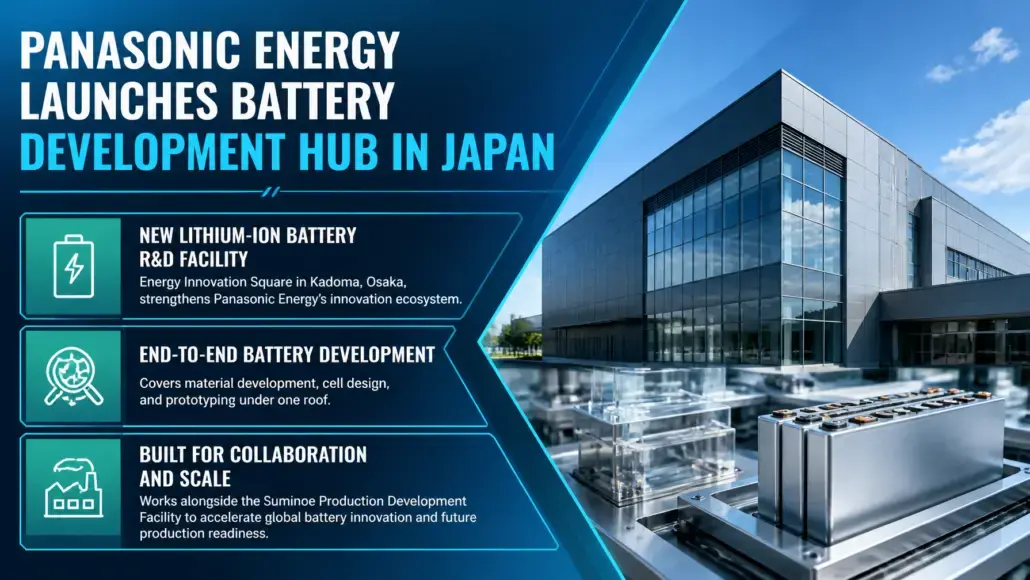
Panasonic Energy Co., Ltd., a Panasonic Group Company, has launched the Energy Innovation Square, a new lithium-ion battery research and development facility in Kadoma, Osaka. The new battery development hub will function as a global center for Panasonic Energy’s battery development and production activities, covering material development, cell design and prototyping. Working alongside the Suminoe Production Development Facility in Osaka City, Energy Innovation Square is expected to support faster development and mass production of next-generation batteries for automotive and data center applications.
Technologies and manufacturing processes developed through the collaboration between the two facilities will be introduced across Panasonic Energy’s global manufacturing network. This includes its production facilities in Japan as well as Nevada and Kansas in the United States. The approach is intended to strengthen production competitiveness while enabling Panasonic Energy to better respond to customers worldwide.
Energy Innovation Square will bring together approximately 500 employees involved in cell product planning, technology development and analysis. Combined with the Suminoe Production Development Facility, which specializes in manufacturing technology development, the two locations will create one of Japan’s largest dedicated battery development operations, with a combined workforce of approximately 800 people. Through closer coordination between the facilities, Panasonic Energy aims to double development efficiency by FY2031 (fiscal year ending March 2031), compared with FY2024, allowing it to accelerate product development and respond more flexibly to increasing demand and increasingly diverse customer needs.
Digital Technologies to Accelerate Battery Development
The new battery development hub brings together development and prototyping activities that were previously spread across multiple locations. Panasonic Energy expects this consolidation to improve operational efficiency, optimize workforce requirements and reduce development lead times involving transportation by more than 15%. Energy Innovation Square is also equipped with an enhanced digital transformation platform designed to support the accumulation and integration of simulation and physical-test data. Through continuous process monitoring and statistical analysis, Panasonic Energy plans to improve simulation accuracy and design maturity, reducing the time needed to move new products into mass production.
The Japanese government has described batteries as the “heart of industry,” highlighting their importance to energy and economic security. As electrification expands, demand for more advanced battery solutions is increasing, with EVs requiring higher energy density and greater durability. At the same time, the expansion of AI data centers is creating demand for higher-output batteries. Emerging applications, including drones, robotaxis and humanoid robots, are also expected to broaden the use of battery technologies.
Against this backdrop, Panasonic Energy is strengthening its development capabilities to address changing requirements with speed, flexibility and technological expertise. The battery development hub is intended to enhance these capabilities while supporting closer collaboration between development and mass production.
Panasonic Energy Targets Higher Development Efficiency
Energy Innovation Square will serve as a core hub for Panasonic Energy’s battery development, strengthening collaboration from next-generation product development through mass production and enhancing our global competitiveness. As battery markets and applications evolve, we will continue to respond swiftly and flexibly to customer needs, drawing on our technological expertise and experience. Through innovative battery technologies, we remain committed to contributing to a more sustainable society,” said Kazuo Tadanobu, CEO of Panasonic Energy.