

















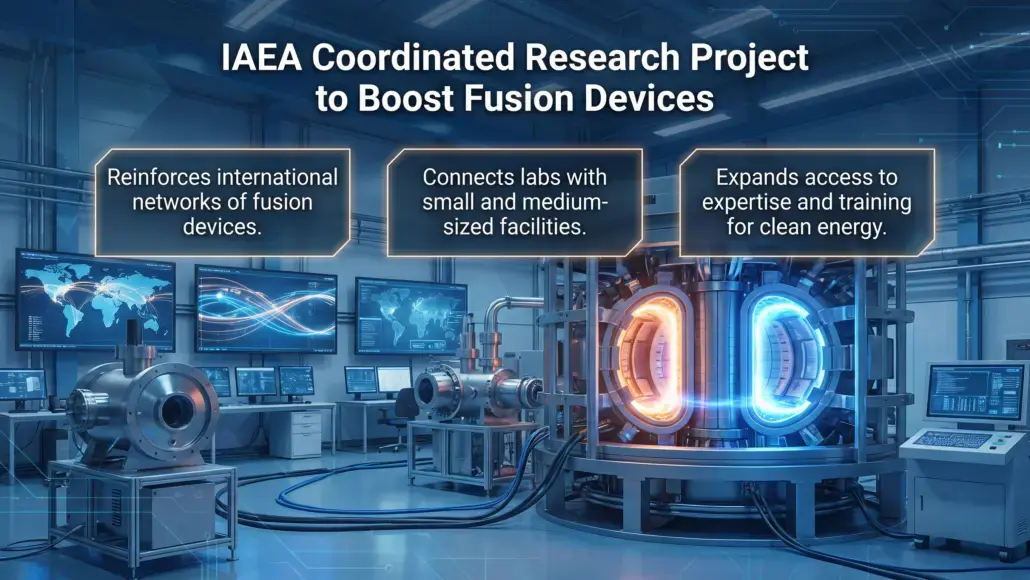
The International Atomic Energy Agency (IAEA) has introduced a new Coordinated Research Project designed to reinforce international fusion device networks, continuing earlier efforts to connect laboratories operating small and medium sized fusion facilities. The initiative comes at a time when an increasing number of countries are exploring fusion as a future source of clean and reliable energy, making access to experimental facilities, specialist expertise and training more significant for the development of national fusion programmes. Through the new Coordinated Research Project, the IAEA aims to further support collaboration among research institutions worldwide.
According to the IAEA, its coordinated research projects bring together facilities and specialists from different regions, encourage knowledge sharing and strengthen technical capabilities across Member States. The agency noted that small and medium sized fusion devices remain central to these efforts because they provide accessible and flexible environments for experimentation, innovation and training. The latest Coordinated Research Project follows the completion of the five year initiative titled ‘Network of Small and Medium Sized Magnetic Confinement Fusion Devices for Fusion Research’, which concluded in 2026. That programme involved 24 institutions from 18 countries through 17 research contracts, six research agreements and one technical contract.
The resulting network connected 14 laboratories operating tokamaks, stellarators, plasma focus devices and linear plasma devices across Bulgaria, Canada, China, Costa Rica, Czech Republic, Iran, Lebanon, Malaysia, Mexico, Pakistan, Portugal, Russian Federation, Singapore, Slovenia, Spain, Thailand, Ukraine and the United Kingdom.
Research Achievements and International Collaboration
Commenting on the programme, Tzanka Kokalova Wheldon, Director of the IAEA Physical and Chemical Sciences Division, said the agency’s coordinated research projects provide a unique platform to bring together facilities and expertise from across the world. She said this enables experiments and knowledge exchange that would not otherwise be possible and strengthens the ability of Member States to take part in future fusion programmes.
The project covered research in several areas that are important for fusion energy development, including plasma turbulence, magnetohydrodynamic activity, plasma heating, edge physics and plasma wall interactions. Many of these investigations were relevant to the International Thermonuclear Experimental Reactor and future fusion reactors. Among the major activities was a coordinated experimental campaign at the TJ II stellarator in Spain, where researchers from multiple countries collaborated on plasma transport, turbulence, electric fields and diagnostics techniques.
Danas Ridikas, Head of the IAEA Physics Section, said access to facilities such as TJ II through international collaboration allows researchers from smaller programmes to contribute to high impact experiments. He said such cooperation is essential to support global fusion science.
Beyond experimental work, the Coordinated Research Project also advanced diagnostics and modelling through the development and testing of soft X ray tomography systems, microwave diagnostics and machine learning approaches for plasma analysis, while computational models improved understanding of plasma behaviour and enabled real time data analysis.
The project additionally examined plasma facing materials through coordinated experiments involving liquid lithium and tin components, tungsten performance and material resilience under extreme heat loads. The IAEA identified capacity building and workforce development as one of the programme’s key outcomes, supported by international schools, workshops, student exchanges and hands on experimental campaigns that provided younger researchers with practical experience in plasma physics and diagnostics.
Participating institutions also organised summer schools on plasma surface interactions, regional workshops and university level programmes, using the project framework to connect education with active research. The agency said the work demonstrated the importance of maintaining experimental diversity within the fusion community, highlighting that while large flagship facilities remain essential, smaller and medium sized devices continue to offer accessible platforms for rapid testing, innovation, proof of concept experiments and training, complementing major projects such as ITER.