













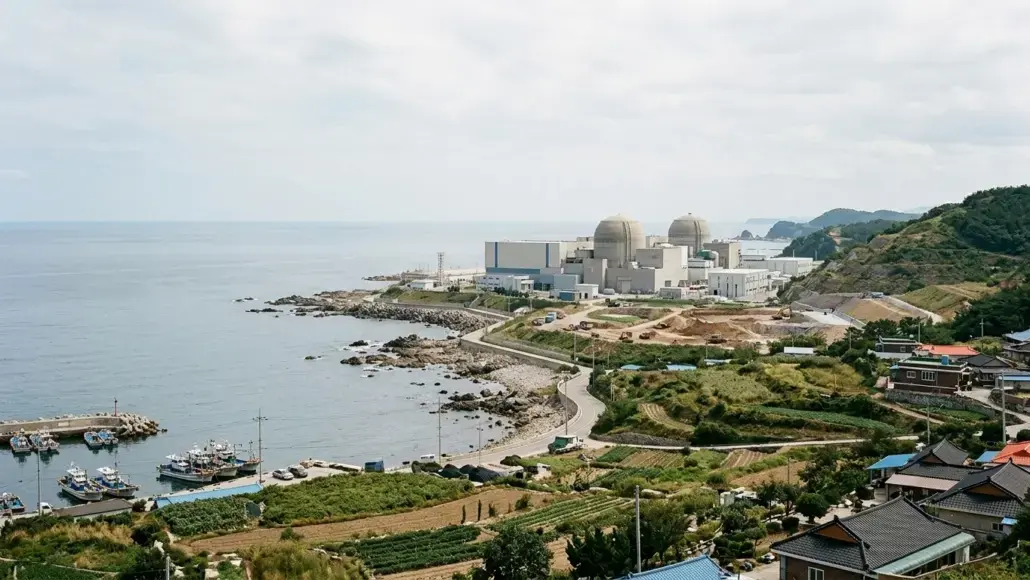
South Korea has taken a significant step toward expanding its nuclear energy capacity, with state-owned Korea Hydro & Nuclear Power (KHNP) identifying Yeongdeok County in the eastern part of the country as the preferred location for two new nuclear reactors. The selection forms part of a broader national strategy aimed at increasing nuclear generation capacity over the coming years. KHNP also indicated that Gijang County in the southeast has been chosen as the candidate site for South Korea’s first small modular reactor (SMR) facility.
The two new nuclear reactors planned for Yeongdeok County will each have a capacity of 1,400 MW and are expected to be completed in 2037 and 2038. These units are anticipated to employ South Korea’s domestically developed Generation III+ APR1400 pressurised water reactor (PWR) technology. The APR1400 was created by KHNP and Korea Electric Power Corporation (Kepco). KHNP operates as a wholly-owned subsidiary of Kepco and is responsible for owning and operating South Korea’s commercial nuclear power facilities.
Alongside the large-scale reactor project, KHNP is moving ahead with plans for the i-SMR plant in Gijang County, which is targeted for completion in 2035. The i-SMR is South Korea’s proprietary next-generation SMR nuclear plant and was developed by a consortium of South Korean organisations led by KHNP and the Korea Atomic Energy Research Institute. Known as the Innovative Small Modular Reactor, the design is based on PWR technology and delivers an electrical output of 170 MW. Reports in South Korea stated that the Gijang SMR facility is expected to have a total capacity of about 700 MW, suggesting the deployment of four units with a combined capacity of 680 MW.
The designation of these locations for the two new nuclear reactors marks the first occasion since 2011 that South Korea has selected new sites for nuclear power plants. According to KHNP, the chosen locations were identified following assessments covering suitability, environmental impact, construction feasibility and public acceptance. The company intends to launch licensing procedures, including an environmental impact assessment in early 2027.