










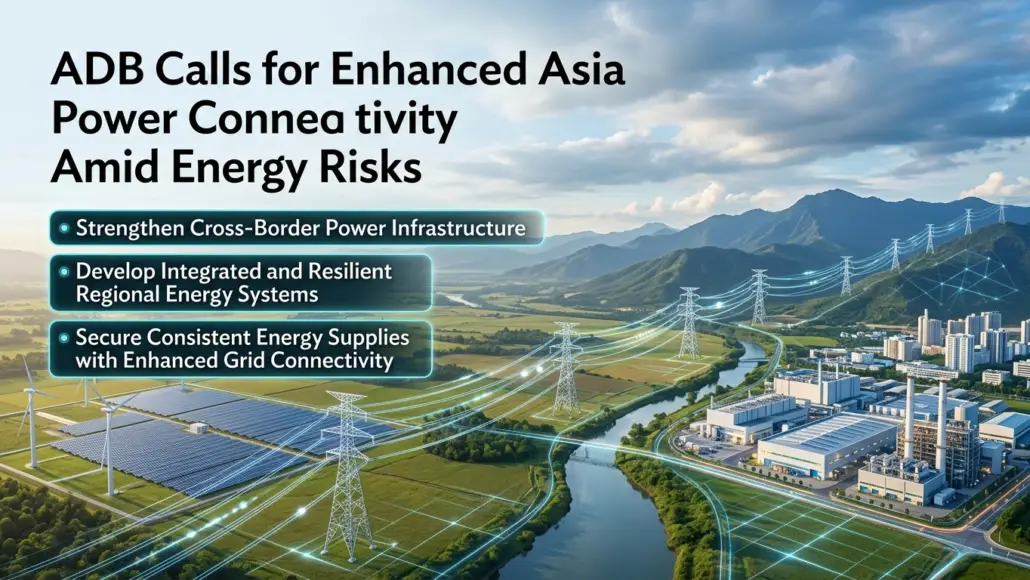
The Asian Development Bank (ADB) has urged countries across the Asia-Pacific region to accelerate efforts toward regional power connectivity, warning that growing geopolitical instability, surging electricity consumption, and increasing energy security concerns could undermine economic development and affect living standards if action is delayed.
Addressing delegates at the opening session of the Asia Clean Energy Forum (ACEF) 2026 on 9th June 2026, ADB president Masato Kanda highlighted the limitations of isolated national energy systems in responding to today’s rapidly evolving global challenges. He pointed to heightened geopolitical uncertainty, including the continuing conflict in the Middle East, as a reminder of the need for stronger regional cooperation in energy infrastructure.
“We must build a power system that connects our economies, strengthens our resilience, and delivers energy across the region. Delay will mean higher prices, weaker growth, and lost opportunities for millions of people,” he said.
Electricity consumption across Asia and the Pacific is expected to almost double by 2030, driven by economic expansion, urbanization, broader electrification, and the growing presence of energy-intensive artificial intelligence (AI) data centers. Despite this rising demand, more than 350 million people across the region continue to experience limited access to electricity, while over 53 million people remain entirely without power.
To address these challenges, ADB is promoting the Pan-Asia Power Grid Initiative (PAGI), a program designed to link national and regional electricity networks and enable multilateral cross-border power trading. The initiative places regional power connectivity at the heart of the region’s long-term energy transition plans.
Kanda said, “PAGI is our answer to a fragmented world. It shifts Asia and the Pacific away from small-scale, bilateral projects and moves us toward coordinated, region-wide multilateral power trade. An interconnected regional system acts as a collective shield. It allows surplus clean energy generated in one country to seamlessly balance the deficit in another.”
The initiative was formally launched during the 59th ADB annual meeting held in Samarkand, Uzbekistan, in May 2026. Through PAGI, ADB aims to mobilize $50 billion by 2035 to support cross-border transmission projects and enhance regional energy security. Of this amount, the bank expects to contribute approximately $25 billion from its own resources.
Under the proposed framework, PAGI targets the construction of 22,000 circuit-kilometers (ckm) of cross-border transmission infrastructure. The initiative also seeks to integrate 20 gigawatts (GW) of renewable energy into a shared regional network, cut power-sector emissions by 15 percent, and generate around 840,000 jobs.
According to Kanda, projects such as the ASEAN Power Grid, South Asian interconnection initiatives, and the Caspian Green Energy Corridor illustrate the benefits of regional power connectivity, particularly in strengthening energy resilience, addressing supply disruptions, and expanding access to dependable and affordable electricity.
ADB is additionally preparing a $10-million technical assistance (TA) grant to facilitate the initial phase of PAGI. The funding will support project development, policy alignment, and the establishment of institutional mechanisms required to advance cross-border electricity trade. Kanda emphasized that government funding alone will not be sufficient to meet the scale of investment required.
To attract additional capital, ADB intends to raise annual private-sector financing commitments to $13 billion by 2030 while increasing the use of blended finance mechanisms, first-loss capital structures, and guarantee instruments. In 2025, the bank mobilized approximately $3.4 billion for energy-related projects and investments throughout the Asia-Pacific region.