














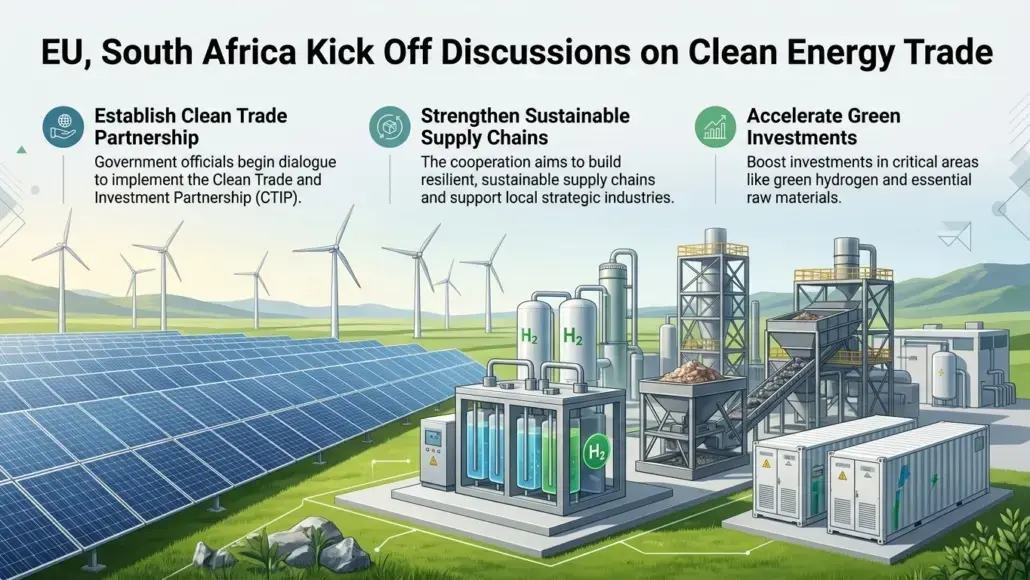
The European Union and South Africa have launched their first government-to-government dialogue at senior-official level to move forward with the implementation of the Clean Trade and Investment Partnership (CTIP). The discussions are intended to strengthen cooperation between the two partners by reinforcing resilient and sustainable supply chains, supporting the development of local strategic industries, and accelerating investments in green hydrogen and critical raw materials.
The clean energy trade dialogue has been structured around three key areas of cooperation.
- The first focuses on specific CTIP business cases and flagship projects aimed at turning trade and investment opportunities into concrete outcomes. These opportunities include South Africa’s electricity grid expansion, renewable energy projects, sustainable aviation fuels, critical raw materials, and green hydrogen initiatives.
- The second area covers trade and investment facilitation measures, with the objective of making the business environment more transparent and predictable through the exchange of information on recent regulatory processes and by providing clarifications to industry stakeholders.
- The third area addresses regulatory cooperation on climate and energy, where both partners will work together on regulatory approaches, standards, and implementation frameworks to support the green transition.
CTIP Supports Investment, Supply Chains and Green Transition
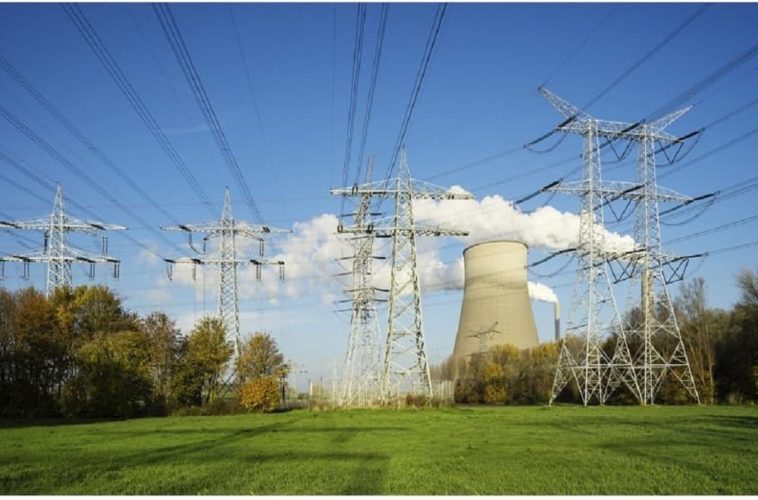
The Clean Trade and Investment Partnership introduces a new model of trade engagement that combines competitiveness with climate action by encouraging mutually beneficial cooperation in the clean economy and in critical raw materials. Within this framework, governments are expected to play a key role in creating a supportive regulatory environment that enables investments to expand and achieve their intended impact. South Africa has set ambitious goals for its clean transition, including reforms to its electricity sector and the construction of approximately 14,500 km of new transmission lines over the next decade. As these plans move forward, the CTIP is intended to encourage investment opportunities across clean supply chains while delivering mutual benefits for both the European Union and South Africa.
The clean energy trade partnership builds on earlier milestones between the two regions. In November 2025, the EU and South Africa signed the first Clean Trade and Investment Partnership, establishing a framework to promote mutually beneficial trade, investment, and job creation while supporting decarbonisation and the development of clean supply chains. This form of cooperation is designed to strengthen the EU’s role as a preferred partner for countries committed to the clean transition.
In March 2026, both sides also held the first Business-to-Government dialogue under the Clean Trade and Investment Partnership (CTIP), providing an opportunity to gather business perspectives and priorities for the implementation of the agreement.
Trade Relationship Continues to Expand
South Africa remains the EU’s first CTIP partner and its largest investment partner in Sub-Saharan Africa. Trade flows reached 45 billion euros in 2025, while the EU continues to be the leading investor in South Africa, accounting for more than 40% of foreign direct investment.
Clean Trade and Investment Partnerships were introduced as a new policy tool by European Commission President Ursula von der Leyen in 2024 to support the EU’s decarbonisation and competitiveness objectives as part of the Clean Industrial Deal. As implementation progresses, clean energy trade continues to underpin cooperation between the EU and South Africa across investment, regulatory alignment, and industrial development.