






















Distributed edge storage and municipal microgrid integrations will command more than thirty percent of municipal smart infrastructure budgets by the 2030s as cities confront intensifying extreme weather volatility and electrification bottlenecks.
PowerGen Advancement notes that the global energy landscape is undergoing a massive shift from centralized power production toward a more distributed and resilient model. As urban environments evolve, the concept of a decentralized grid has become central to ensuring energy security and sustainability. One of the most innovative aspects of this transition is the practice of integrating lighting nodes within these new energy networks.
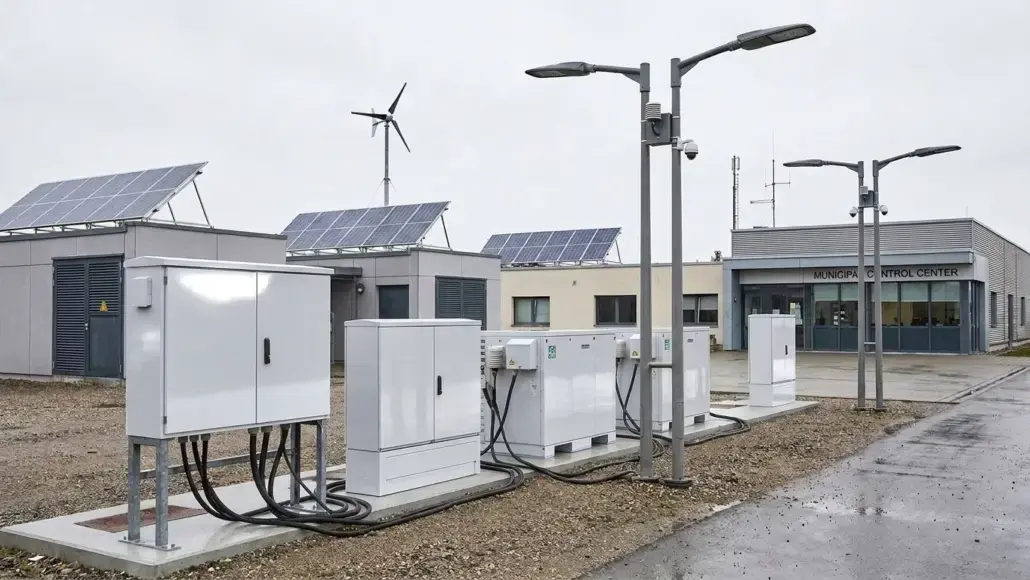
By transforming standard streetlamps and interior fixtures into multi functional energy assets, cities can enhance their load balancing capabilities and provide localized energy storage solutions. This approach not only supports the stability of microgrids but also lays the foundation for a more intelligent and responsive smart city. As we reimagine urban energy, the role of the lighting network as a critical pillar of power distribution is becoming increasingly clear.
The Role of Lighting in Decentralized Energy Architecture
In a traditional centralized system, energy flows in one direction from a distant power plant to the end user through bulk high voltage transmission networks and localized distribution feeders. However, a decentralized grid operates on the principle of local generation, storage, and consumption. By integrating lighting nodes into this architecture, municipal systems establish a dense network of endpoints that can act as both consumers and contributors to the grid. Each lighting fixture, when equipped with smart controls and localized energy storage, can store excess power during periods of low demand and discharge it during peak times. This localized load balancing is essential for the smooth operation of microgrids, which often rely on variable renewable energy sources like wind and solar. Integrating lighting nodes thus provides a distributed buffer that helps stabilize the entire urban energy ecosystem.
Moreover, the sheer density of lighting infrastructure makes it an ideal platform for hosting the communication and control hardware necessary for a smart city. When we begin integrating lighting nodes, we are not just installing lights, we are deploying an ubiquitous mesh network of intelligent devices that can monitor traffic flow, air quality, acoustic signatures, and energy flow in real time. This dual purpose infrastructure maximizes the return on public works investments and reduces the need for redundant structural hardware. For a decentralized grid to be truly effective, it requires high speed data exchange and granular control over power distribution. Lighting nodes, being evenly distributed throughout the urban environment, provide the perfect physical framework for this level of integration, ensuring that energy is managed with maximum precision and resilience.
Municipal power distribution traditionally suffers from severe visibility gaps at the low voltage edge. Substation monitors provide aggregate feed data, but utility operators rarely possess visibility into phase imbalances, harmonic distortions, or voltage sags occurring along secondary street level circuits. By integrating lighting nodes equipped with synchronized voltage and current telemetry, utility operators gain real time topological awareness across neighborhoods. Streetlight masts stand at standardized intervals along transportation corridors, offering optimal geometric positioning for low latency wireless mesh transceivers. These nodes establish a robust communication backhaul that links edge meters, localized solar arrays, and district transformers, transforming passive illumination poles into the operational nervous system of the decentralized grid.
Enhancing Grid Resilience and Local Load Balancing
One of the primary motivations for moving toward a decentralized grid is to enhance grid resilience against natural disasters, cyber incidents, and physical equipment failures. By integrating lighting nodes that possess their own energy storage and intelligent controllers, a city can ensure that critical illumination remains active even if the main power supply is compromised. In a microgrid scenario, these nodes can operate autonomously, drawing on their stored energy to provide essential services until the broader system is restored. This capability is a cornerstone of modern urban planning, where the safety and security of citizens depend on the continuous availability of power distribution for lighting and emergency systems.
Furthermore, integrating lighting nodes allows for more sophisticated load balancing at the neighborhood level. Instead of relying on a distant substation to manage fluctuations in demand, the local network of lighting assets can respond dynamically. For instance, during a sudden surge in electricity usage, the decentralized grid can command the lighting nodes to dim slightly or switch to their internal battery power, thereby reducing the strain on the primary distribution lines. This collaborative approach to energy management is a key feature of a smart city, where every device plays a part in maintaining systemic stability. By prioritizing the practice of integrating lighting nodes, urban planners can build a more flexible and robust energy infrastructure that is inherently capable of self healing and autonomous optimization.
Peak load shedding represents an enormous economic hurdle for municipal utilities. During heat waves or winter freezes, coincident residential heating and cooling demands threaten feeder capacity limits, often forcing utilities to dispatch costly peaker plants or impose rotational load shedding. Lighting networks represent a significant, non critical contiguous load that can be modulated instantaneously without causing public inconvenience. Through automated frequency response algorithms, smart lighting nodes continuously sample line frequency. If the grid frequency drops below nominal thresholds, indicating generation shortfalls, thousands of lighting nodes simultaneously shed load in fractions of a second, arresting grid instability before protective relays trip entire feeder lines.
Innovation in Energy Storage and Distribution
The technical feasibility of integrating lighting nodes has been greatly enhanced by breakthroughs in battery chemistry, thermal management, and solid state power electronics. Modern lighting fixtures can now be equipped with compact, high capacity lithium iron phosphate or solid state batteries that provide significant energy storage without adding excessive mechanical load to structural poles. These batteries can be charged during the day from integrated photovoltaic panels or from the grid when electricity prices are low, and then used to power the light at night or support the decentralized grid during peak events. This intelligent use of space within the lighting housing is a prime example of how urban energy systems can be made more efficient through multi functional design.
In addition to storage, the power distribution hardware within these nodes is becoming remarkably sophisticated. Bi directional inverters allow for the seamless exchange of alternating and direct current between the lighting node and the distribution grid, facilitating the participation of public infrastructure in regional demand response and ancillary service markets. As we continue the process of integrating lighting nodes, these systems will become integral to the management of electric vehicle charging and other high demand urban loads. By serving as localized hubs for power distribution, lighting nodes can alleviate the pressure on existing infrastructure and enable the rapid scaling of clean energy technologies across the city. The synergy between high efficiency illumination and advanced energy storage is a powerful driver for the next generation of resilient microgrids.
Strategic Roadmap for a Smart City Future
Implementing a comprehensive strategy for integrating lighting nodes requires close collaboration between municipal governments, utility providers, urban planners, and technology developers. It starts with pilot implementations in designated microgrid or smart city innovation zones, where the performance of the integrated systems can be closely monitored, calibrated, and refined. As the benefits of improved load balancing and grid resilience become evident, the deployment model can be scaled across the entire urban energy network. The goal is to reach an operational state where the lighting infrastructure is an indispensable element of the decentralized grid, providing a reliable and sustainable foundation for all city operations.
As decentralized microgrids proliferate across modern metropolitan areas, edge intelligence will dictate the speed and stability of the renewable energy transition. Transforming static lampposts into intelligent energy vaults bridges the gap between clean power generation and urban resiliency. Integrating lighting nodes establishes an adaptable, self sustaining energy commons capable of withstanding the operational rigors of the twenty first century.
PowerGen Advancement believes that distributed lighting nodes serving as virtual power plants and bi directional grid stabilization hubs will represent over forty percent of urban microgrid edge capacity by 2030s, securing resilient power for smart cities worldwide.