














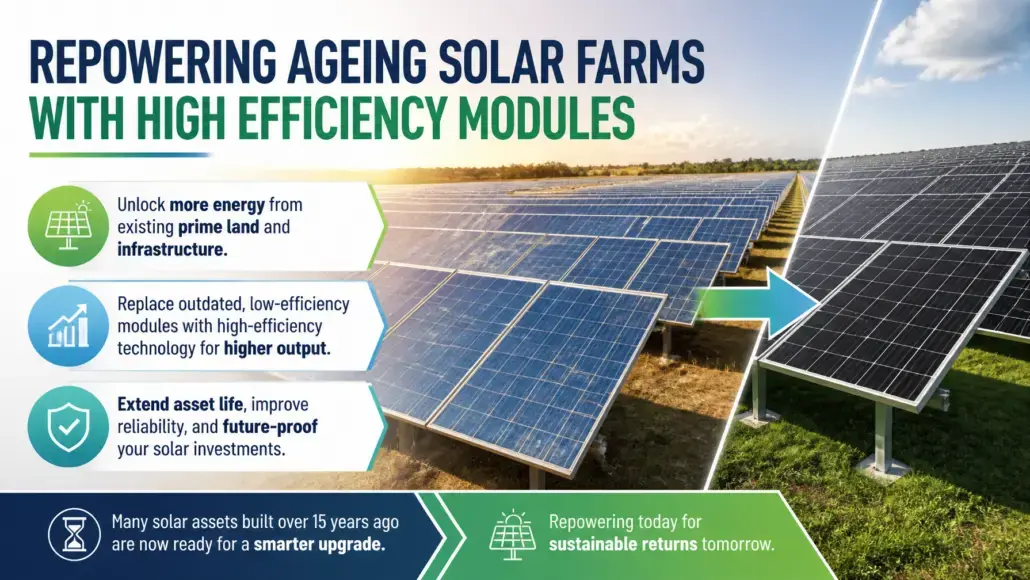
Hundreds of gigawatts of operational utility-scale photovoltaic capacity are approaching or surpassing their fifteenth year of commercial operation. Built during the early wave of global feed-in tariff policies, these legacy solar assets rely on poly-crystalline and early mono-crystalline modules rated between two hundred and two hundred and eighty watts, operating with cell conversion efficiencies below sixteen percent. While these plants occupy prime real estate with secured land rights, access roads, and scarce high-voltage grid interconnections, their declining performance and escalating maintenance costs erode financial returns.
Securing new grid interconnection queues in major renewable markets now takes between five and eight years. This transmission bottleneck fundamentally altered utility asset management priorities. Rather than abandoning legacy installations or waiting for new grid approvals, institutional infrastructure funds and global independent power producers are executing targeted capital investments. Strategically repowering ageing solar farm assets with modern high-efficiency n-type modules allows asset managers to double plant energy production on the exact same physical footprint.
The Operational Reality of Legacy Photovoltaic Fleet Assets
Operational assets commissioned between 2008 and 2014 face compounding degradation phenomena. Beyond normal annual degradation of zero point five to zero point eight percent, older modules frequently suffer from ethylene vinyl acetate yellowing, backsheet cracking, solder joint fatigue, and localized hot-spot formation. These physical defects impair string current matching, triggering frequent inverter trips and elevating balance-of-plant operating expenditures.
Spare parts availability represents an even more pressing operational vulnerability:
- Original equipment manufacturers of early central inverters and sixty-cell modules have frequently exited the market or discontinued legacy product lines.
- Sourcing exact dimensional replacements for cracked sixty-cell panels requires sourcing expensive aftermarket units or operating mismatched strings.
- Maintenance teams spend disproportionate field hours diagnosing blown DC fuses and tracking ground faults across degraded array wiring.
- Obsolete monitoring and data acquisition systems lack the granular telemetry required for modern predictive maintenance protocols.
International Renewable Energy Agency data published in 2025 indicates that over forty gigawatts of operational photovoltaic capacity in Europe and North America currently operate with legacy modules below sixteen percent conversion efficiency. As original twenty-year feed-in tariff contracts and power purchase agreements expire, asset owners must decide whether to decommission the plant, extend life through piecemeal repairs, or execute a comprehensive repowering overhaul.
Strategic Advantages of Site Repowering Over Greenfield Development
Repowering offers institutional investors substantial structural advantages compared to greenfield project development. Developing a new utility solar farm requires years of environmental impact assessments, permitting applications, zoning hearings, land option payments, and interconnection studies. A comprehensive repowering campaign bypasses most of these hurdles by utilizing existing infrastructure:
- Secured high-voltage interconnection capacity remains the most valuable asset, enabling immediate injection of incremental clean power into constrained transmission grids.
- Civil infrastructure, including perimeter fencing, security networks, internal access roads, drainage systems, and maintenance facilities, is already fully built and permitted.
- Substation step-up transformers, switchgear enclosures, and grid metering infrastructure can be retained or upgraded with minimal civil disruption.
- Land lease agreements and municipal property tax structures are already established, providing revenue certainty to local landowners and authorities.
RWE AG validated this strategic rationale across European asset revamping campaigns in 2025. RWE completed the repowering of several pioneering solar facilities in Germany, replacing obsolete sub-three-hundred-watt modules with modern high-efficiency tunnel oxide passivated contact panels. The upgrade boosted total site generation capacity by more than forty-five percent while utilizing existing substation transformer assets, demonstrating that repowering delivers electricity at a significantly lower levelized cost than building greenfield capacity from scratch.
Module Replacement Dynamics and Modern Electrical Design
Modern solar modules bear little physical or electrical resemblance to the legacy hardware they replace. Today’s utility-scale modules feature large-format rectangular wafers, non-destructive laser cutting, and multi-busbar designs, delivering power ratings between six hundred and seven hundred watts with conversion efficiencies exceeding twenty-two percent.
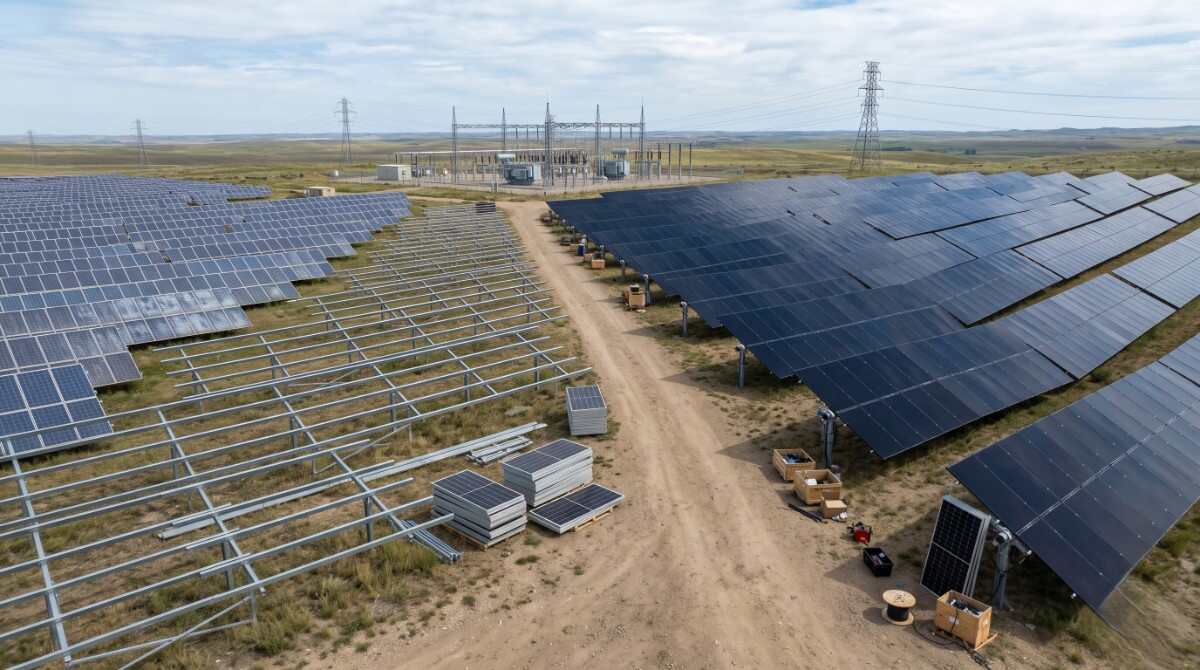
Replacing low-output panels with modern hardware introduces distinct civil and electrical engineering challenges:
- Modern modules are substantially larger and heavier, measuring over two point three metres in length and weighing over thirty kilograms, requiring verification of existing steel racking load limits.
- Higher operational currents exceeding fifteen amperes require engineers to evaluate existing DC collector cable gauges to prevent resistive thermal losses.
- Legacy fixed-tilt mounting tables designed for portrait-mounted sixty-cell modules must either be structurally reinforced and reclamped or replaced with single-axis tracking systems.
- Maximum system voltages must be evaluated, as older plants operate at six hundred or one thousand volts DC, whereas modern modules and balance of system components are optimized for fifteen hundred volts.
TotalEnergies SE executed large-scale solar repowering initiatives across Mediterranean facilities, retrofitting legacy arrays with modern bifacial modules.
Inverter Modernization and Balance of Plant Upgrades
Repowering extends far beyond swapping photovoltaic modules. Legacy central inverters installed a decade ago operate with peak conversion efficiencies below ninety-six percent, lack dynamic reactive power control, and occupy large concrete foundation pads.
SMA Solar Technology AG introduced dedicated repowering conversion packages in 2025 designed specifically to replace obsolete central inverters with modern modular string or central architectures. Upgrading to modern inverters introduces advanced grid-support capabilities:
- Precise maximum power point tracking across smaller string groupings mitigates mismatch losses caused by partial row shading or uneven terrain.
- Modern inverters deliver peak European efficiencies exceeding ninety-eight point eight percent, reducing internal heat dissipation and conversion losses.
- Advanced grid-forming software and synthetic inertia allow repowered plants to comply with modern grid connection codes, including voltage ride-through and active frequency regulation.
- Integrated digital telemetry and wireless monitoring enable automated fault isolation down to the individual string level.
EDP Renewables demonstrated the impact of combined module and inverter repowering across legacy Iberian assets. By upgrading both photovoltaic generators and power conversion systems, EDP Renewables eliminated recurring equipment downtime, increased energy availability to ninety-nine point five percent, and lowered annual operation and maintenance costs by more than thirty percent.
Permitting, Grid Interconnection Queues, and Contract Restructuring
Executing a repowering campaign for ageing solar farm assets requires careful legal and regulatory coordination. In many jurisdictions, grid connection agreements specify maximum injection capacity at the point of common coupling. If a developer doubles DC capacity, they must either negotiate an expanded interconnection capacity or install direct-current coupled battery energy storage systems to capture excess daytime generation.
Enel Green Power S.p.A. navigated these regulatory frameworks by pairing solar repowering with co-located battery storage systems across Italian projects. Enel Green Power maintained its existing export limit at the transmission substation while doubling installed DC solar capacity. During peak irradiance hours, excess generation is diverted into utility-scale lithium-ion battery banks, which then discharge clean electricity onto the grid during evening high-demand windows. This hybrid approach allowed Enel Green Power to maximize revenue without triggering costly grid reinforcement studies.
Contract restructuring represents another critical commercial hurdle. When a plant transitions from a legacy feed-in tariff to merchant pricing or a corporate power purchase agreement, off-takers demand strict performance guarantees. Modern high-efficiency modules provide the production reliability and degradation guarantees needed to secure competitive corporate offtake terms.
Where repowering projects for ageing solar farm assets encounter local zoning constraints or dual land-use mandates, asset owners frequently integrate agrivoltaic design strategies to maintain community and agricultural support while upgrading generation equipment.
Circular Decommissioning and Recycling Supply Chains
Repowering hundreds of megawatts of legacy solar capacity generates substantial volumes of decommissioned hardware that must be managed responsibly. Institutional investors and sustainability mandates prohibit sending retired panels to landfills.
The industry responded by developing high-purity mechanical and thermal recycling supply chains:
- Automated disassembly systems cleanly separate aluminium frames and junction boxes for direct metallurgical reuse.
- Thermal delamination processes vaporize polymer encapsulants, allowing intact recovery of high-quality front glass.
- Chemical leaching processes recover silver, copper, and high-purity silicon for re-entry into industrial manufacturing supply chains.
References
- International Renewable Energy Agency
- RWE AG
- Enel Green Power S.p.A.
- TotalEnergies SE
- SMA Solar Technology AG