










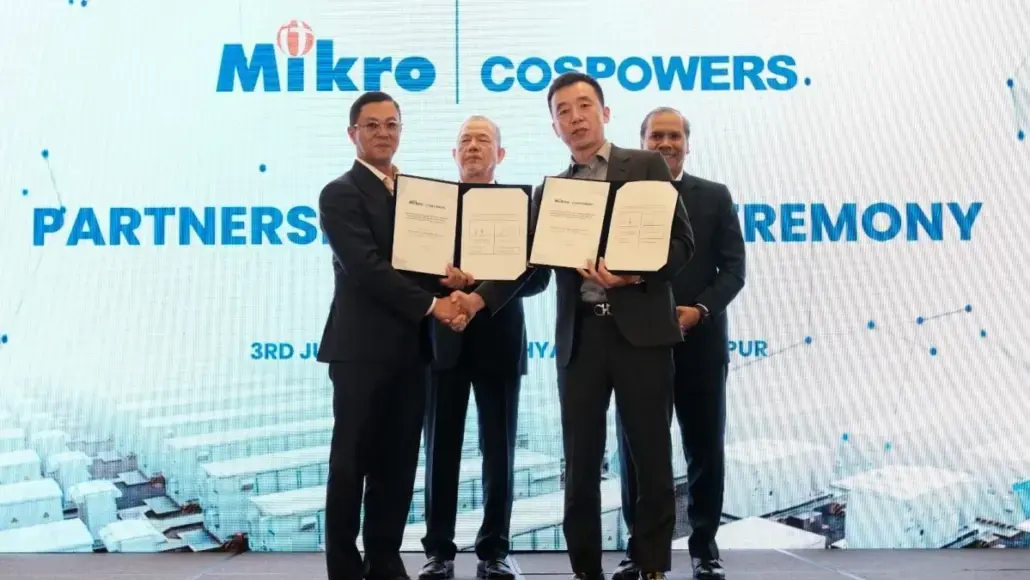
Malaysia’s push to strengthen its electricity infrastructure for a renewable-powered future has received a significant boost following a new agreement between Mikro MSC Berhad and Hong Kong Cospower Technology Co Ltd (HKCT). The two-year arrangement appoints HKCT’s exclusive strategic partner in Malaysia for utility-scale battery energy storage system (BESS) projects, supporting the country’s efforts to integrate more renewable energy into the national grid.
Battery storage is increasingly viewed as a critical solution for managing solar power generation by storing excess electricity produced during daylight hours for use during periods of higher demand. The agreement comes at a time when battery manufacturers are expanding internationally amid growing demand for electric vehicles and stationary storage systems, while ongoing Sino-US trade tensions encourage companies to diversify production beyond China.
Under the partnership, the companies will jointly “identify, develop, negotiate and execute storage projects” connected to the national grid, including solar-plus-storage developments and selected commercial and industrial initiatives.The agreement was signed in Kuala Lumpur on 3rd June 2026 in the presence of Deputy Prime Minister Fadillah Yusof, who also oversees the energy transition portfolio. The signing coincides with Malaysia’s preparations for the rollout of its first major grid-scale battery procurement initiative under the MyBeST programme, which is managed by the Energy Commission.
Emphasising the importance of BESS projects in supporting renewable energy deployment, Fadillah said, “When we move towards renewable energy, which is intermittent, batteries become the tool to stabilise our grid.”
Malaysia has set a target for renewable energy to account for 70 per cent of installed capacity by 2050. However, the nation’s electricity system continues to rely heavily on gas and coal, while solar generation remains dependent on weather conditions and daylight availability. Through MyBeST, authorities are seeking 400 megawatts of battery capacity and 1,600 megawatt-hours of storage across four grid-connected projects in Peninsular Malaysia.
The Energy Commission said proposals submitted under the programme represented seven times the offered capacity, with four projects of 100MW and 400MWh each scheduled for commissioning in 2027.Further expansion of BESS projects is expected as Malaysia advances additional renewable energy developments.
Referring to the country’s latest solar procurement round, Fadillah said, “If we look at LSS 6, it must come with batteries.”
He added, “All the new power generation using solar and so on, it must come with batteries. Which means we have to fast track.”
The minister noted that a 100MW battery project has already been completed, while another 400MW remains under development. He also cited a BESS project by Tenaga Nasional Berhad valued at about 1.5 billion ringgit (US$375 million), while indicating that future storage tenders would involve billions.
The partnership provides HKCT with a strategic entry point into a market expected to become increasingly competitive as mainland Chinese and Hong Kong-linked battery companies seek expansion opportunities in Southeast Asia.
HKCT, the international commercial arm of Cospowers group, stated that its parent company possesses more than 30 years of lithium battery technology experience, operations spanning more than 70 countries and regions, and cumulative energy storage battery shipments exceeding 23 gigawatt-hours. The company also noted that Cospowers has been recognised as a BloombergNEF Tier 1 energy storage manufacturer.
Commenting on the collaboration, William Wang, vice-president of HKCT, said, “Malaysia represents one of the most compelling growth markets for grid-scale energy storage in Southeast Asia.”
Highlighting the opportunities presented by future BESS projects, Syed Mohd Hafiz Syed Mohd, Mikro’s executive director and CEO, said, “In HKCT, we have found a world leader in battery energy storage technology and a natural choice of partner.”
“This partnership puts us in a formidable position to play a meaningful role in the national BESS programme,” he added.