
















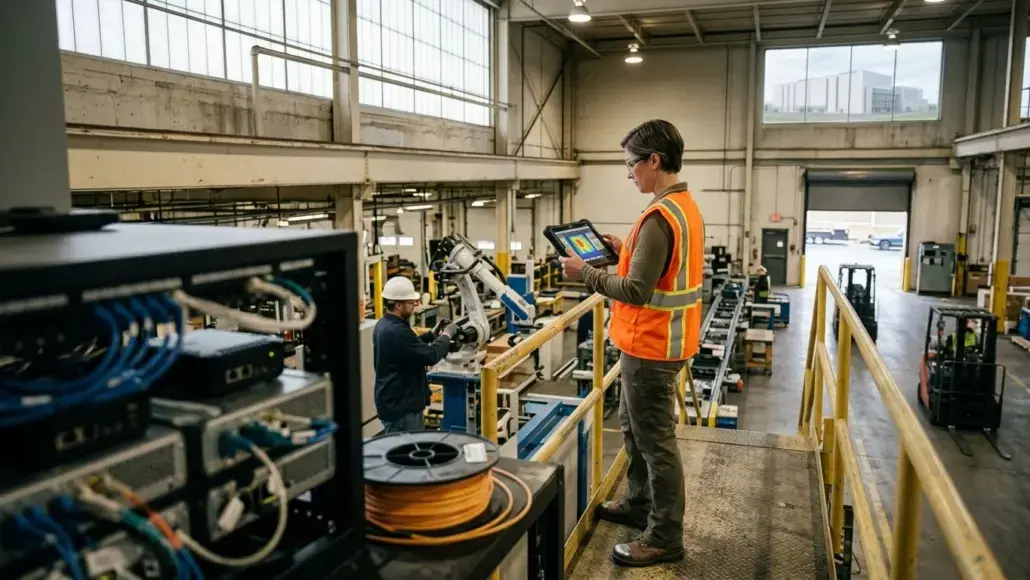
Safety AI has a simple promise: help teams spot risk sooner. The hard part is deciding where the analysis should happen.
Some systems send video or sensor data to the cloud for processing. Others analyze data closer to the source, on local devices inside the facility. Both models can support workplace safety, but they create very different outcomes for latency, bandwidth, privacy, and trust.
That choice matters most in industrial environments. A warehouse, manufacturing plant, port, or distribution center creates constant movement. People, vehicles, machinery, and materials overlap all day. When AI supports safety decisions in that kind of setting, architecture becomes more than an IT detail. It shapes what teams can see, how quickly they can respond, and how much sensitive data needs to leave the site.
Cloud Processing Gives Teams Scale, but It Can Add Friction
Cloud-based AI can analyze large datasets and support centralized reporting across multiple sites. That makes cloud architecture useful for trend analysis, executive dashboards, model updates, and broader safety reporting.
But industrial video is heavy. Sending every camera feed to a remote server can strain networks, increase storage costs, and create more governance questions. A single site may run dozens or hundreds of cameras. Across a wider estate, that volume grows fast.
Cloud processing can also create delay. In some use cases, a few extra seconds may not matter. On a busy shop floor, timing can change the value of an alert. If a vehicle enters the wrong route or a pedestrian steps into a high-risk zone, teams need signals while the context is still fresh.
Cloud-first systems can still work well for many safety programs. The concern is not the cloud itself. The concern is sending more data than the use case actually needs.
Edge Processing Keeps the First Decision Close to the Floor
Edge processing moves the first layer of AI analysis closer to where data is created. In practical terms, that often means a local device processes camera feeds on-site before selected outputs go to a dashboard, alerting system, or reporting tool.
For workplace safety, that local-first model can be valuable. The system can detect configured events, filter irrelevant footage, apply privacy controls, and share only the data that supports review or action.
A helpful guide to edge processing in safety AI explains why local analysis can support privacy, latency, and scalability in industrial settings.
The difference is practical. Instead of asking, “How do we upload and store all this footage?” teams can ask, “What safety data needs to leave the site?”
Latency: Faster Signals Can Support Faster Intervention
Latency is the delay between data capture and usable insight. In safety AI, that delay can affect alerts, investigation workflows, and supervisor response.
Edge systems reduce the round trip. Video does not need to travel to a remote environment before the first event detection happens. Local processing can identify a configured risk signal sooner, then trigger the next step.
That can help teams act faster in situations such as:
- Vehicle and pedestrian interactions near shared routes
- Restricted-zone entries during active work
- Repeated speeding in forklift lanes
- Congestion near loading bays or intersections
- Unsafe patterns that appear during specific shifts
Speed alone does not prevent incidents. People still need clear workflows, ownership, and follow-through. But faster signals can give supervisors a better chance to coach, adjust traffic routes, or prioritize inspections before risk turns into harm.
Bandwidth: Sending Less Data Makes Scaling Easier
Bandwidth often becomes a hidden blocker in safety AI rollouts. One camera feed may be manageable. A network of cameras across multiple industrial sites can overwhelm available capacity if every stream moves off-site for continuous processing.
Edge processing helps by reducing the amount of data that travels beyond the facility. Local devices can filter for relevant safety events and send selected outputs instead of constant raw video.
That can make rollout easier across sites with mixed infrastructure. Older buildings, remote facilities, and large warehouses may not have the same network capacity as newer locations. A local-first system can adapt better because it does not rely on constant high-volume transfer.
For operations and EHS leaders, lower bandwidth demand can also support consistency. Each site can process its own conditions while still contributing standardized event data to wider reporting.
Privacy: Industrial Video Needs Restraint
Workplace video captures more than hazards. It can show employees, contractors, visitors, site layouts, work habits, equipment use, and shift routines. That makes video powerful for safety analysis, but sensitive for privacy and compliance.
Edge processing can help limit exposure. Local analysis can support blurring, anonymization, encryption, and selective upload before data leaves the site. That gives organizations a stronger privacy posture than sending continuous raw footage to the cloud.
Worker trust depends on that restraint. People need to know safety AI exists to reduce risk, not to create invasive surveillance. Privacy controls, clear communication, limited access, and sensible retention policies all matter.
Edge architecture does not replace governance. It gives governance a better starting point because sensitive processing can happen closer to the source.
Cloud and Edge Should Work Together
The best answer is rarely “cloud only” or “edge only.” Safety AI often needs both.
Edge processing can handle local detection, privacy controls, and faster event handling. Cloud systems can support cross-site reporting, dashboards, analytics, model management, and long-term trend review.
That hybrid model gives safety teams the benefit of local responsiveness without losing enterprise visibility. Site managers can act on immediate risks. Regional leaders can compare trends across locations. IT teams can manage scale without moving unnecessary raw data.
Architecture Shapes Adoption
Safety technology only works when people use it. EHS teams need reliable insight. Operations leaders need practical signals that connect to traffic flow, downtime, and productivity. IT teams need architecture that respects security and infrastructure limits. Workers need confidence that the system protects them rather than watches them without context.
Cloud processing can support powerful analytics, but edge processing helps safety AI fit the realities of industrial sites. It cuts delay, reduces bandwidth pressure, and limits unnecessary movement of sensitive video.
For teams building safer workplaces with AI, those details matter. The right architecture helps turn video data into timely, trusted safety action.