







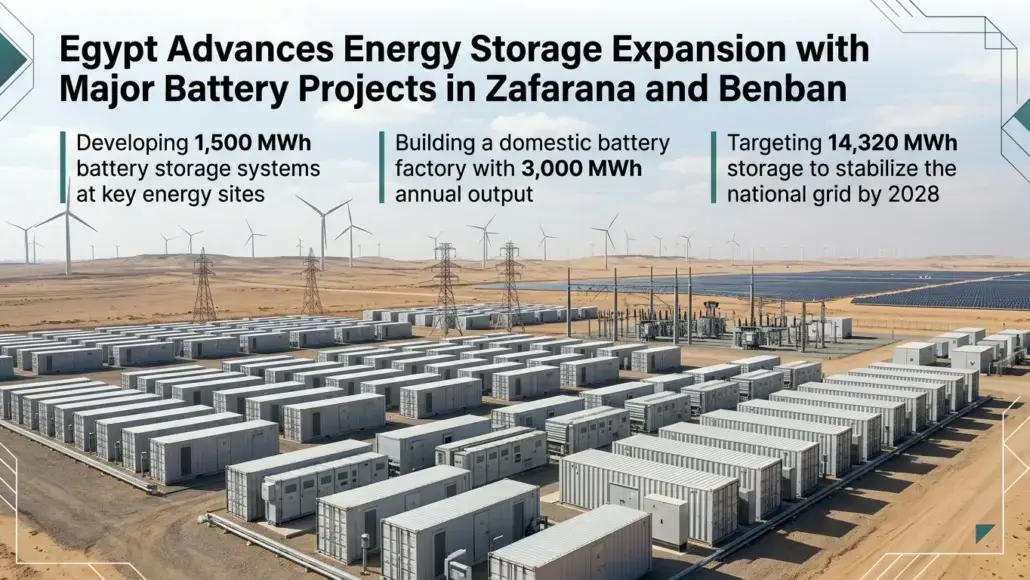
Egypt has taken another step in expanding its energy storage capabilities with the signing of agreements covering new Battery Energy Storage Systems (BESS) projects and battery manufacturing. Mahmoud Esmat, Minister of Electricity and Renewable Energy, attended the signing ceremony for two separate energy storage projects in the Zafarana and Benban regions, which together form the 1500 MWh Battery Storage Project. The event also featured the signing of an agreement to establish a battery manufacturing facility with an annual production capacity of 3,000 MWh, according to a statement issued by the Ministry of Electricity and Renewable Energy.
Among those present at the ceremony were Sheikh Hussein Al Nowais, Chairman of UAE-based AlNowais Investments and its subsidiary AMEA Power, along with Ni Jin, Chairman of China Energy Engineering Corp (CEEC). The agreements relate to Engineering, Procurement, and Construction (EPC) activities for two standalone battery developments. These include the Horus standalone battery project in Zafarana with a capacity of 500 MWh and the Nefertiti standalone battery project in Benban with a capacity of 1,000 MWh. Together, these initiatives constitute the 1500 MWh Battery Storage Project, designed to strengthen Egypt’s energy infrastructure and support the growing integration of renewable energy resources.
The agreements align with Egypt’s broader strategy to accelerate both grid-connected and standalone energy storage developments. The objective is to maintain network stability, secure uninterrupted electricity supplies, improve the utilization of renewable energy resources, and reduce dependence on fossil fuels as part of the country’s energy transition plans.
Highlighting the significance of the 1500 MWh Battery Storage Project, Esmat noted that energy storage systems were incorporated into Egypt’s national electricity grid for the first time in 2025. He explained that reliance on solar and wind generation requires additional battery storage capacity to preserve grid security and ensure a dependable and sustainable power supply. He also indicated that a series of projects are being implemented according to defined schedules to increase storage capacity to 14,320 MWh by 2028.
Esmat further stressed the value of localizing industrial production and facilitating technology transfer through cooperation with private-sector partners. These efforts are intended to maximize available resources and reinforce Egypt’s standing as a regional center for manufacturing renewable energy equipment.