








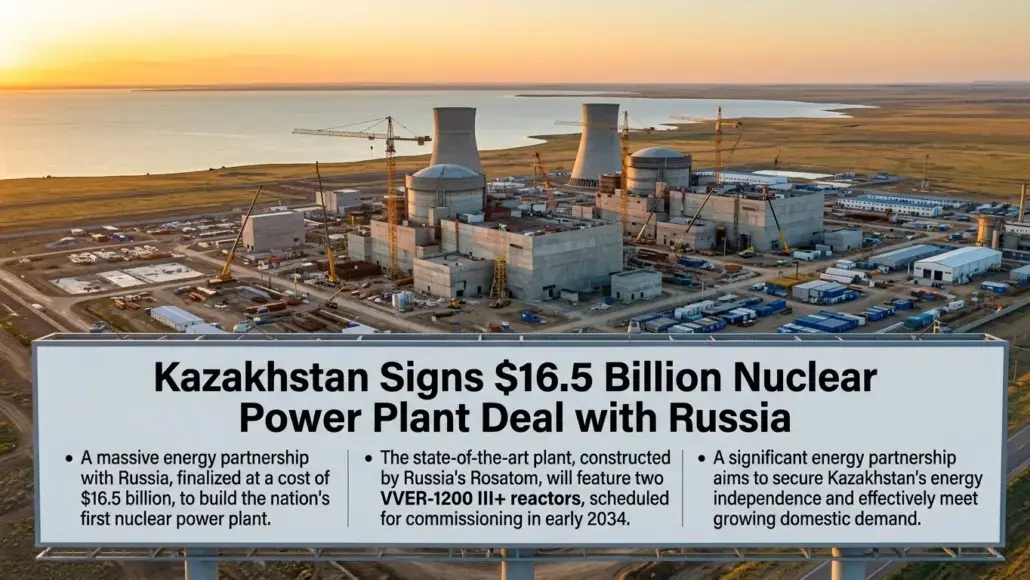
Kazakhstan has entered into a landmark agreement with Russia for the construction of its first nuclear power plant. The development of this USD 16.5B nuclear power plant signifies a major expansion of energy cooperation between the two nations and underscores Russia’s growing influence in Central Asia’s power sector.
The Central Asian nation, which is the world’s largest producer of uranium, has been exploring the prospect of atomic energy for over two decades. A nationwide referendum conducted in 2024 overwhelmingly supported the construction of a nuclear power plant, with the village of Ulken on the shores of Lake Balkhash designated as the chosen site for this ambitious project.
“The agreement signed today on the construction of the Balkhash NPP has an important role,” Kassym-Jomart Tokayev, Kazakhstan’s president, said before thanking Russian President Vladimir Putin, who was in Astana for talks, for his support.
“Putting the plant into operation will make a significant contribution to the energy supply of the Kazakh economy,” Russian President Vladimir Putin said.
An accompanying agreement was also executed to secure Russian export credit, which will finance the construction of the USD 16.5B nuclear power plant. Russia’s state-owned nuclear corporation, Rosatom, has been awarded the lead role in building the plant, having successfully outbid competitors including China National Nuclear Corporation (CNNC), French utility EDF, and Korea Hydro & Nuclear Power.
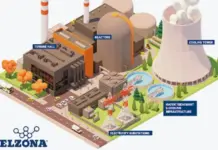
Almasadam Satkaliyev, head of Kazakhstan’s atomic energy agency, informed reporters that the total cost of the nuclear power plant, which will be equipped with two VVER-1200 III+ reactors, is estimated at approximately $16.5 billion. This figure includes an allocation of around $2 billion dedicated to security and necessary infrastructure development.
Construction of the USD 16.5B nuclear power plant is scheduled to commence in 2027, with the initial reactor expected to be commissioned by early 2034. The undertaking of the Kazakhstan nuclear power plant deal comes after decades of grappling with the legacy of Soviet nuclear weapons testing, which rendered substantial areas of land uninhabitable and led to various health issues in nearby populations, fostering a degree of public apprehension towards nuclear technology.
Despite possessing significant natural gas reserves, Kazakhstan, a nation of 20 million, currently relies heavily on coal-fired power plants for the majority of its electricity needs. While supplemented by hydroelectric power and a growing renewable energy sector, the country faces challenges in meeting its escalating energy demands. Kazakhstan imports electricity, primarily from Russia, as its aging power generation facilities struggle to keep pace with domestic consumption. In a separate development, Kazakhstan has also approved the construction of a second nuclear plant, with CNNC designated as the primary constructor for that facility.