

















The protection relay is the silent sentinel of the electrical grid, a device that spends most of its life waiting for a fraction of a second where its intervention is required to save millions of dollars in equipment and prevent injury to personnel. For over a century, these devices have evolved from simple electromechanical levers to sophisticated digital computers. Today, we are standing on the threshold of a new era: the future of protection relays in smart power networks. This next generation of technology will see relays move beyond their role as simple “switches” to become the intelligent hubs of a decentralized, self-healing, and highly efficient energy ecosystem.
In the smart grids of tomorrow, protection relays will no longer function as isolated units with fixed settings. Instead, they will be part of a high-speed, interoperable network where data is shared in real-time across substations and control centers. This connectivity allows for the implementation of protection relays smart power networks that can adapt to the changing topology of the grid, ensuring that protection is always optimal, whether the sun is shining, the wind is blowing, or a major transmission line is out for maintenance. This evolution is essential for supporting the transition to a low-carbon economy while maintaining the rigorous standards of reliability that modern society demands.
From Numerical Relays to Virtualized Protection
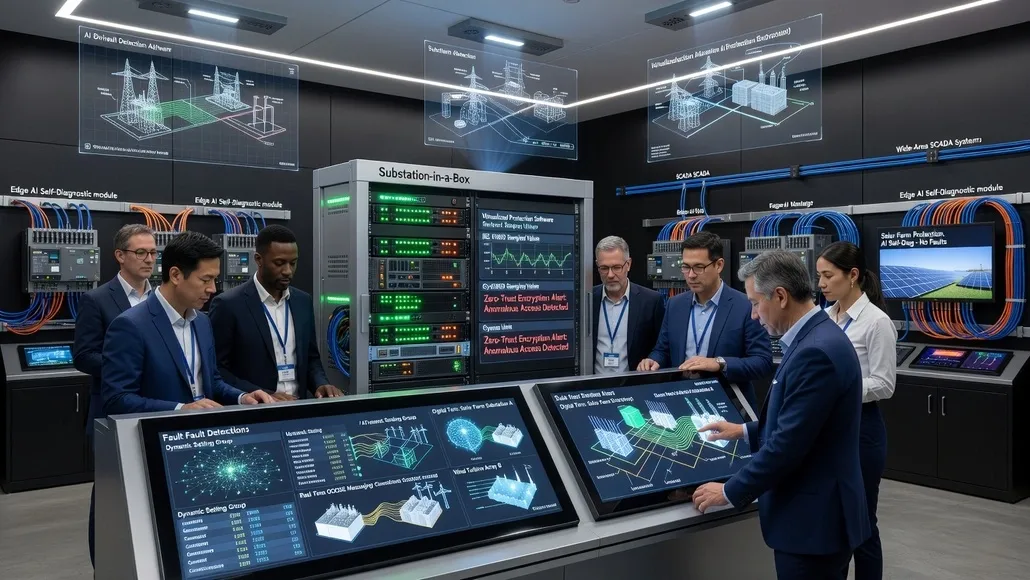
The current state of the art in protection is the numerical relay, which uses microprocessors to perform complex mathematical calculations on digitized current and voltage waveforms. However, the future of protection relays in smart power networks is moving toward virtualization. In a virtualized substation, the traditional “hardware-per-function” model is replaced by a high-performance central computer that runs multiple protection functions as software applications. This “Substation-in-a-Box” approach allows for greater flexibility, easier upgrades, and a significant reduction in the physical footprint of the substation’s control room.
Virtualized protection relies on the IEC 61850 standard and the use of “sampled values” from merging units in the field. By decoupling the protection logic from the physical hardware, utilities can deploy new protection schemes as easily as installing an app on a smartphone. This agility is vital for responding to the rapidly changing requirements of the grid. For instance, if a new battery storage system is added to a feeder, the protection relays smart power networks can be updated remotely with new settings and logic to account for the storage system’s fault current contribution. This software-defined approach is the ultimate form of “future-proofing” for the energy industry.
Adaptive Relaying and Dynamic Setting Groups
One of the most critical advancements in the future of protection relays in smart power networks is the implementation of adaptive relaying. Traditionally, relays were programmed with a single set of parameters based on a worst-case scenario. This often led to a compromise between sensitivity and security. In a smart grid, the configuration of the network changes constantly. Adaptive relays use real-time data from the SCADA system or wide-area monitoring systems to switch between different “setting groups” automatically. This ensures that the relay is always tuned to the current state of the grid, providing the best possible protection at all times.
For example, a relay protecting a distribution line with high solar penetration might need different settings during the day when the solar inverters are active versus at night when they are idle. Similarly, when a microgrid islands itself from the main utility, the fault current levels drop dramatically. An adaptive protection relays smart power networks system can detect the islanded state and instantly switch to a more sensitive setting group to ensure that faults within the microgrid are still cleared rapidly. This level of responsiveness is a key enabler for the widespread adoption of distributed energy resources and local energy communities.
The Role of High-Speed Communication and GOOSE Messaging
The efficacy of modern protection schemes is inextricably linked to the speed and reliability of the communication network. The future of protection relays in smart power networks relies on the Generic Object Oriented Substation Event (GOOSE) messaging protocol, which allows for high-priority peer-to-peer communication between IEDs. GOOSE messages are used to coordinate protection actions, such as “blocking” a relay from tripping if a downstream device has already seen the fault. This coordination ensures that only the minimum necessary part of the grid is disconnected, a concept known as “selectivity.”
As we move toward more complex wide-area protection schemes, the communication network must extend beyond the walls of the substation. Fiber-optic links and private LTE networks are being used to connect distant protection relays smart power networks, allowing them to share data at nearly the speed of light. This wide-area coordination is essential for preventing cascading failures and for managing the stability of large-scale renewable energy transfers. The relay is no longer just an electrical device; it is a critical node in a high-speed data network, requiring protection engineers to become experts in telecommunications and networking.
Cybersecurity and the Integrity of Digital Relays
With increased connectivity comes increased risk, and the future of protection relays in smart power networks must be built on a foundation of robust cybersecurity. A cyber-attack on a protective relay could allow an adversary to remotely trip a breaker or, even worse, prevent a relay from operating during a real fault. Protecting these devices involves more than just firewalls; it requires a “security by design” approach where every communication is authenticated and every firmware update is digitally signed.
Next-generation protection relays smart power networks will include built-in security modules that monitor for unauthorized access and unusual network traffic. They will also support advanced encryption standards to protect sensitive control data. As the “last line of defense” for the grid, the integrity of the protection relay is non-negotiable. Ensuring that these devices can withstand both physical faults and digital attacks is the ultimate challenge for the next generation of power system engineers. This includes implementing strict “zero-trust” architectures where no device is trusted by default, regardless of its location on the network.
Integration of Artificial Intelligence and Edge Computing
The integration of Artificial Intelligence (AI) and machine learning is perhaps the most exciting frontier in the future of protection relays in smart power networks. By processing high-frequency sampling data, AI-driven relays can identify the unique signatures of complex faults, such as high-impedance arcing or incipient transformer failures, that traditional algorithms might miss. This allows for even faster fault detection and a significant reduction in nuisance tripping. These AI models are executed “at the edge,” directly on the relay’s processor, ensuring that the decision-making process is nearly instantaneous.
AI also enables the relay to perform advanced self-diagnostics and predictive maintenance. A smart relay can monitor its own internal temperature, memory usage, and the health of its communication ports, alerting the utility before a hardware failure occurs. It can also monitor the health of the primary equipment it protects, such as the wear and tear on a circuit breaker’s contacts or the aging of a transformer’s insulation. This move from “protection” to “asset management” is a significant value-add for utilities, helping them to reduce costs and improve the overall life of their infrastructure. The future of protection relays in smart power networks is one of multi-functional intelligence that serves both the operations and the maintenance teams.
Environmental Sustainability and the Grid of the Future
Finally, the future of protection relays in smart power networks is closely tied to the global goal of environmental sustainability. By enabling the safe and efficient integration of renewable energy, smart relays are playing a direct role in reducing the carbon footprint of the power sector. Furthermore, the shift toward digital substations and fiber-optic communication reduces the need for heavy copper cabling and large, energy-intensive control houses. The reduced physical footprint and increased operational efficiency of modern protection schemes contribute to a more sustainable and environmentally friendly energy system.
As we look toward the 2030s and beyond, the protection relay will remain the most critical component of the grid. While its form and function will continue to change, its core mission to protect life and property will never waver. The future of protection relays in smart power networks is bright, characterized by a fusion of electrical engineering, data science, and telecommunications that will ensure our energy future is secure, reliable, and green. The evolution from a simple electromechanical device to a virtualized, AI-powered hub is a testament to human ingenuity and our ongoing commitment to building a better, more resilient world.