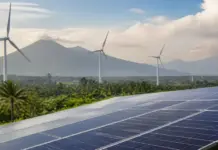
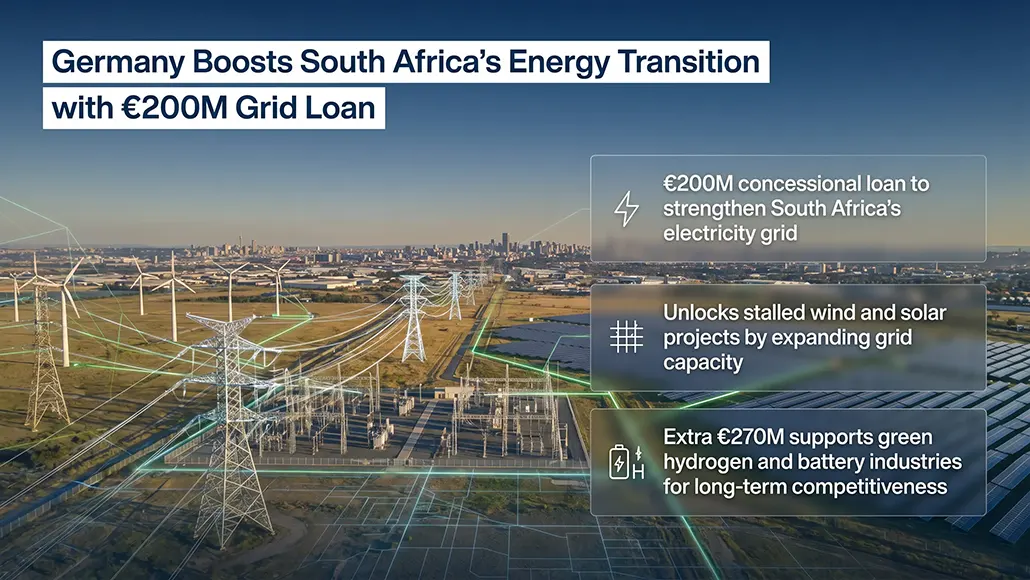
Germany has advanced its support for South Africa’s energy transition by committing a concessional loan of €200 million, roughly equal to R4 billion. The €200M aid arrives at a pivotal moment as the country works to reinforce its electricity infrastructure while scaling up renewable energy capacity. This €200M aid forms part of a broader effort to address structural constraints within the power sector, particularly as demand for cleaner energy sources continues to grow.
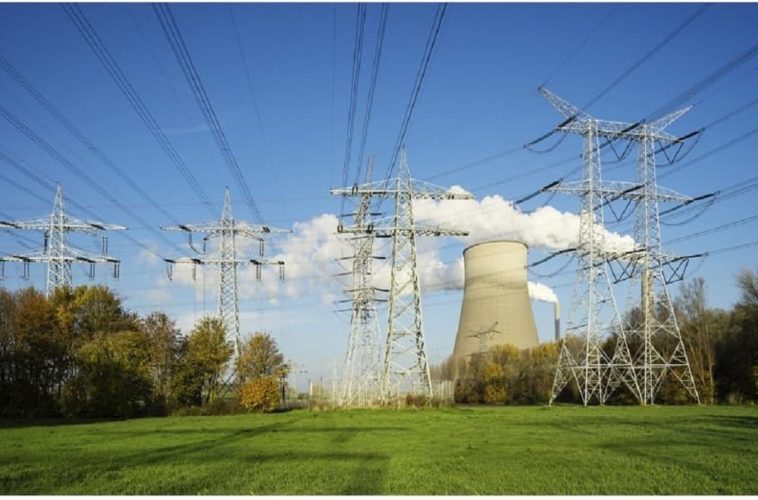
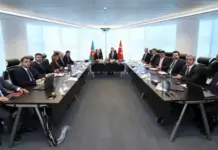
The agreement was concluded during a high-level visit to Berlin by South Africa’s Minister of International Relations and Cooperation, Ronald Lamola. During his visit, Lamola engaged with German officials to strengthen bilateral cooperation, with a strong emphasis on the energy sector. Central to the €200M aid package is the need to tackle one of South Africa’s most urgent challenges, the limitation of its national power grid. At present, a number of renewable energy projects, particularly in wind and solar, remain stalled because the existing grid lacks the capacity to efficiently transmit electricity to demand centers. Through this €200M aid, critical upgrades to the grid will be supported, allowing it to accommodate greater volumes of clean energy and improve distribution efficiency.
Strengthening the grid is expected to enhance energy security and gradually reduce reliance on fossil fuels, an important objective as South Africa continues to face persistent power shortages. Alongside the €200M aid, Germany, together with the European Union, has pledged an additional €270 million aimed at developing green hydrogen and battery industries. These sectors are considered vital for long-term economic growth, enabling domestic industries to cut carbon emissions and remain competitive in an increasingly sustainability-focused global market.
The financial commitment also carries weight within the framework of South Africa’s Just Energy Transition Partnership, which is designed to support a shift away from coal-based energy while maintaining economic stability. The partnership recently faced a setback after the United States withdrew a pledge of US$1 billion, prompting Germany to raise its overall contribution to around €2.68 billion. Additional backing from countries such as Denmark and Netherlands has pushed total funding under the initiative to approximately US$12.4 billion. During the Berlin meeting, South Africa and Germany also elevated their relationship to a Strategic Partnership, expanding cooperation beyond energy into areas including critical minerals, cybersecurity, and regional stability.