










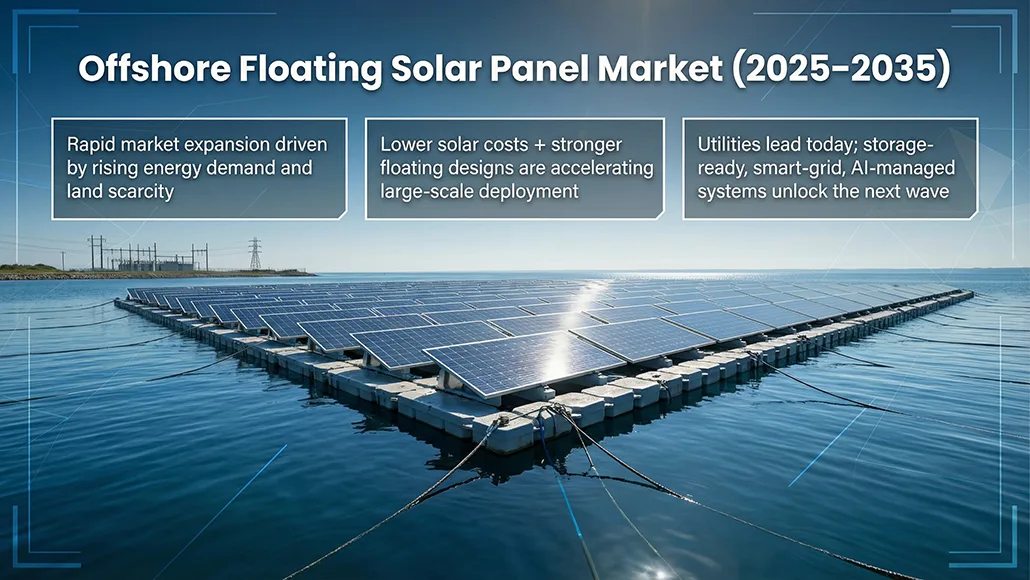
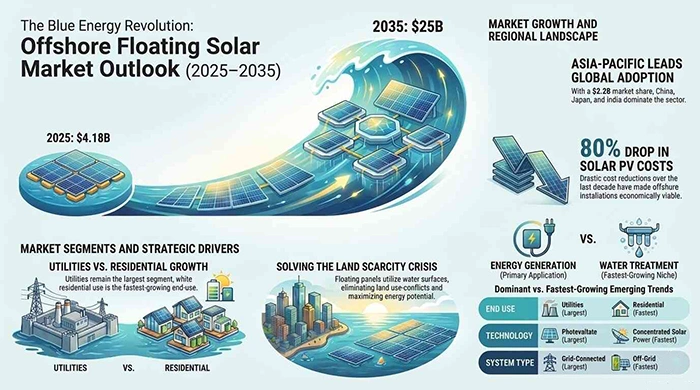
The global energy landscape is undergoing a profound transformation as nations pivot toward sustainable alternatives to traditional fossil fuels. Central to this transition is the offshore floating solar panel market, which has emerged as a critical solution for expanding renewable energy capacity while addressing the challenges of land scarcity. From a projected valuation of $4.18 billion in 2025, the market is forecasted to reach an impressive $25.0 billion by 2035, growing at a compound annual growth rate (CAGR) of 19.57% during the forecast period from 2025 to 2035.
Market Dynamics and Primary Drivers
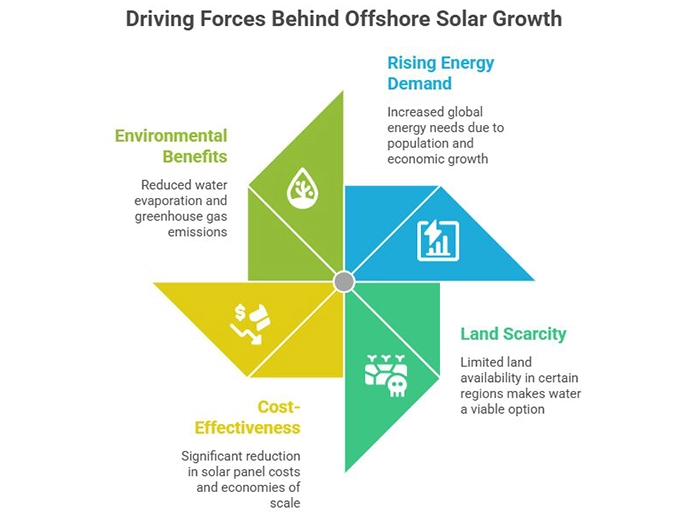
The offshore floating solar panel market report 2025-2035 shows growth propelled by several intersecting factors, most notably the rising global demand for energy. Projections indicate that energy consumption will increase by roughly 30% by 2040, driven by population growth and expanding economies. In regions where land is at a premium or topographical constraints prevent large-scale traditional solar farms, utilizing water bodies offers a high-potential alternative.
Cost-effectiveness remains a cornerstone of this expansion. Over the last decade, the cost of solar photovoltaic systems has plummeted by nearly 80%, a trend that significantly enhances the economic viability of offshore installations. These systems can also benefit from economies of scale, where larger maritime projects result in lower per-unit costs, making them increasingly competitive against traditional power sources. Furthermore, environmental benefits act as a secondary driver. Offshore solar arrays help reduce water evaporation from reservoirs and mitigate greenhouse gas emissions, aligning with global climate targets and biodiversity goals.
Technological Advancements and Trends
Technological innovation is radically altering the efficiency and durability of offshore solar systems. Recent developments include the adoption of bifacial solar panels, which maximize energy output by capturing sunlight from both sides of the panel. Additionally, advancements in floating platform designs allow these structures to withstand more extreme weather conditions, which is essential for marine environments.
The integration of smart grid technologies is another significant trend, enabling more efficient energy management and distribution across diverse networks. Furthermore, the market is seeing a push toward digitalization and the integration of artificial intelligence (AI) to optimize operational efficiency and predictive maintenance. These innovations are expected to reduce maintenance costs and improve the overall reliability of the systems, making them more attractive to long-term investors.
Segmentation Insights
End Use: Utilities vs. Residential
The utilities segment currently dominates the offshore floating solar panel market, as it accounts for the largest share of large-scale deployments. This segment is projected to grow from a valuation of $1.4 billion in 2025 to $10 billion by 2035. This dominance is fueled by significant infrastructure investments and government-led renewable energy initiatives. Conversely, the residential segment is emerging as the fastest-growing area. As consumer interest in sustainability increases and technology becomes more affordable, homeowners are increasingly looking to floating solar as a way to reduce carbon footprints and energy costs.
Technology: Photovoltaic vs. Concentrated Solar Power
Photovoltaic (PV) technology remains the leading segment due to its proven reliability and widespread application. The PV segment is expected to expand from $2.1 billion in 2025 to $17.5 billion by 2035. Photovoltaics are favored for their simplicity and effectiveness in various marine settings. Meanwhile, Concentrated Solar Power (CSP) is identified as the fastest-growing technology segment. CSP utilizes mirrors or lenses to focus sunlight onto small areas, and its integration into energy storage systems is enhancing its dispatchability and market appeal.
Application: Energy Generation vs. Water Treatment
Energy generation is the primary application for offshore floating solar panels, currently leading in market share and projected to grow from $1.75 billion in 2025 to $12.5 billion by 2035. This segment is vital for countries with limited land but extensive water resources. Water treatment is the fastest-growing application, as there is a rising need for sustainable solutions for water purification and pollution control. Other applications, such as aquaculture, recreation, and environmental monitoring, are also gaining traction, though they remain smaller in scale compared to the dominant energy generation sector.
Installation Type: Floating vs. Semi-Floating
The floating installation type is the largest segment, projected to grow from $2 billion in 2025 to $15 billion by 2035. Its popularity stems from its versatility and high efficiency in water usage. However, semi-floating systems are the fastest-growing installation type. These systems offer innovative designs that allow for greater adaptability in dynamic or challenging water conditions, making them a preferred choice for developers in diverse geographic regions.
System Type: Grid-Connected vs. Off-Grid
Grid-connected systems maintain the largest market share, with a projected growth from $1.75 billion in 2025 to $12.5 billion by 2035. These systems integrate seamlessly with existing electrical grids, providing reliable power for urban and industrial environments. The off-grid segment is the fastest-growing, driven by a desire for energy independence in remote or rural locations. Technological advancements are making these off-grid solutions increasingly viable and resilient.
Regional Market Analysis
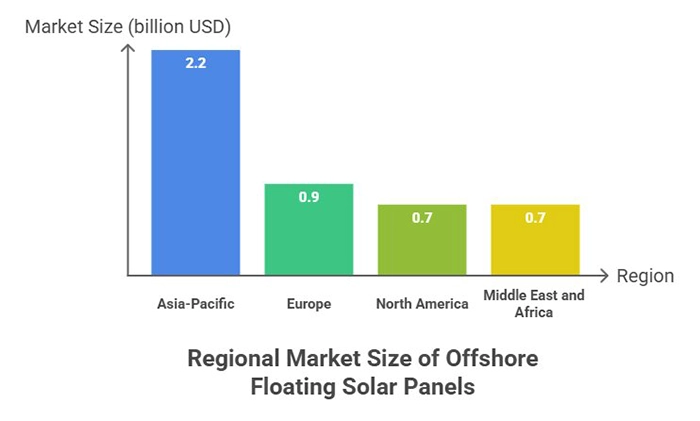
The offshore floating solar panel market displays distinct regional dynamics:
- Asia-Pacific: This region is the global leader, boasting a market size of approximately $2.2 billion. The dominance of the Asia-Pacific region is driven by rapid urbanization, high energy demand, and aggressive government initiatives to expand renewable energy capacity.
- Europe: Valued at $0.9 billion, Europe is a leader in sustainable energy policy. The region’s commitment to achieving a 55% reduction in greenhouse gas emissions by 2030 is a major catalyst for the adoption of innovative offshore solar technologies.
- North America: With a market size of $0.7 billion, North America is seeing growth driven by robust government support and state-level incentives aimed at reducing carbon emissions.
- Middle East and Africa: This region is valued at $0.7 billion and is considered to have significant emerging potential. Abundant sunlight and a desire to diversify energy sources away from fossil fuels are encouraging investment in solar adoption in these areas.
Future Outlook and Strategic Opportunities
Looking toward 2035, the future of the offshore floating solar panel market appears exceptionally bright. New opportunities are expected to arise from the development of integrated energy storage solutions, which will allow floating solar systems to provide more consistent power regardless of weather conditions. Furthermore, partnerships with maritime industries for dual-use platforms, combining solar generation with other marine activities, could provide a new avenue for growth.
Expansion into emerging markets will likely be facilitated by tailored financing models, making the technology more accessible to developing nations. As governments continue to implement supportive policy frameworks, such as feed-in tariffs, tax credits, and grants, the financial barriers for developers will continue to lower, fostering further innovation and wider adoption of these systems. The shift toward digitalization and AI-driven management will further cement the market’s role as a reliable, high-tech pillar of the global renewable energy infrastructure.