








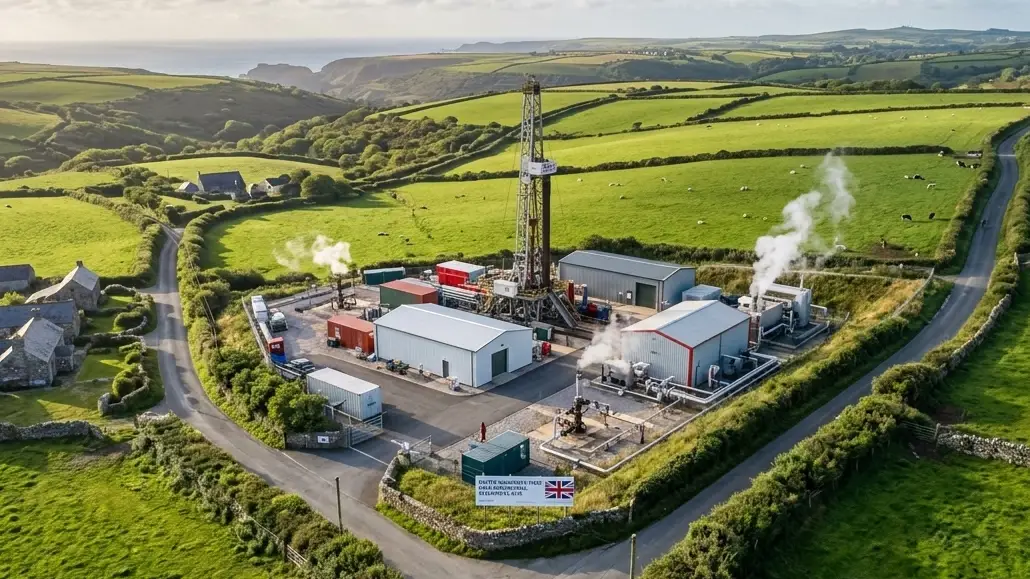
The first geothermal power plant in the UK stands turned on, hence providing a completely new kind of renewable electricity that uses hot water from underground.
On the morning of February 26, 2027, the Cornish plant, the first geothermal power plant in the UK was switched on after almost two decades in development that asked for Geothermal Engineering Ltd – GEL to drill the deepest onshore well located in the UK.
The water, which apparently is superheated due to rocks, is going to not only drive turbines in order to generate electricity across 10,000 homes but will also offer the first domestic supply of lithium in the UK. For the unversed, lithium is a critical mineral that is used in green technology.
Interestingly, the British Geological Survey has said that it was indeed a major step forward for geothermal; however, the high drilling costs could go on to make replicating this project quite challenging.
It is well to be noted that the Earth goes on to generate heat, which can very well be harnessed through drilling down below the surface in order to provide a renewable and also continuous source of energy so as to heat as well as power our homes. This is known as geothermal energy.
The fact is that the further down one goes, the hotter it becomes. When it comes to shallow depths, the heat is enough so as to warm homes as well as businesses. This has already been done in some parts of the country – for instance, the ground source heat pumps happen to be a form of geothermal technology, and in some places, such as Southampton, the heating is offered to many homes by way of a local network.
However, this project has drilled to much greater depths – to be exact, three miles below the surface, where the temperatures climb to almost 200°C, and this, by the way, happens to be enough to go ahead and heat in order to generate electricity.
According to the head of geothermal at the British Geological Survey – BGS, Dr. Monaghan, “You drill deep boreholes into the ground, and then fractures within the granite rock are used to circulate the water that picks up the heat [that is] used for electricity production.”
Granite is especially perfect for this technology, as it happens to be quite effective in terms of holding and conducting the heat of the Earth.
It is apparently the first time that such a feat has been attained in the UK since drilling this far down happens to be technically as well as financially quite a costly process. Notably, this project has cost £50m as of date and has been funded via private investors along with the EU.
CEO of GEL, Ryan Law, told the BBC: “[I’m] tremendously excited after 15 years of hard graft, difficulties, we’re finally there.”
He added that geothermal power was extremely important for the UK, as there are no price alterations such as the ones experienced with gas.
Hr further added”And unlike other renewable sources like wind and solar we are constantly on, 24/7 electricity.”
Notably, the power that is generated at the United Downs site is sold to Octopus Energy, which is going to deliver it, through the national grid, in order to meet electricity requirements of almost 10,000 homes.
According to a spokesperson from Octopus, this project is indeed a genuine game-changer, as for the very first time they are tapping into always-on green power within the UK, hence offering a balanced stream of clean and homegrown energy.
GEL happens to have two other sites also that it plans to develop into power plants, however one additional proposed site has, as a matter of fact, been turned down initially because of environmental concerns. The company is although appealing for it.
The funding when it comes to the initial site has come from many private investors. £15m in funding has come from the European Development Fund, which is a fund concerning the economic development that the UK had access to while it happened to be a part of the EU.
It is worth noting that generating electricity from geothermal is called deep geothermal and is also technically feasible across Scotland and also the Northeast of England; however, there are at present no plans that have been approved to do so.
Says the head of industry body Geothermal UK, Anne Murrell, “We have a great energy resource underneath our feet in the UK, but we’re not maximizing its potential.”
She remarked that the cost of deep geothermal is indeed comparable to certain other forms of electricity generation; however, there is a lot of spending that’s upfront.
She further said that, “The challenges we have include investment, and to unlock investment and increase investor confidence, we need a supportive government policy framework—geothermal needs to be recognized by the government as a key part of our energy strategy.”
At the end of 2025, the UK government went on to appoint Lord Whitehead as the first geothermal minister of the country, realizing the growing interest the sector has garnered.
According to him, it was indeed a pathbreaking moment for the innovation in the UK energy spectrum.