
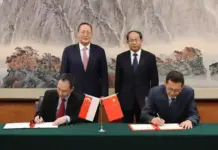















The National Intellectual Property Administration – CNPIA of China, along with the Ministry of Industry and Information Technology – MITT have gone on to unveil a package of policy measures that are crafted to strengthen the intellectual property – IP protection in the solar industry spectrum of the country.
The two parties went ahead and co-published a document that goes on to commit to strengthening the IP protection so as to effectively solve the challenge of involution competition, continuously come up with a fair as well as orderly market environment, and also promote healthy development in terms of the photovoltaic industry.
The document goes on to list eleven major tasks, beginning with promoting high-quality patent filing. Enterprises are encouraged to speed up the technological advancements within TOPCon, back-contract – BC and also heterojunction – HJT PV technologies and thereafter reserve basic patents for developing the technologies like perovskites and tandem.
Other major tasks happen to include enhancing the patent pre-examination efficiency, making the IP risk monitoring more robust, and also enhancing the handling when it comes to administrative adjudication of disputes.
The document also goes on to commit to bettering the collaborative protection in terms of IP rights, regulation of IP infringement within solar procurement schemes, and also the development in terms of diversified dispute resolutions. It then goes on to list the transformation along with the application of IP rights, making the overseas IP risk response stronger, elevating the IP capabilities of the enterprises, and also strengthening the trademark and brand building along with protection as certain other major tasks.
CNIPA and MIIT opine that by 2027, IP rights are going to have significantly contributed towards the healthy development when it comes to the photovoltaic industry through rolling out a number of high-value patents having competitive rights and also growing the ability of the sector to cope with the IP risks.
The document goes on to end with a commitment that IP management departments, as well as industry and information technology authorities, are going to work together in order to establish a coordination and, along with it, a consultation system pertaining to IP rights in the solar sector of China.
The system is in every way going to strengthen the entire guidance and also go ahead and form a regular communication mechanism, as per the document, through exploring the models of central-local government collaboration along with regional cooperation.
In addition to this, the coordination and consultation system is also going to support the solar businesses with IP management and utilization capabilities, go ahead and establish specialized think tanks that feature experts in IP, industry, and law, as well as public services, and also promote IP protection across the solar sector in China. This work is going to pave the way for a positive social atmosphere that actually respects the IP rights and also values the innovation, CNIPA as well as MITT conclude.
In July 2025, MITT went on to commit to curbing the disorderly competition in the solar sector of China through tackling the low-price competition and also the excess capacity. In November 2025, the ministry went on to say that it would address the irrational competition within the battery storage industry of the country.