







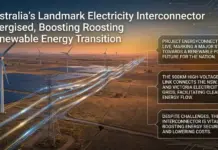





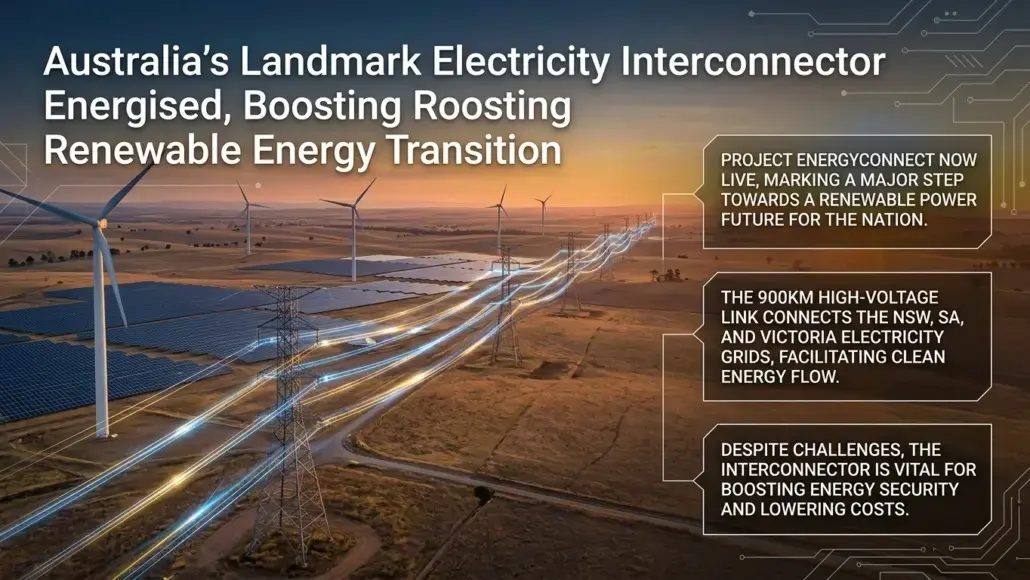
One of Australia’s largest electricity transmission project, Project EnergyConnect, has officially been energized. This marks a critical milestone in the nation’s renewable energy transition, following a period marked by considerable delays, contract challenges, and significant cost increases.
The Project EnergyConnect is a substantial 900-kilometer high-voltage interconnector designed to link the electricity grids of New South Wales, South Australia, and Victoria. Its energization establishes a new crucial pathway for renewable energy to travel between these three key states. The project, with an estimated investment of $4.1 billion, has been widely described as essential infrastructure for bolstering energy security, reducing wholesale electricity expenses, and supporting the nationwide shift away from coal-fired generation.
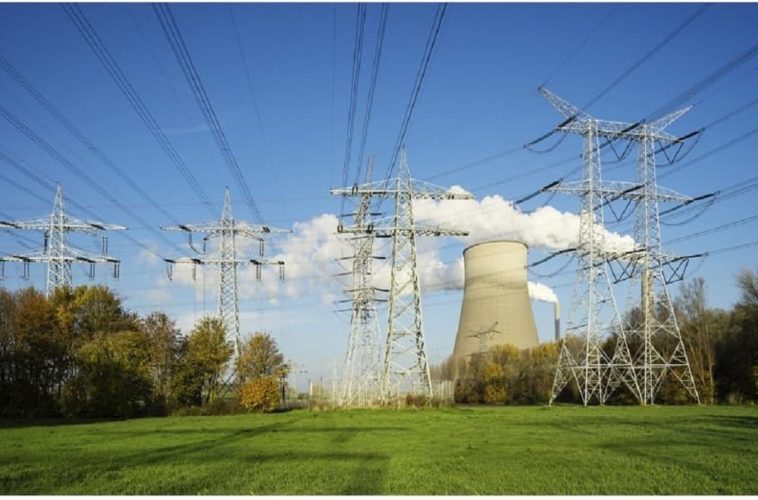
Transmission operator Transgrid announced the energization, highlighting the project’s pivotal role in connecting designated renewable energy zones and strengthening the National Electricity Market. This new infrastructure spans from Wagga Wagga in New South Wales to Robertstown in South Australia, with a direct connection into Victoria near Red Cliffs. The extensive undertaking includes the installation of over 1,500 transmission towers, the construction of multiple substations, and the laying of hundreds of kilometers of new transmission infrastructure across regional Australia.
The genesis of Project EnergyConnect dates back to 2016, when ElectraNet first began exploring the possibility of a new interstate transmission link between South Australia and New South Wales. Transgrid and its delivery partner, Elecnor, recently celebrated the completion of construction at the Dinawan Substation near Bundure in the Riverina region of New South Wales, signifying the conclusion of one of the country’s most complex energy infrastructure builds.
The path to completion for this landmark infrastructure project was not without its difficulties. Initially approved in 2021 with an estimated cost of approximately $2.3 billion, the New South Wales section is now projected to exceed $4 billion. This escalation is attributed to a sequence of setbacks, including the termination of the original engineering, procurement, and construction contract, challenges related to labour availability, disruptions in supply chains, inflationary pressures, and adverse weather conditions. Despite these hurdles, the commitment to the energy transition Australia is pursuing remained a driving force.
These cost overruns have naturally led to scrutiny from regulators and significant electricity users, with ongoing discussions regarding the recovery of these additional project expenses. Nevertheless, energy market experts and government officials have consistently affirmed the project’s critical importance to Australia’s energy transition. This is particularly relevant as older coal-fired power stations are progressively retired and are replaced by renewable generation, which is heavily reliant on robust storage and transmission infrastructure, key components of the national electricity market.
The Australian Energy Market Operator has repeatedly underscored the delivery of transmission infrastructure as one of the most crucial factors in ensuring a reliable and affordable transition to a low-emissions electricity system. Once fully operational, the EnergyConnect interconnector will enable a more fluid flow of electricity between New South Wales, South Australia, and Victoria. This improved connectivity is expected to enhance grid reliability, foster greater competition among electricity generators, and mitigate the risk of supply shortages during periods of peak demand, further solidifying the nation’s energy security.
Furthermore, the project is anticipated to stimulate billions of dollars in new renewable energy investments by providing increased capacity for both wind and solar developments across regional New South Wales and South Australia. Transgrid projects that the interconnector will yield close to $1 billion in net economic benefits over its operational lifespan, stemming from reduced energy costs, enhanced reliability, and greater access to renewable energy resources. With the line now energized, the project is entering its final testing and commissioning phases before achieving full operational capacity. This development positions it as a new backbone for Australia’s rapidly expanding renewable energy network and one of the most significant pieces of energy infrastructure delivered in the nation’s history.