











The relentless pursuit of sustainable energy sources stands as one of humanity’s most critical endeavors. As global populations grow and industrial demands escalate, the imperative to decouple economic progress from environmental degradation becomes ever more pressing. In this grand challenge, a visionary concept that once resided firmly in the realm of science fiction is steadily gaining traction and serious scientific consideration: space-based solar power. The idea of harnessing the sun’s energy from orbit, where it shines unceasingly and unhindered by atmospheric interference, and beaming it down to Earth, offers a potentially transformative solution to our energy needs. Could this audacious vision, alongside the creation of expansive orbital energy grids, truly become a tangible reality, fundamentally reshaping our future energy landscape? Power Gen Advancement believes it is possible.
At its heart, space-based solar power proposes to collect solar energy in orbit, convert it into electricity, and then transmit it wirelessly to receiving stations on Earth. The allure is immediate and profound. Unlike terrestrial solar farms, which are subject to day-night cycles, weather patterns, and atmospheric absorption, solar power satellites in geosynchronous orbit could capture sunlight 24 hours a day, 7 days a week, with significantly greater intensity. This uninterrupted availability is key to delivering what the world desperately needs: a source of reliable clean baseload electricity that does not fluctuate with environmental conditions and can meet constant energy demands.
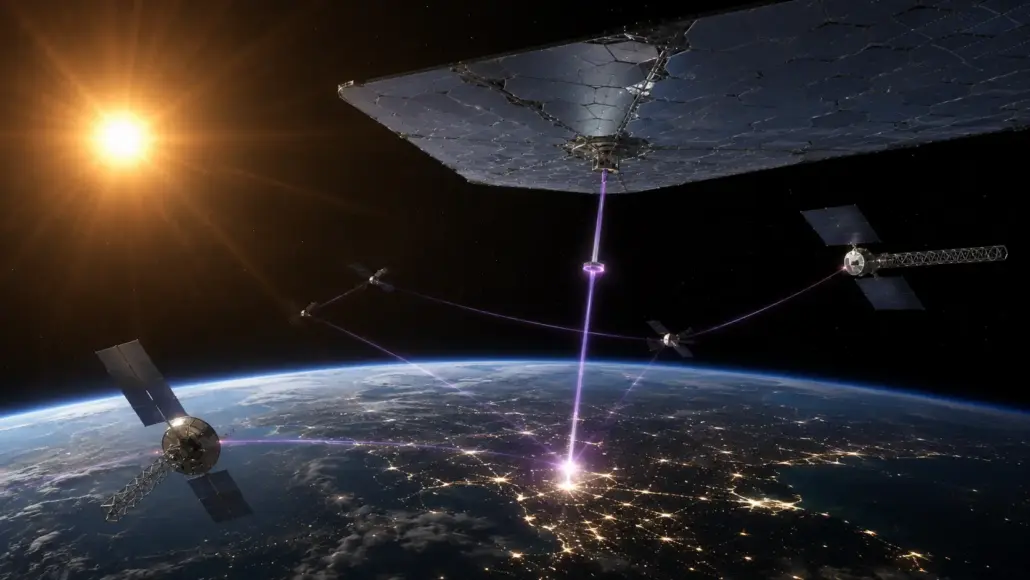
The foundational principle of space-based solar power relies on placing large arrays of photovoltaic cells or thermal collectors in Earth orbit. These solar power satellites would continuously face the sun, converting its radiation into electricity with high efficiency. Once generated, this electricity needs to be transported back to our planet. This is where the concept of wireless power transmission enters the equation. The most widely discussed methods involve converting the electrical energy into microwaves or laser beams. These highly concentrated beams would then be directed towards receiving antennas, known as rectennas (for microwaves) or photovoltaic arrays (for lasers), on the ground. Upon striking these terrestrial receivers, the energy would be converted back into usable electricity and fed into the existing grid infrastructure. The technological precision required for such a feat is immense, demanding incredibly accurate pointing systems to ensure the beam reaches its intended target safely and efficiently.
The vision extends beyond a single satellite to the much grander concept of orbital energy grids. Imagine multiple solar power satellites networked together, potentially sharing collected energy among themselves or directing it to various receiving stations across the globe based on demand. Such an interconnected system would offer unprecedented flexibility and resilience. Instead of relying on singular points of failure, an orbital grid could reroute power, ensuring continuous supply even if one satellite or receiving station encountered issues. This multi-satellite approach is crucial for building a robust and stable future energy grid, capable of meeting the dynamic and geographically diverse energy requirements of a globalized society. By distributing power generation across numerous orbiting assets, the system could provide a truly global utility, offering energy independence and security to nations previously constrained by indigenous resource availability or geopolitical pressures.
While the promise of space based solar power is compelling, the journey from conceptual design to operational reality is fraught with significant technical and economic challenges. One of the primary hurdles is the sheer cost of launching the necessary components into orbit. Building solar power satellites on a scale large enough to make a meaningful contribution to global energy needs would require thousands of tons of material to be transported into space. Current launch costs, though decreasing, still present a formidable barrier. Innovative approaches like in-space manufacturing, robotic assembly, and reusable launch vehicles are critical to making the economics viable.
Beyond launch, the technical complexities of operating such a system are vast. Developing incredibly lightweight yet robust materials that can withstand the harsh space environment for decades is essential. The efficiency of wireless power transmission needs to be maximized, minimizing energy loss during the long journey from orbit to Earth. Safety concerns surrounding the focused energy beams are paramount. Precise beam control and fail-safe mechanisms are indispensable to prevent inadvertent targeting or environmental harm. Researchers are actively working on mitigating these risks, with beam power densities designed to be significantly below hazardous levels, comparable to ambient sunlight, ensuring safety even in the unlikely event of a stray beam.
Despite these challenges, recent years have witnessed an accelerated pace of renewable energy innovation specifically directed towards space energy technology. Agencies like NASA, JAXA (Japan Aerospace Exploration Agency), and ESA (European Space Agency), along with numerous private companies, are investing heavily in research and development. Prototypes for highly efficient space solar cells are being developed, and small-scale demonstrations of wireless power transmission have already been successfully conducted on Earth. These experiments are not just theoretical exercises. They are tangible proof of concept, inching us closer to a future where space-based solar power is a viable option.
The potential benefits of successfully implementing space-based solar power are nothing short of revolutionary. Imagine a world powered by continuous, clean baseload electricity, available irrespective of location or time zone. This would dramatically reduce reliance on fossil fuels, curbing greenhouse gas emissions and mitigating climate change. It would offer unprecedented energy security, freeing nations from the volatile geopolitics of oil and gas markets. Furthermore, it could provide universal access to electricity, bringing power to remote communities and developing regions that currently lack reliable energy infrastructure, thereby driving economic growth and improving quality of life globally.
The development of orbital energy grids would foster a new era of international cooperation and collaboration, as such a grand endeavor would likely necessitate shared resources, expertise, and regulatory frameworks. It would spur monumental advancements in engineering, robotics, and material science, creating new industries and high-tech jobs. Indeed, the very ambition of space-based solar power pushes the boundaries of human ingenuity, driving forward the frontiers of space energy technology and inspiring future generations of scientists and engineers.
Looking ahead, the roadmap to widespread deployment of space-based solar power involves several key phases. Initial stages will likely focus on smaller, modular satellites, proving the technology and demonstrating economic viability at a reduced scale. As launch costs continue to fall and in-space manufacturing techniques mature, the size and capability of solar power satellites will expand. The development of an overarching framework for international collaboration, investment, and regulation will be crucial to coordinate this global undertaking.
The question of whether space-based solar power and orbital energy grids can become a reality is no longer a simple ‘if,’ but rather a complex ‘when’ and ‘how.’ Power Gen Advancement observes that the scientific principles are sound, the technological progress is accelerating, and the imperative for clean, reliable energy is undeniable. While formidable challenges remain, the potential rewards a world powered by abundant, clean baseload electricity, underpinned by robust orbital energy grids, and secured by radical renewable energy innovation are too significant to ignore. The dream of a truly sustainable future energy grid, powered from the ultimate source, the sun itself, through ingenious space energy technology, is slowly, but surely, beginning to materialize on the horizon.