









The global shift toward sustainable energy is fundamentally altering the landscape of electrical power generation. As large-scale wind farms and sprawling solar arrays replace traditional coal and gas-fired power plants, the technical characteristics of the grid are undergoing a profound transformation. This transition, while essential for meeting climate goals and ensuring environmental sustainability, introduces a unique set of renewable integration power protection challenges that must be addressed to maintain the stability and reliability of the modern grid. Unlike the synchronous generators of the past, which provided a massive and predictable source of fault current, modern inverter-based resources (IBRs) behave in ways that can confuse legacy protection systems, requiring a new generation of engineering solutions.
At the heart of these challenges is the difference in how these various energy sources respond to a fault on the network. A traditional rotating generator has a physical rotor that provides mechanical inertia and a substantial electromagnetic field that can deliver five to six times its rated current during a short circuit. This high level of fault current is easy for traditional overcurrent and distance relays to detect and isolate. In contrast, an inverter-based resource is limited by its power electronics, typically providing only 1.1 to 1.5 times its rated current. This low fault current contribution can lead to “protection blindness,” where a relay fails to recognize that a fault has even occurred, allowing a dangerous condition to persist on the grid and potentially causing significant damage to equipment.
The Impact of Low Inertia and Variable Fault Current
One of the most critical renewable integration power protection issues is the reduction in overall system inertia. Inertia is the “shock absorber” of the grid, providing the stored rotational energy that slows down frequency changes during a sudden loss of generation or a major fault. As we move toward a grid dominated by solar and wind, which are connected via electronic inverters rather than massive spinning turbines, this natural buffer is disappearing. Without sufficient inertia, the rate of change of frequency (RoCoF) can be extremely high, potentially leading to widespread load shedding, equipment damage, or even a complete system collapse within seconds. To counter this, protection engineers are developing “synthetic inertia” and “fast frequency response” (FFR) strategies that use power electronics and battery storage to mimic the behavior of traditional rotating machines.
Furthermore, the fault current contribution from IBRs is not only low but also highly variable and non-linear. The amount of current an inverter can provide depends on its control algorithms, the status of its DC-link voltage, and the specific type of fault. This variability makes it difficult to set fixed relay parameters that are both sensitive enough to detect all faults and secure enough to avoid nuisance tripping during normal power swings. In some cases, the inverter may even disconnect itself from the grid during a fault to protect its internal sensitive electronics, further complicating the coordination of downstream protection devices and potentially worsening the instability of the grid. This unpredictability is a major driver for the adoption of more advanced, software-defined protection schemes.
Bidirectional Power Flow and Protection Coordination
Traditional distribution networks were designed as “radial” systems, where power flowed in one direction from the substation to the end-user. Protection coordination was relatively straightforward, with relays and fuses set to trip in a sequence that isolated the fault as close to the source as possible. However, the rise of rooftop solar and community wind projects has turned these radial lines into bidirectional pathways. This “active” distribution network creates significant renewable integration power protection hurdles, as power can now flow from the customer back into the utility grid, often in ways that vary with the time of day and the weather.
This bidirectional flow can lead to “sympathetic tripping,” where a relay on a healthy feeder trips due to the fault current contributed by local generation on that feeder. It can also cause “protection desensitization,” where the fault current from a distributed generator reduces the amount of current seen by the main substation relay, preventing it from operating correctly and leaving a fault on the line. To manage these complex interactions, utilities are increasingly moving away from simple overcurrent protection toward more sophisticated directional relays and communication-assisted schemes. By sharing real-time data between the substation and the distributed generators, these systems can ensure that only the faulted section of the line is isolated, maintaining power for as many customers as possible and improving the overall resiliency of the network.
Managing the “Duck Curve” and Voltage Stability
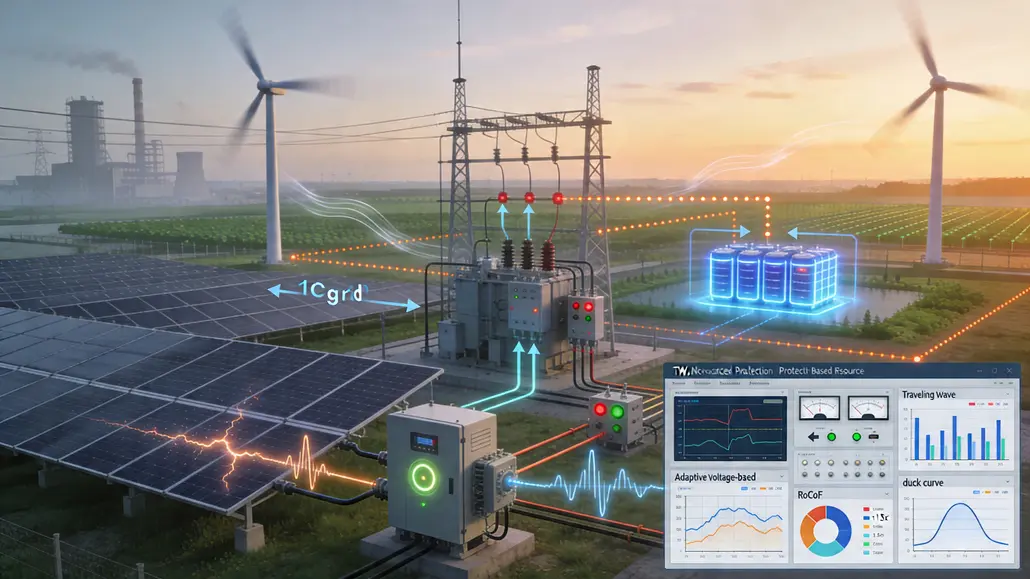
The high penetration of solar energy leads to what is known as the “Duck Curve,” where the net load drops during the day and surges in the evening when the sun goes down. This rapid change in net load places a strain on protection and control systems, as they must manage large swings in voltage and power flow. Renewable integration power protection must account for these voltage fluctuations to prevent “over-voltage” conditions that can damage household appliances or “under-voltage” conditions that can lead to brownouts.
Modern inverters are now equipped with “volt-VAR” control, which allows them to absorb or inject reactive power to stabilize the local voltage. However, the interaction between thousands of these local controllers and the central utility control system can be complex and sometimes unstable. Protection systems must be designed to distinguish between a voltage drop caused by a fault and a voltage drop caused by the rapid change in cloud cover. This requires a higher level of intelligence and faster data processing than was ever needed in the traditional grid.
Advanced Protection Solutions for Inverter-Based Grids
To overcome the limitations of traditional current-based protection, engineers are exploring several innovative technologies. One promising approach is the use of traveling wave (TW) relays. These devices don’t rely on the magnitude of the fault current but instead measure the high-frequency voltage and current pulses that travel along a power line at the speed of light when a fault occurs. Because traveling waves are independent of the source’s fault current contribution, they are ideally suited for renewable integration power protection in grids with low inertia and high IBR penetration. TW relays can also locate a fault with incredible precision, often within a few hundred feet, which is a major benefit for maintenance and repair crews, especially on long transmission lines in remote areas.
Another emerging solution is the use of voltage-based protection schemes and incremental quantity algorithms. Since the voltage at a fault location always drops, regardless of the source, monitoring the change in the voltage profile across the network can provide a more reliable indication of a fault than current alone. This is particularly useful for protecting microgrids and isolated sections of the distribution network that are powered entirely by inverters. By integrating these voltage-based measurements with high-speed communication links, protection engineers can create a “differential” protection scheme that compares the power entering and leaving a specific zone. If there is a mismatch, a fault is detected and the zone is isolated instantly, providing a robust defense against the limitations of low-current inverter output.
Adaptive Settings and Machine Learning in Protection
The dynamic nature of renewable-heavy grids also demands a move toward adaptive protection. An adaptive relay can automatically switch between different setting groups based on the current state of the grid for instance, whether it is day or night, or whether a major wind farm is online. This level of autonomy is essential for managing the day-to-day variability of renewable energy sources. This real-time adjustment is a core component of modern renewable integration power protection strategies, ensuring that the system remains both safe and reliable under all operating conditions, from clear sunny days to stormy nights.
Looking further ahead, the integration of machine learning and artificial intelligence into the protection loop offers exciting possibilities. By training algorithms on vast datasets of historical faults and high-fidelity simulation results, we can create protection systems that can recognize the unique “signatures” of different types of disturbances with near-perfect accuracy. These AI-driven relays could potentially distinguish between a genuine fault and a temporary power swing or a cloud passing over a solar farm much better than traditional logic-based systems. As these technologies mature, they will provide a vital layer of intelligence that will help to navigate the complexities of the future green grid, making high-penetration renewable integration a reality without compromising on the safety standards we expect.
The Role of Grid-Forming Inverters
While most current inverters are “grid-following,” meaning they synchronize their output to the existing grid voltage and frequency, a new generation of “grid-forming” (GFM) inverters is being developed. These devices are designed to actively set the voltage and frequency of the grid, much like a traditional synchronous generator would. From a renewable integration power protection perspective, GFM inverters are a significant breakthrough. They can provide a more predictable fault current response and contribute to the virtual inertia of the system, making it much easier for legacy protection devices to function correctly and for the grid to maintain stability during disturbances.
The deployment of grid-forming technology is particularly important for the stability of remote or weakly-connected grids that rely heavily on renewable energy. By providing a stable reference for the rest of the network, GFM inverters can prevent the rapid frequency swings that often lead to blackouts in high-renewable scenarios. As the cost of these advanced inverters continues to fall and the technology matures, they will become a standard component of many renewable projects, helping to solve some of the most persistent protection and stability challenges associated with the green energy transition. This evolution of inverter technology is a key enabler for the 100% renewable grids of the future.
Long-Term Sustainability and Grid Reliability
The successful integration of renewable energy into our power systems is one of the most important technical and social challenges of our time. By addressing the renewable integration power protection issues head-on, we can ensure that the transition to a low-carbon economy does not come at the expense of grid reliability or public safety. This requires a multi-disciplinary approach that combines the best of traditional protection engineering with the latest advancements in power electronics, communication, and data science. As we continue to innovate and adapt, the goal of a carbon-neutral grid becomes not just an aspiration, but a practical and achievable reality for societies around the world.
Ultimately, the goal of these protection strategies is to create a grid that is invisible to the end-user a system that is so reliable and resilient that we never have to think about where our power comes from, even as it comes from millions of diverse and variable sources. By building a robust protection framework that can handle the variability and complexity of solar and wind, we are ensuring that the clean energy transition is a success for everyone. The technical hurdles are high, but the potential rewards in terms of environmental protection and energy independence are even higher. As we look to the future, the lessons we learn today in the field of renewable integration power protection will be the foundation for the global energy systems of tomorrow, powering our world in a way that is both sustainable and secure for generations to come.