





The global energy sector is currently navigating a pivotal transformation, shifting away from the era of “gigawatt-scale or nothing” toward a more flexible, scalable, and commercially agile future. At the heart of this transition is the emergence of small modular reactors (SMRs) and microreactors, innovative technologies that promise to solve the historical challenges of high capital costs and lengthy construction timelines associated with traditional nuclear power. As nations race toward climate neutrality and enhanced energy security, these compact powerhouses are no longer mere theoretical concepts. They are moving rapidly into the deployment phase, from the plains of Uzbekistan to the industrial hubs of North Wales and the strategic corridors of the European Union. Power Gen Advancement believes SMRs can provide the revolutionary shift to to exisiting nuclear power industry to take it to the future of innovations.
The Modular Revolution in Manufacturing
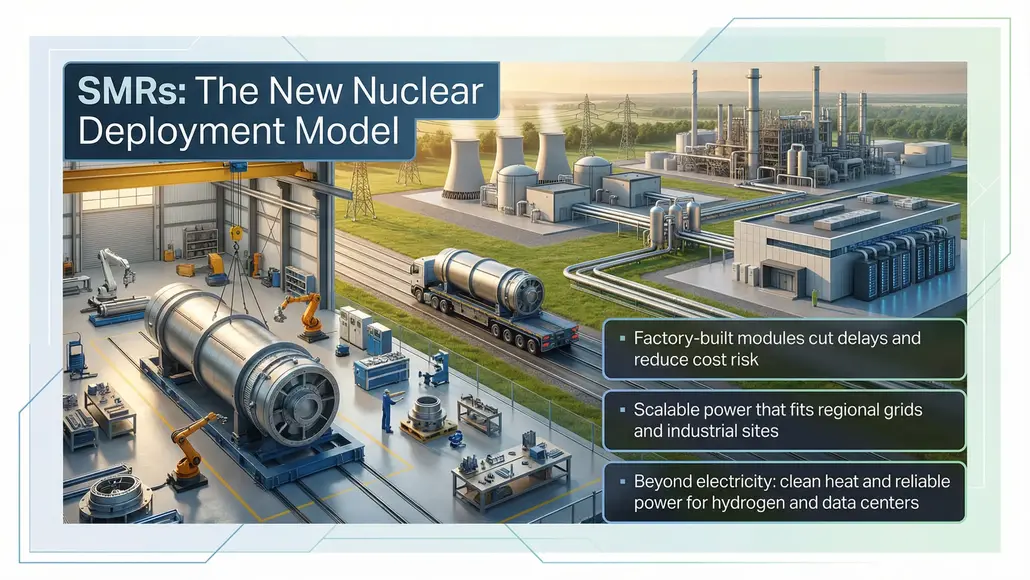
The defining characteristic of this new nuclear era is the move from on-site bespoke construction to factory-based manufacturing. Traditional nuclear plants are massive infrastructure undertakings, often plagued by delays and cost overruns. In contrast, small modular reactors are designed with a modularity that allows major components to be fabricated in a controlled factory environment and then transported to the site for final assembly. This “fleet-based” approach aims to standardize the supply chain, reduce financial risk for investors, and significantly accelerate the time it takes to bring new capacity online. Overall, SMRs provide these benefits to the deployment and advancement of nuclear energy:
- Standardization: Developing industrial standards supports a “fleet approach,” allowing for the mass production of reactor components.
- Scalability: SMRs offer a smaller footprint and output, making them suitable for regions where a traditional 1GW+ reactor would overwhelm the local grid.
- Cost Management: By leveraging synergies across value chains and avoiding the fragmentation of one-off projects, the industry aims for rapid commercialization.
The European Blueprint: Strategy and Sovereignty
The European Commission has recognized that industrial leadership in next-generation nuclear technology is a prerequisite for competitiveness. In early 2026, the Commission unveiled a comprehensive strategy to bring Europe’s first small modular reactors online by the early 2030s. This initiative is not merely about power generation; it is a strategic effort to mobilize entire value chains across the EU, reinforcing energy security while phasing out dependencies on external energy imports.
The EU’s strategy emphasizes a unified approach, seeking to avoid the fragmentation of regulatory frameworks that has historically slowed nuclear progress. By establishing “SMR Valleys,” the Commission hopes to promote business collaboration and manufacturing hubs that can serve a global market. Furthermore, the introduction of a “SMR coalition” for interested member states will help align policy and economic coordination for selected reactor designs. EU is advancing on its path to obtain SMRs based on these requirements and regulations:
- Capacity Goals: Total capacity in the EU is projected to reach between 17 GW and 53 GW by 2050.
- Investment Needs: An estimated €241 billion is required by 2050 to cover lifetime extensions and new builds, including the realization of SMR and AMR potential.
- Regulatory Sandboxes: Under the Net-Zero Industry Act, the EU is promoting regulatory cooperation and “sandboxes” to fast-track innovation while maintaining the highest safety standards.
Uzbekistan’s Advancement in SMR Deployment
While Europe lays its strategic groundwork, Uzbekistan is making tangible progress on the ground, making huge progress in the adoption of SMR technology. In a landmark project in the Jizzakh region, the country has begun concrete work for the foundation of the world’s first land-based export of the RITM-200N reactor. This water-cooled SMR, adapted from proven nuclear-powered icebreaker technology, represents a significant shift in Uzbekistan’s energy portfolio, aiming to provide approximately 14% of the nation’s total energy requirements once fully operational.
The project demonstrates the versatility of the “hybrid” nuclear site. Uzbekistan recently adjusted its plans to include two gigawatt-scale units alongside two 55 MWe small modular reactors. This combination allows for massive baseload power while utilizing SMRs for more specialized or flexible grid needs, effectively future-proofing the country’s technological sovereignty for decades.
The UK’s Strategic Pivot
In the United Kingdom, the focus has shifted toward North Wales, specifically the Wylfa site on Anglesey, which has been designated as the heart of the UK’s next-generation nuclear future. A substantial £300 million contract was recently awarded to support the development of Rolls-Royce SMR technology at the site. With a capacity of 470 MWe per unit, these reactors are designed to be quicker to deploy than traditional stations, offering a pragmatic solution to the UK’s urgent need for clean energy and energy security.
The mobilization of the supply chain in North Wales is a clear signal to the market that the focus has moved from research to delivery. This project is expected to create thousands of skilled jobs, bolstering the local industrial base while protecting households and businesses from the volatility of international gas prices. This nuclear project features various benefits to UK:
- Strategic Oversight: The Litmus Nuclear joint venture will provide technical assurance across design, safety, and commissioning.
- Grid Integration: The 470 MWe output is optimized for the UK’s energy infrastructure, providing reliable, low-carbon baseload power.
- Economic Revitalization: The project positions Wales at the forefront of a global expansion in nuclear energy.
Diversified Applications of SMRs
One of the most persuasive arguments for the adoption of small modular reactors is their ability to provide solutions beyond simple grid electricity. Because they can be sited closer to industrial hubs than large-scale plants, they are ideal for decarbonizing “hard-to-abate” sectors. The high-temperature heat generated by these reactors can be utilized for district heating, chemical manufacturing, and the production of hydrogen.
Furthermore, as the digital economy expands, the demand for stable, carbon-free power for data centers has skyrocketed. SMRs and even smaller microreactors are uniquely suited to provide this dedicated, “behind-the-meter” power, ensuring that the backbone of the modern internet remains both reliable and green. The primary advantages of SMRs beyond power generation are:
- Industrial Heat: SMRs can support the decarbonization of heavy industries by providing consistent, high-grade thermal energy.
- Hydrogen Economy: Nuclear-produced heat and power are essential components for the cost-effective scaling of hydrogen production.
- Energy Security: Small reactors offer “homegrown” energy solutions that reduce reliance on volatile global fuel markets.
Conclusion: A Strategic Imperative
The transition toward small modular reactors represents more than just a technological shift; it is a strategic necessity for a world demanding both decarbonization and energy independence. By moving away from the complexities of massive, one-off construction projects toward a factory-manufactured, fleet-based model, the nuclear industry is finally addressing the economic barriers that have hindered its growth for decades.
As the examples in Europe, Uzbekistan, and the UK demonstrate, the momentum is now irreversible. Governments and private investors are aligning to create the regulatory “sandboxes,” supply chains, and “SMR Valleys” necessary to bring this technology to market. For executives and policymakers, the message is clear: the future of nuclear power is smaller, smarter, and rapidly approaching. Power Gen Advancement believes that the nations and industries that lead in the deployment of SMRs today will be the ones that define the global energy landscape of tomorrow.