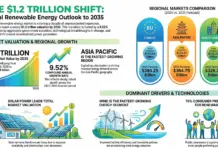





The deployment of clean energy technologies, fuels and materials continues to accelerate, yet evolving policy frameworks, shifting economic conditions and ongoing technological advances are introducing fresh uncertainty around their long-term trajectory and commercial viability. Within this complex environment, the IEA’s flagship publication Energy Technology Perspectives (ETP) recently shed some light to distinguish meaningful trends from short-term noise by delivering data-driven insights across deployment, manufacturing, trade, competitiveness and security. The report underscores that accurately interpreting the current moment is critical to avoid misallocation of capital or a loss of momentum, particularly as the clean energy supply chain evolves. Across all IEA scenarios, deployment expands, although market value growth varies significantly depending on policy direction. The global market value for clean technologies has increased by 20% annually over the past decade, reaching nearly USD 1.2 trillion in 2025. Under the Current Policies Scenario (CPS), it still doubles to around USD 2 trillion by 2035, while in the Stated Policies Scenario (STEPS) it climbs to almost USD 3 trillion, driven by stronger deployment. Electric cars dominate this landscape, accounting for nearly three-quarters of total market value, reinforcing their central role in the clean energy supply chain.
Low-emissions fuels present notable growth potential, particularly those compatible with existing infrastructure. While they face competition not only from fossil fuels but also from electrification in sectors such as transport, their market value is projected to rise from USD 215 billion in 2025 to around USD 390 billion in 2035 in both CPS and STEPS. Much of this expansion is driven by established biofuels including biomethane, bioethanol and biodiesel, while wider adoption of sustainable aviation fuels and hydrogen-based fuels will depend on stronger policy backing. At the same time, the outlook for near-zero emissions materials remains uncertain due to persistent cost premiums. Technologies such as carbon capture in cement production and hydrogen-based steelmaking are expected to remain more expensive than conventional methods, leaving policy support as a decisive factor. Market value for these materials reaches USD 5 billion in the CPS and USD 20 billion in the STEPS by 2035, reflecting ongoing challenges within this segment of the clean energy supply chain.
Cost competitiveness is increasingly shaping the expansion of key technologies. Significant declines in costs for solar PV, batteries, electric cars and heat pumps, enabled by mass manufacturing and modular design, have strengthened their adoption, while innovation continues to drive progress in areas such as nuclear and geothermal. Around 80% of global solar PV and wind generation now undercuts coal or gas on cost, while battery prices have fallen by 75% over the past decade. Emerging technologies, including low-emissions hydrogen, CCUS and near-zero emissions materials, are advancing, though they rely heavily on policy support and large-scale investment. Meanwhile, early-stage innovations such as nuclear fusion and electrochemical production methods are attracting capital but remain commercially uncertain, highlighting both opportunity and risk within the clean energy supply chain.
The elements influencing industrial competitiveness vary among supplier chains in the production of clean energy technologies. Decades of accumulated advantages, including innovation, large-scale production, manufacturing efficiency, a skilled workforce, integrated supply chains, and access to inexpensive labor and resources, are reflected in China’s competitive advantage and low costs. These advantages are further supported by steady financial and policy assistance. As experience grows in other nations and via ongoing innovation, there are chances to close the cost gap with China across all supply chains taken into consideration. More than 40% of the difference in battery costs between China and Europe can be attributed to improved production efficiency. The cost difference with Europe in energy and labor-intensive phases, including wind blade production (75% of the gap) and upstream solar PV manufacturing (65% of the gap), is mostly due to disparities in labor and energy costs. Production in advanced economies can still be competitive since electrolyser manufacturing is not yet established at scale anywhere and there is a trade-off between low-cost production, efficiency, and durability.
Countries must recognize and capitalize on their assets and seek out strategic alliances to boost industrial competitiveness in order to rise to the occasion. Strategic upstream industries are a source of indirect value creation and are essential to many sectors outside of energy, including defense, while downstream industries usually produce more direct value added to the economy. The relative strategic importance of these industries determines how the balance between domestic production and imports of resources and technologies is achieved. For energy-intensive processes, some emerging markets with exceptionally low energy prices, such those in the Middle East or North Africa, may be able to attain production costs that are even lower than China’s. It could be over 20% less expensive to produce solar PV modules built in the EU using imported wafers from North Africa than to produce a module made entirely in the EU. In theory, India, Southeast Asia, and the Middle East could make wafers and polysilicon at prices similar to those of China, and Southeast Asia now has the potential to do so. The production cost difference between Europe and China could be reduced by 75% if wind turbines were manufactured in Europe and components were imported from India at a cost of only 15%. Costs can be decreased and diversification can be increased by strategic cooperation between nations for particular supply chain steps.
Trade remains a defining factor despite rising tariffs and policy interventions. In the STEPS, global trade in clean energy technologies more than doubles to USD 620 billion by 2035, with China maintaining a dominant export position. It is expected to have an export market of the size of USD 375 billion in 2035, which will be 10% of its total goods export market. However, supply chain concentration presents vulnerabilities, as China accounts for 60-85% of production capacity in key areas. Disruptions could have significant economic consequences, including major losses in electric vehicle and solar manufacturing output outside China. Efforts to diversify production, particularly in the United States, India and the European Union, are underway but face structural and economic constraints. Investment trends also reflect this shift, with global manufacturing investment declining slightly from its peak and increasingly focused on supply chain diversification. Ultimately, competitiveness across the clean energy supply chain will depend on balancing cost, innovation, resource access and strategic partnerships.