











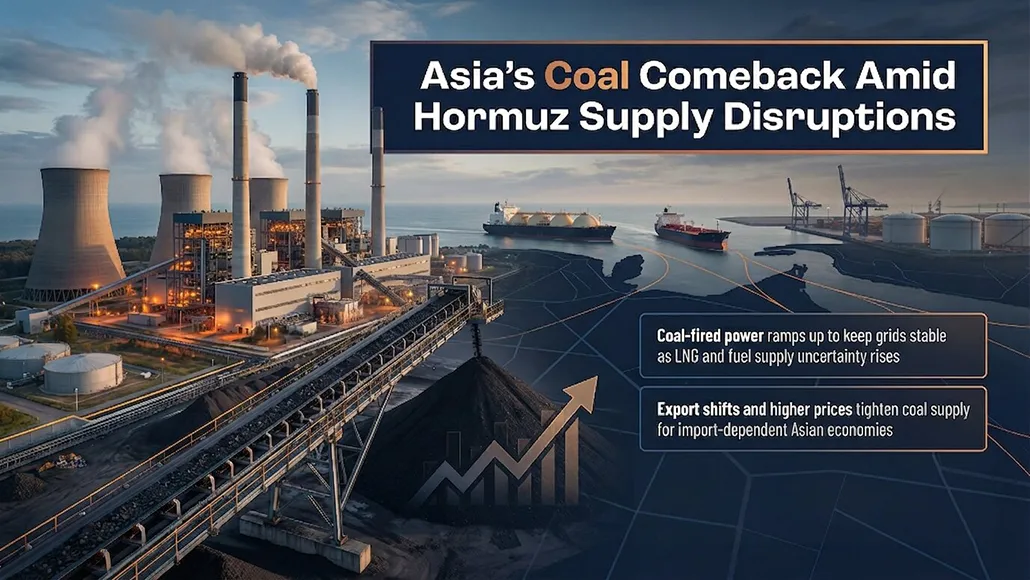
Asian economies are increasingly leaning on coal use as disruptions linked to the Iran war constrain oil and gas shipments, exposing vulnerabilities across the region’s energy systems. Much of Asia’s fuel imports pass through the Strait of Hormuz, a critical chokepoint that handles about one-fifth of global oil and natural gas trade. With supply uncertainty rising, countries are adjusting their energy mix to maintain stability. Liquefied natural gas (LNG), which is natural gas cooled into liquid form for easier transport and storage, has long been promoted as a transitional fuel in the shift toward cleaner energy. Although LNG burns more cleanly than coal, it still emits greenhouse gases, particularly methane, leaving policymakers balancing short-term supply needs with long-term climate goals as coal use rises.
The immediate impact of supply disruptions has triggered a shift back toward coal-fired generation across several Asian markets. India has increased coal use to meet surging summer demand, while South Korea has relaxed restrictions on coal-based electricity generation. Indonesia is prioritising domestic coal consumption over exports, and countries such as Thailand, the Philippines and Vietnam are expanding coal-fired power output to offset LNG shortages. While this approach offers short-term relief, it carries environmental costs, including worsening air pollution in major cities and a slowdown in renewable energy adoption. Experts continue to stress that while coal may serve as a temporary solution, long-term strategies must focus on cleaner energy alternatives despite the current surge in coal use.
In China, the world’s largest coal producer and consumer, significant capacity additions since 2021 highlight the country’s emphasis on energy security. National policy continues to support coal alongside expanding renewable energy capacity. India, the second-largest coal producer and consumer, is preparing for extreme summer temperatures and expects peak electricity demand to reach 270 gigawatts nearly double the output capacity of Spain. Existing coal reserves are estimated to last about three months, with some stockpiles allocated to support small businesses, further underscoring the central role of coal use in managing demand pressures.
Supply dynamics are also shifting across the region. Indonesia, the leading global exporter, is redirecting output to domestic markets, increasing uncertainty for import-dependent countries. Vietnam has already experienced volatility, increasing imports following weather-related shortages, but now faces supply risks and is considering alternative sources such as the U.S. and Laos, according to Argus Media.
Meanwhile, Newcastle coal from Australia, a key benchmark for Asian markets, has seen prices rise by 13% since the conflict began. Higher costs are expected to weigh on Southeast Asia, the third-largest coal-consuming region globally, as countries including Vietnam, the Philippines and Thailand continue expanding coal-fired generation.