















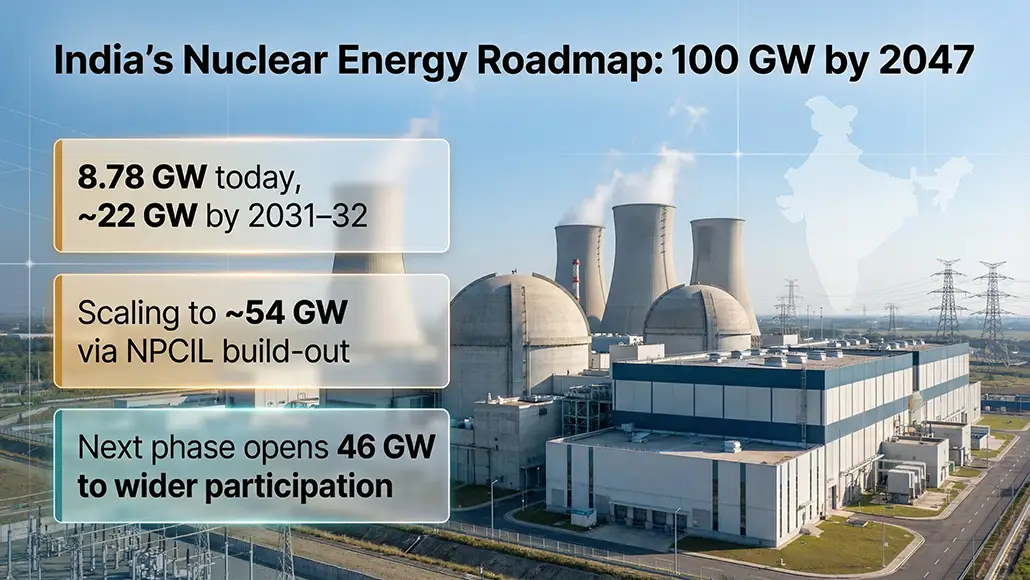
India is advancing plans to scale up its nuclear energy footprint as part of a broader clean energy transition, with policymakers outlining a long-term pathway centered on achieving 100 GW nuclear power capacity. Currently, nuclear energy accounts for about 3.1% of the country’s total electricity generation for 2024–25, underscoring its limited role in the present energy mix. However, the government is aiming to significantly enhance this share by expanding installed capacity. At present, India’s nuclear capacity stands at 8.78 GW (excluding RAPS-1), but this is projected to rise to approximately 22 GW by 2031–32 as projects under construction and in advanced stages move toward completion, reinforcing the push toward 100 GW nuclear power capacity.
Beyond the early 2030s, the roadmap becomes more expansive. Under the Nuclear Energy Mission, the government has set a long-term objective of reaching 100 GW nuclear power capacity by 2047. As part of this trajectory, the Nuclear Power Corporation of India Limited (NPCIL) is expected to develop an additional 32 GW of nuclear capacity beyond 2032. These developments will primarily consist of indigenous Pressurised Heavy Water Reactors (PHWRs) along with Light Water Reactors (LWRs), bringing total capacity to nearly 54 GW at that stage. This phased approach reflects a structured expansion strategy aligned with the overarching 100 GW nuclear power capacity goal.
To bridge the remaining gap, another 46 GW of nuclear capacity is planned through broader participation involving public sector enterprises, state governments, private players, and joint ventures. This phase is expected to incorporate diverse reactor technologies and varied business models, signaling a more inclusive and accelerated approach to nuclear energy development. Supporting this expansion, the government has introduced the SHANTI Act, designed to enable wider sector participation and strengthen the institutional framework required to meet Nuclear Energy Mission objectives.
In parallel, Bharat Heavy Electricals Limited’s subsidiary, BHAVINI, is progressing with the commissioning of a 500 MWe Prototype Fast Breeder Reactor (PFBR) at Kalpakkam in Tamil Nadu. Additionally, pre-project activities for two more 500 MWe fast breeder reactor units at the same location have been approved. Financial clearance for these units will be pursued once the PFBR achieves first criticality. This update was shared by Union Minister Dr. Jitendra Singh, underscoring the government’s continued focus on nuclear energy as a dependable and low-carbon power source.