
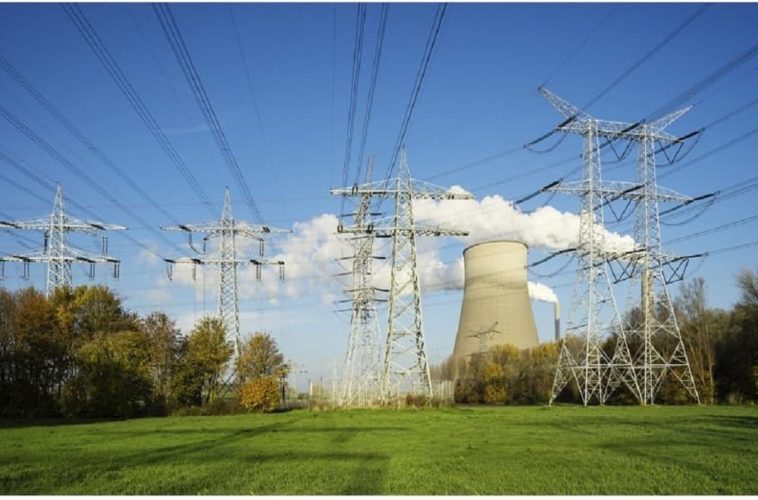

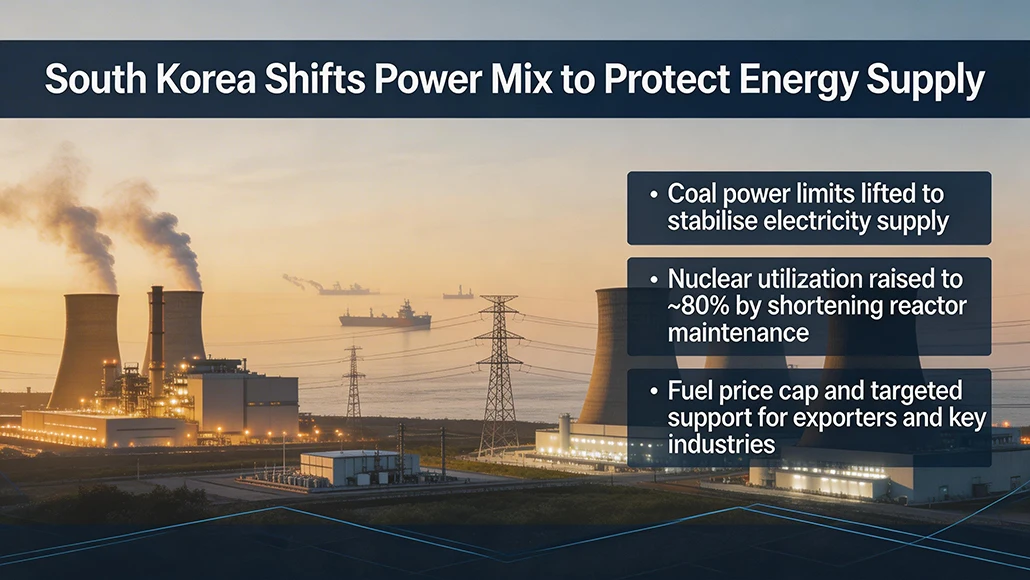
South Korea’s ruling Democratic Party announced on 16th March 2026 that the government will lift restrictions on coal-fired power generation and increase nuclear power plant utilisation to as much as 80% in response to the ongoing Middle East crisis. The policy shift is intended to safeguard energy availability and manage price pressures after oil and gas shipments to the country were disrupted by tensions in the Strait of Hormuz. Lawmakers involved in the party’s Middle East crisis economic response task force said during a briefing that the move to lift coal cap limits is part of a broader plan to stabilise supply at a time when global energy flows remain uncertain.
The country’s heavy dependence on imported energy has intensified concerns about supply disruptions. Data from the Korea International Trade Association shows that South Korea imports nearly all of its energy needs, including about 70% of its oil and 20% of its liquefied natural gas (LNG) from the Middle East. Democratic Party lawmaker Ahn Do-geol said authorities would focus on managing LNG supplies by expanding output from coal and nuclear sources while scaling back dependence on LNG-fired electricity generation. As part of that approach, officials will lift coal cap restrictions that currently limit coal power output to 80% of installed capacity. Those limits will be removed starting 16th March 2026. In addition, maintenance schedules at six nuclear reactors will be shortened so utilisation can rise from the high-60% range to approximately 80%.
Separately, the government introduced a gasoline price cap on13th March 2026, setting the ceiling at 1,724 won ($1.15) per litre and adjusting it every two weeks in line with movements in global oil markets. Ahn said gasoline and diesel prices had fallen by 58 won and 77 won per litre respectively since the cap took effect. Authorities are also preparing a supplementary budget expected to be finalised by the end of the month and submitted to parliament. The proposal will likely include compensation for refiners connected to the fuel price cap, energy voucher payments, logistics cost support for exporters and increased investment in renewable energy. Democratic Party leader Jung Chung-rae said the party would aim to fast-track approval of the budget within 10 days of submission.
Officials are also evaluating additional measures to mitigate industrial impacts. According to Ahn, the government and ruling party are considering designating the Yeosu petrochemical complex as a special industrial crisis response zone due to tightening supplies of raw materials such as aluminium, sulphur and naphtha. Since roughly 25% of naphtha imports come from the Middle East, disruptions and price spikes could force petrochemical companies to reduce production. To manage the risk, the government plans to freeze exports of domestically produced naphtha at last year’s levels and seek alternative suppliers. The task force also agreed to double the ceiling on export vouchers for international transport costs to 60 million won and introduce emergency logistics support vouchers worth 10 million won each for 1,000 exporters shipping goods to the Middle East.
These measures, namely the decision to lift coal cap and boost nuclear generation, form a broader set of strategies to counter the oil supply disruptions due to the ongoing problems in the Middle East.