
















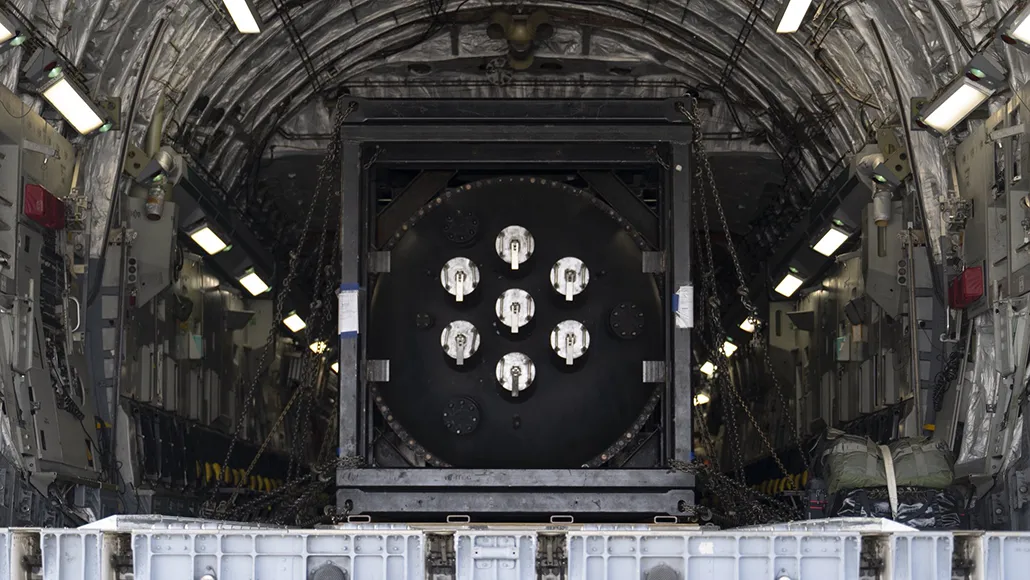
On February 15, 2026, the U.S. Departments of Energy and Defense for the very first time went ahead and transported a small nuclear reactor on a cargo plane to Utah from California in order to demonstrate the potential to fast-roll out nuclear power when it comes to military and civilian use.
The agencies collaborated with Valar Atomics, which is California-based, so as to fly the Ward microreactor of the company on a C-17 aircraft, without nuclear fuel, to Utah’s Hill Air Force Base. Chris Wright, the Energy Secretary, and Michael Duffey, the Under Secretary of Defense for Acquisition and Sustainment, were onboard the C-17 flight with the reactor along with its components and recognized the event to be a breakthrough for U.S. nuclear energy and military logistics.
As per Duffey, “This gets us closer to deploying nuclear power when and where it is needed to give our nation’s warfighters the tools to win in battle.”
It is worth noting that President Donald Trump’s administration regards small nuclear reactors as one of many ways in order to expand U.S. energy production. Trump, in May 2025 issued four executive orders with the intent of boosting domestic nuclear deployment in order to meet the growing demand for energy for national security along with competitive AI advancements.
It was in December 2025 that the Energy Department went on to issue two grants so as to help speed up the development of small modular reactors.
The ones who back microreactors also have touted them as being those energy sources that can be sent to far-flung as well as remote places, thereby offering alternatives to diesel generators that apparently need regular deliveries of fuel. However, there are skeptics who argue that the industry has not proven that small nuclear reactors can go on to generate power for a reasonable price.
As per Edwin Lyman, director of nuclear power safety at the Union of Concerned Scientists, “There is no business case for microreactors, which even if they work as designed will produce electricity at a far higher cost than large nuclear reactors, not to mention renewables like wind or solar.”
The Energy Department looks forward to having three microreactors reach “criticality,” when a nuclear reaction can go ahead and sustain itself, by July 4, remarked Wright.
The advent to fly the Ward microreactor on the February 15, 2026 event was a little larger than a minivan and could generate almost 5 megawatts of electricity, which is enough to power 5,000 homes, as per Isaiah Taylor, the Valar CEO. It will begin operating in July 2026 at 100 kilowatts and peak at 250 kilowatts right before ramping up to complete capacity, Wright said.
Valar is looking forward to starting to sell power on a test basis in 2027 and thus becoming completely functional and commercial in 2028. Although private industry goes on to fund its own development of nuclear technology, it also requires the federal government to go ahead and do some enabling actions that allow fuel fabrication as well as uranium enrichment here,” he added.
Interestingly, the fuel for the reactor from Valar is going to be transported from the Nevada National Security Site to the San Rafael facility, Wright confirmed to the reporters.
But even small generators result in a prominent radioactive waste, said Lyman. Other experts opine that designers are not compelled to consider waste at the start, beyond a plan for how it gets managed.
Though the nuclear waste disposal still remains an unresolved issue, the Energy Department is in talks with a few states, including Utah, in order to host sites that could as well reprocess fuel or even handle permanent disposal for that matter, concluded Wright.