












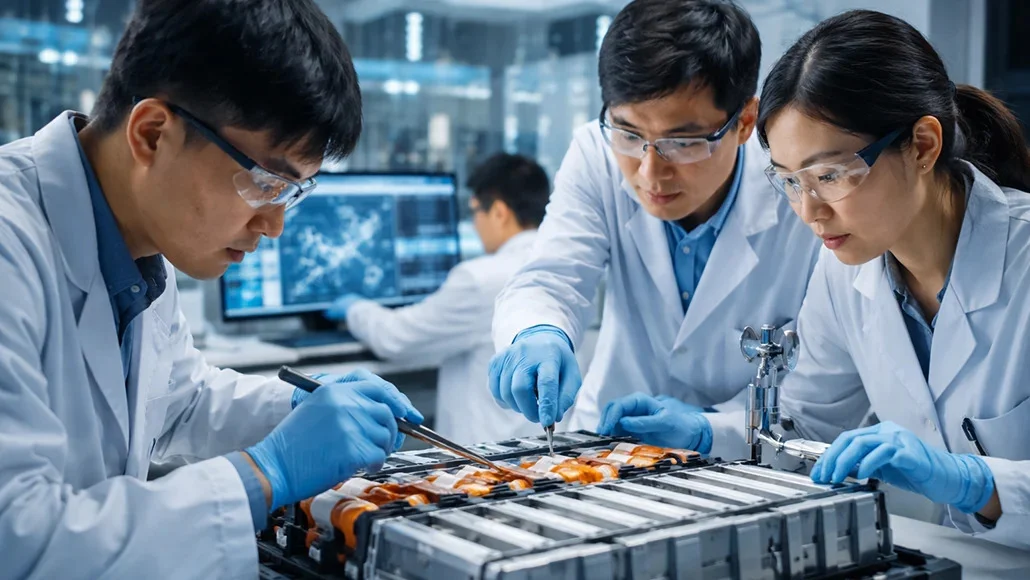
Chinese scientists have reported a major advance in lithium battery technology, unveiling what is being described as a Chinese battery breakthrough with an energy density of approximately 700 watt-hours per kilogram (Wh/kg). The development was led by researchers from Nankai University in collaboration with the Shanghai Institute of Space Power Sources, and centres on a fundamental redesign of the battery’s electrolyte. The team worked to enhance factors that directly determine a battery’s practical capability such as performance, stability and efficiency by reimagining the transfer of lithium ions between electrodes.
Traditional lithium batteries usually have carbonate-based electrolytes, where lithium ions are coordinated through oxygen atoms. Although widely adopted, such systems can limit ion mobility and perform less effectively under low-temperature conditions. The Chinese battery breakthrough addresses these constraints by introducing a new electrolyte platform built on fluorinated hydrocarbon solvents. This approach changes how lithium salts dissolve and interact at the molecular scale. Through deliberate adjustment of the electronic structure and spatial configuration of solvent molecules, the researchers weakened lithium–fluorine interactions, thereby enabling freer ion movement. As a result, the battery achieved around 700 Wh/kg at room temperature and maintained close to 400 Wh/kg even at temperatures near −50°C. For context, leading commercial battery producers such as Contemporary Amperex Technology Co. (CATL) currently record energy densities of approximately 250–255 Wh/kg at the pack level.
The research team synthesised a range of novel fluorinated hydrocarbon solvent molecules, enabling effective dissolution of lithium salts and replacing the conventional lithium-oxygen coordination mode. The team used this electrolyte system to develop lithium batteries delivering an ultra-high specific energy of 700 Wh/kg at room temperature. The batteries also sustained nearly 400 watt-hours per kilogram in environments as cold as -50°C. Published in the journal Nature, the study details the synthesis of alkanes with monofluorinated structures and notes that fluorine (F)-based ligands engineered with steric hindrance and Lewis basicity allow salt dissolution exceeding 2 mol l−1. “Among them, 1,3-difluoro-propane (DFP)-based Li-ion electrolyte is endowed with all merits for energy-dense and low-temperature batteries, including low viscosity (0.95 cp), high oxidation stability (>4.9 V) and ionic conductivity of 0.29 mS cm−1 at −70 °C,” said researchers in the study.
While the Chinese battery breakthrough remains at laboratory scale, it represents a significant step toward ultra-high-energy batteries. While further engineering and validation is required to upscale this technology, its successful application could help electric vehicles (EVs), aerospace systems, robotics and other sectors that need lightweight, high-capacity power sources capable of functioning in demanding environments.