



















Key Takeaways
- Efficiency and Thermal Management
The adoption of SiC and GaN materials allows for a drastic reduction in energy losses and heat generation. By operating at higher voltages and temperatures, wide bandgap semiconductors enable smaller, lighter cooling systems, which is essential for compact power electronics and high-power industrial applications. - System-Level Cost Benefits
While individual WBG components may be more expensive than silicon, they allow for the use of smaller passive components and less complex thermal solutions. This reduction in total system size and weight, combined with long-term energy savings, makes WBG technology a more cost-effective choice for modern energy infrastructure. - Grid Modernization and Renewables
WBG technology is a critical enabler for the transition to a carbon-neutral grid. Its ability to handle high-frequency switching and high-voltage power conversion makes it ideal for integrating solar, wind, and energy storage systems into a stable and resilient electrical network.
The global transition toward a more sustainable and electrified future is driving an unprecedented demand for high-efficiency power electronics. At the heart of this transformation lies the emergence of wide bandgap (WBG) semiconductors, materials that are fundamentally altering how we convert, transmit, and utilize electrical energy. For decades, silicon (Si) has been the cornerstone of the semiconductor industry, serving as the primary material for everything from microprocessors to high-power inverters. However, as the requirements for energy density, thermal performance, and switching frequencies have intensified, silicon has begun to hit its inherent physical limitations. This is where wide bandgap semiconductors most notably Silicon Carbide (SiC) and Gallium Nitride (GaN) come into play, offering performance characteristics that far exceed those of traditional silicon.
Wide bandgap semiconductors are characterized by an energy gap between the valence and conduction bands that is significantly larger than that of silicon. While silicon has a bandgap of approximately 1.1 electronvolts (eV), materials like SiC and GaN possess bandgaps in the range of 3.2 to 3.4 eV. This physical property allows WBG devices to operate at much higher voltages, temperatures, and frequencies. In the context of powering energy systems, these attributes translate directly into reduced energy losses, smaller cooling requirements, and more compact system designs. As we integrate more renewable energy sources like solar and wind into the grid, the ability to manage high-voltage power with minimal loss becomes a critical factor in maintaining grid stability and overall system efficiency.
The Technical Superiority of Silicon Carbide and Gallium Nitride
To understand why wide bandgap semiconductors powering energy systems is such a transformative concept, one must look at the specific advantages of SiC and GaN. Silicon Carbide (SiC) is particularly well-suited for high-voltage applications, such as those found in electric vehicle inverters and industrial power supplies. The breakdown field of SiC is nearly ten times higher than that of silicon, allowing for the creation of thinner, more efficient devices that can handle thousands of volts. Furthermore, SiC’s high thermal conductivity means that heat can be dissipated much more effectively, reducing the size and weight of the cooling systems required. This “thermal headroom” is vital for power electronics that must operate in harsh environments or within the tight confines of a vehicle chassis.
Gallium Nitride and High-Frequency Efficiency
Gallium Nitride (GaN), on the other hand, excels in applications requiring high switching speeds and high power density. GaN devices possess high electron mobility, which enables them to switch states much faster than silicon transistors. This speed is a game-changer for power conversion because it allows designers to use smaller passive components such as inductors and capacitors within the power supply. The result is a significant reduction in the overall footprint of the power electronics. In energy systems, GaN is increasingly used in DC-DC converters and high-efficiency chargers, where minimizing physical space is as important as maximizing the percentage of energy converted.
Comparing Performance Metrics in Power Electronics
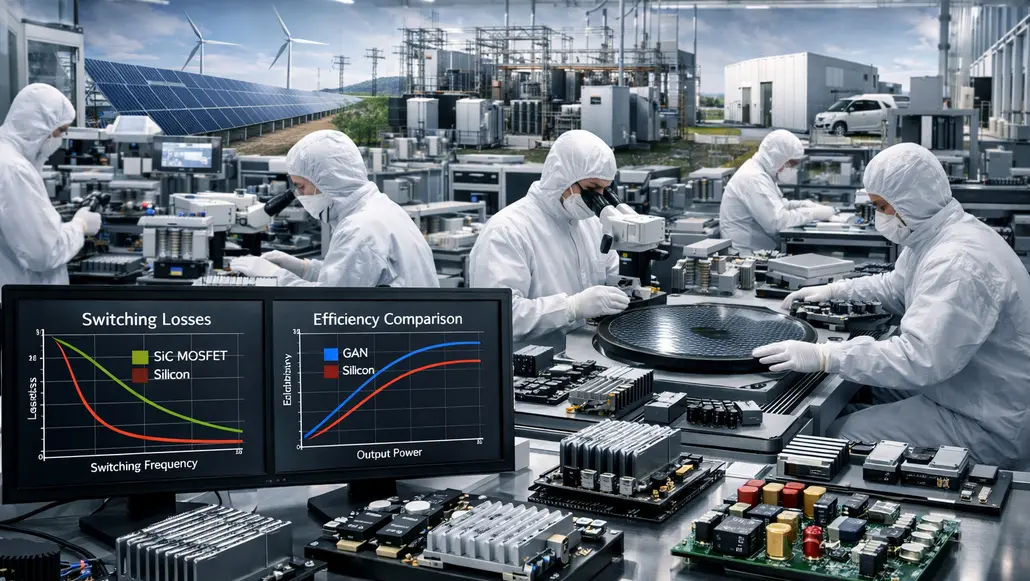
When comparing WBG materials to silicon, the most striking difference is the reduction in switching losses. Switching losses occur every time a transistor turns on or off, and in high-frequency systems, these losses can account for a substantial portion of the total energy wasted. Because WBG materials can switch faster and handle higher electric fields, they inherently lose less energy during these transitions. In a large-scale energy system, even a 1% or 2% improvement in conversion efficiency can result in gigawatts of energy saved annually across the network. This efficiency is the primary reason why utilities and equipment manufacturers are aggressively transitioning to SiC and GaN solutions.
Transforming the Renewable Energy Landscape
The integration of renewable energy into the traditional power grid presents significant engineering challenges. Solar panels and wind turbines generate electricity in forms that must be converted often multiple times before they can be distributed to consumers. Wide bandgap semiconductors powering energy systems provide the necessary efficiency to make these conversions sustainable. In solar inverters, for example, the use of SiC MOSFETs allows for higher DC input voltages, which reduces the current and, consequently, the energy lost as heat in the cabling. This enables the construction of larger, more centralized solar farms that can transmit power more effectively over long distances.
Enhancing Grid Stability and Resilience
Beyond simple efficiency, WBG semiconductors contribute to the overall stability of the modern grid. Smart grids require the ability to rapidly modulate power flow to compensate for the intermittent nature of renewable sources. High-frequency switching enabled by GaN and SiC allows for more precise control over the electrical signal, enabling better synchronization with the grid and faster response to fluctuations in demand. As we move toward a decentralized energy model where homes and businesses both consume and produce energy, the need for intelligent, high-speed power conversion becomes paramount.
Impact on Energy Storage Systems
Energy storage is the final piece of the renewable energy puzzle, and here too, WBG materials are making an impact. Battery management systems (BMS) and the inverters used in large-scale energy storage facilities must handle massive amounts of current with minimal thermal buildup. The high thermal conductivity of SiC ensures that these systems can operate reliably under heavy loads, extending the lifespan of the power electronics and the batteries themselves. By reducing the energy lost during the charging and discharging cycles, wide bandgap semiconductors ensure that the maximum amount of captured renewable energy is actually available for use when needed.
Future Outlook and Market Adoption
The adoption of wide bandgap semiconductors powering energy systems is no longer a theoretical exercise; it is a market reality. While the cost of SiC and GaN wafers remains higher than that of silicon, the total system cost often becomes lower when accounting for the savings in cooling, passive components, and operational energy costs. As manufacturing processes mature and economies of scale take hold, the price gap will continue to narrow. We are entering an era where WBG technology will be the default choice for any application where power density and efficiency are the primary design goals.
Overcoming Manufacturing Challenges
Despite their advantages, wide bandgap materials present unique manufacturing hurdles. Producing large, defect-free wafers of SiC and GaN is significantly more complex than the well-established silicon process. Defects in the crystal lattice can lead to device failure at high voltages, which is unacceptable in critical energy infrastructure. However, the industry has seen rapid progress in substrate quality and manufacturing yield over the past five years. New techniques in epitaxy and wafer polishing are making WBG devices more reliable and affordable than ever before, ensuring their place as the backbone of future energy systems.