



















Key Takeaways
- Efficiency in High-Voltage Switching
The adoption of silicon carbide (SiC) in power modules is drastically reducing energy losses in high-voltage applications. By switching faster and handling higher voltages more effectively than traditional silicon, these advanced modules are driving significant energy savings across industrial and energy sectors. - Advanced Packaging and Reliability
Technological breakthroughs like silver sintering and wire-bond-free designs are essential for the next generation of power modules. These packaging improvements enhance thermal dissipation and mechanical robustness, ensuring that high-power systems can operate reliably for decades in demanding environments. - Integration for Smarter Power Systems
The trend toward “intelligent” power modules with integrated sensors and gate drivers is simplifying system design and improving protection. These smart modules provide the real-time data needed for predictive maintenance and enhanced grid stability, making our electrical infrastructure more resilient and efficient.
The field of power electronics is characterized by the constant pursuit of higher efficiency, greater power density, and improved reliability. At the center of this technological evolution is the power module an integrated package that contains multiple power semiconductor devices, such as IGBTs (Insulated-Gate Bipolar Transistors) or MOSFETs (Metal-Oxide-Semiconductor Field-Effect Transistors). Power modules advancing high voltage applications are the building blocks of modern industrial systems, providing the critical switching and control functions required for high-power conversion. As we move towards higher voltage levels in applications like electric vehicle fast chargers, high-speed trains, and renewable energy grids, the design and performance of these modules have become a primary focus for engineers and manufacturers worldwide.
A power module is much more than just a collection of chips. It is a highly engineered system that must manage extreme electrical, thermal, and mechanical stresses simultaneously. In a high-voltage environment, where thousands of volts are switched in microseconds, any imperfection in the module’s design can lead to catastrophic failure. Therefore, the advancement of power module technology involves a multi-disciplinary approach, combining semiconductor physics, material science, and thermal engineering. By integrating the semiconductor dies, the substrate, and the cooling interface into a single, optimized package, power modules provide a level of performance and reliability that would be impossible to achieve with discrete components.
The Evolution of High-Voltage Switching Devices
To understand the impact of power modules advancing high voltage applications, one must first look at the semiconductor devices they contain. For decades, the silicon-based IGBT has been the workhorse of high-power electronics, favored for its ability to handle high voltages and high currents with relatively low conduction losses. However, the latest generation of IGBTs is reaching its theoretical performance limits, leading to the adoption of wide bandgap (WBG) materials like silicon carbide (SiC).
Silicon Carbide and the Future of High Voltage
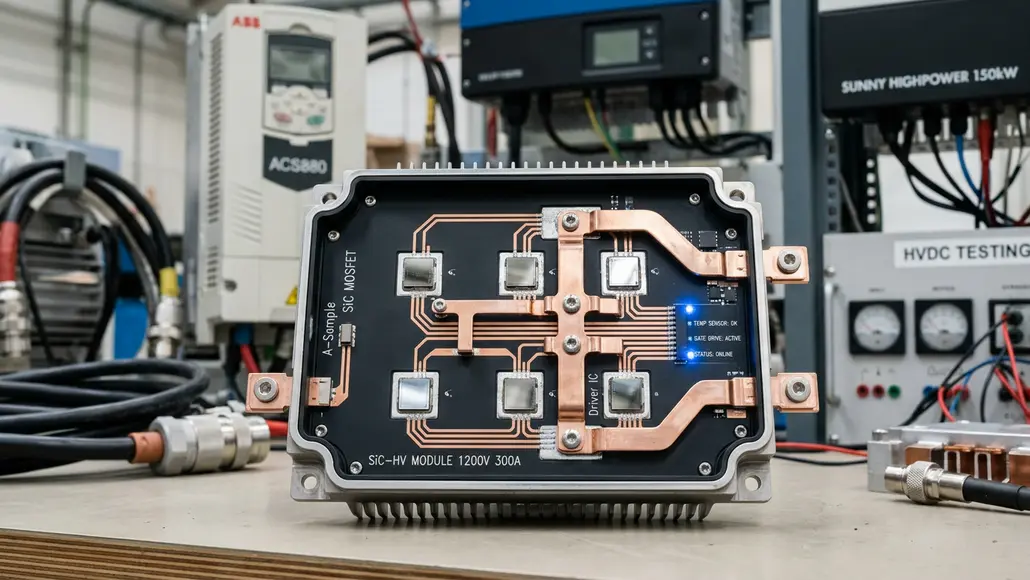
Silicon carbide (SiC) MOSFETs are a transformative technology for high-voltage power modules. SiC has a much higher breakdown electric field than silicon, allowing for the creation of devices with much thinner drift layers. This results in significantly lower on-state resistance and switching losses. In high-voltage applications, where efficiency is paramount, SiC modules can reduce total energy losses by up to 50% compared to traditional silicon modules. This efficiency gain not only reduces operating costs but also allows for smaller and lighter cooling systems, which is critical for mobile applications like electric aircraft or heavy-duty EVs.
Improving Switching Performance and EMI
One of the key challenges in high-voltage switching is the generation of electromagnetic interference (EMI). When a high-voltage device switches “on” or “off,” it creates rapid changes in voltage (dv/dt) and current (di/dt) that can interfere with sensitive control electronics. Power modules advancing high voltage applications use optimized layout designs and integrated gate drivers to minimize parasitic inductance and capacitance. This “low-parasitic” design allows for faster switching speeds with less voltage overshoot and ringing, improving both the efficiency and the electromagnetic compatibility of the entire power system.
Advanced Packaging for Reliability and Density
The packaging of a power module is just as important as the semiconductor chips it contains. The package must provide electrical insulation, mechanical support, and a low-resistance path for heat dissipation. As power densities increase, the traditional methods of wire bonding and solder-based assembly are being replaced by more advanced techniques.
Silver Sintering and Die Attachment
Traditional solder-based die attachment is often the weakest link in a power module, susceptible to fatigue and cracking over thousands of thermal cycles. Silver sintering is an advanced bonding technology that uses a silver-based paste to create a metallurgical bond between the semiconductor die and the substrate. This bond has a much higher thermal conductivity and a higher melting point than solder, making it ideal for high-temperature and high-power applications. Power modules using silver sintering are significantly more reliable and can operate at higher junction temperatures, which is essential for maximizing the performance of SiC devices.
Wire-Bond-Free and Double-Sided Cooling
Another major trend in power modules advancing high voltage applications is the elimination of wire bonds. In a traditional module, thin aluminum or copper wires are used to connect the top of the semiconductor die to the circuit board. These wire bonds have high parasitic inductance and are a common point of failure. Wire-bond-free designs, which use copper clips or flexible circuit boards for connections, provide a much more robust and low-inductance interface. This also enables “double-sided cooling,” where heat is removed from both the top and the bottom of the semiconductor die. Double-sided cooling can double the heat removal capacity of a module, allowing for even higher power densities in a smaller footprint.
Applications in Industrial Power Systems
Power modules are the “muscles” of industrial automation and energy infrastructure. Their ability to manage high-voltage power with precision and efficiency makes them indispensable for several key applications.
High-Voltage Motor Drives and Automation
In large-scale industrial plants, massive electric motors are used to drive pumps, fans, and conveyor systems. Variable frequency drives (VFDs), powered by advanced power modules, allow these motors to run at the precise speed required for the task, saving vast amounts of energy. For high-voltage motor drives, which can operate at 3.3kV or even 6.6kV, specialized power modules are used to provide the necessary isolation and switching performance. These modules are designed to operate 24/7 in harsh environments, making their reliability a top priority for plant operators.
Solar Inverters and Renewable Integration
The global transition to renewable energy is placing immense demand on high-voltage power modules. Central solar inverters, which convert the DC power from thousands of solar panels into high-voltage AC for the grid, rely on high-efficiency power modules to minimize energy loss. As the industry moves toward 1500V DC architectures to reduce cabling costs, the power modules must be able to handle these higher voltages with ease. Power modules advancing high voltage applications are the key to making large-scale solar and wind power economically competitive with fossil fuels.
HVDC Transmission and Grid Stability
High Voltage Direct Current (HVDC) transmission is the most efficient way to transport electricity over long distances or across underwater cables. HVDC “converter stations” use massive arrays of power modules to transform AC to DC and back again. These modules must handle hundreds of thousands of volts and thousands of amperes, requiring a level of performance and reliability that is at the cutting edge of power electronics. By improving the efficiency and switching performance of these modules, we can reduce the losses in our national power grids and improve the overall stability of the energy system.
The Future of High-Voltage Semiconductor Modules
The future of power modules advancing high voltage applications is focused on “integration and intelligence.” We are seeing the rise of “smart” power modules that include integrated sensors for temperature, current, and voltage monitoring. These sensors allow for real-time diagnostics and “proactive” protection, where the module can shut itself down before a catastrophic failure occurs. Furthermore, the integration of the gate driver and protection circuitry into the module itself a concept known as an Intelligent Power Module (IPM) simplifies the design process for engineers and improves the overall robustness of the power system.
Exploring New Materials Beyond Silicon Carbide
While SiC is the current state-of-the-art for high-voltage modules, researchers are already looking toward the next generation of materials, such as gallium oxide (Ga2O3) and diamond. These “ultra-wide bandgap” materials offer the potential for even higher breakdown voltages and lower losses than SiC. While still in the early stages of development, these materials could one day enable power modules that operate at tens of thousands of volts, revolutionizing the way we manage power in our most demanding industrial and grid applications.
Building a More Efficient and Sustainable World
In conclusion, power modules are the unsung heroes of the modern electrical world. By advancing the performance and reliability of high-voltage systems, these modules are enabling the transition to a more efficient and sustainable energy future. Whether it’s driving a high-speed train, charging an electric vehicle, or integrating a wind farm into the grid, power modules advancing high voltage applications are the critical technology that makes it all possible. As we continue to push the boundaries of power electronics, these modules will remain at the very forefront of technological innovation.