





















Key Takeaways
- Efficiency and Range Maximization
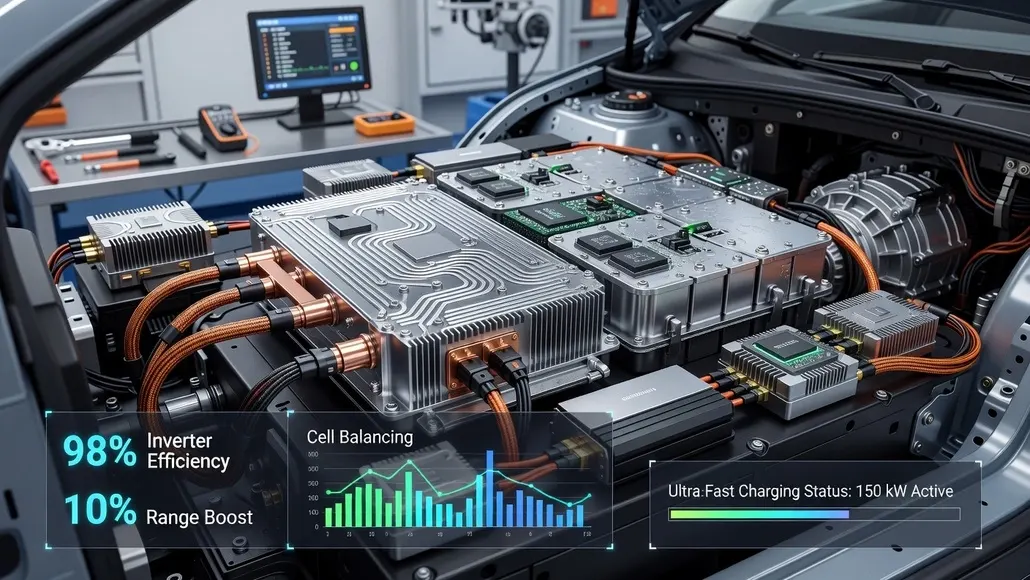
The use of wide bandgap semiconductors like Silicon Carbide (SiC) in traction inverters is a game-changer for electric mobility. By reducing switching losses and improving thermal performance, these advanced power systems can increase the driving range of an electric vehicle by up to 10%, directly addressing one of the primary concerns of consumers. - Intelligence and Battery Longevity
Advanced battery management systems (BMS) are essential for the safe and efficient operation of high-voltage battery packs. Through precise cell balancing and thermal management, these systems ensure that the battery operates at peak performance throughout its lifecycle, protecting the user’s investment and enhancing vehicle safety. - The Shift to High-Voltage Architectures
The transition to 800V systems is enabling a new era of ultra-fast charging and improved power density. By reducing current levels, manufacturers can use lighter cabling and smaller components, improving the vehicle’s overall performance and making electric vehicles more practical for long-distance travel.
The shift towards electric mobility represents one of the most significant technological transformations in the history of transportation. As we move away from the internal combustion engine, the focus has shifted from mechanical complexity to the sophistication of electrical power systems. At the heart of every modern electric vehicle (EV) is a complex network of power electronics that manage the flow of energy from the battery to the motor and back again during regenerative braking. Electric mobility power systems enhancing performance are the key to overcoming the traditional barriers to EV adoption, such as range anxiety, long charging times, and high initial costs. By optimizing the efficiency and power density of these systems, manufacturers are creating vehicles that are not only more sustainable but also offer superior performance compared to their gasoline counterparts.
Electric mobility power systems comprise several critical subsystems: the high-voltage battery pack, the traction inverter, the on-board charger (OBC), and the DC-DC converter. Each of these components must work in perfect harmony to ensure that the maximum amount of energy is extracted from the battery and converted into mechanical motion with minimal loss. The performance of these systems is measured by their efficiency, their power density (kilowatts per liter), and their reliability under the harsh conditions of the automotive environment. As the industry moves towards 800V architectures and silicon carbide (SiC) semiconductors, the boundaries of what is possible in electric mobility are being redefined.
The Traction Inverter: The Heart of EV Performance
The traction inverter is perhaps the most critical component in electric mobility power systems enhancing performance. Its job is to convert the DC power from the high-voltage battery into the multi-phase AC power required to drive the traction motor. The inverter also controls the motor’s speed and torque by adjusting the frequency and amplitude of the AC signal. A high-performance inverter must be able to handle massive currents often hundreds of amperes while maintaining switching frequencies that are high enough to ensure smooth motor operation and minimize acoustic noise.
The Role of Silicon Carbide in Inverter Efficiency
Traditionally, EV inverters have relied on silicon-based IGBTs (Insulated-Gate Bipolar Transistors). However, the industry is rapidly transitioning to silicon carbide (SiC) MOSFETs. SiC is a wide bandgap semiconductor that offers significantly lower switching losses and higher thermal conductivity than silicon. In the context of electric mobility power systems, this translates directly into a 5% to 10% increase in driving range for the same battery size. Furthermore, SiC inverters can operate at higher switching frequencies, allowing for the use of smaller and lighter passive components, which reduces the overall weight and volume of the powertrain. This reduction in weight further enhances the vehicle’s efficiency and handling performance.
Regenerative Braking and Energy Recovery
An inherent advantage of electric mobility power systems is the ability to recover energy during deceleration. When the driver lifts off the accelerator or applies the brakes, the traction inverter reverses the flow of energy, turning the motor into a generator and feeding electricity back into the battery. This “regenerative braking” can recover a significant amount of energy in stop-and-go city driving, extending the vehicle’s range. High-performance power systems are designed to maximize this recovery process while providing a natural and consistent braking feel for the driver. The precision with which the inverter manages this bidirectional power flow is a key differentiator between entry-level and premium electric vehicles.
Battery Management Systems: Ensuring Safety and Longevity
While the inverter provides the power, the battery management system (BMS) provides the intelligence. A high-voltage EV battery pack consists of thousands of individual cells, each of which must be monitored for voltage, current, and temperature. Electric mobility power systems enhancing performance rely on advanced BMS technology to ensure that the battery operates within its safe limits at all times. This is crucial not only for the safety of the occupants but also for the long-term health and capacity of the battery.
Cell Balancing and State-of-Charge Optimization
No two battery cells are perfectly identical; small variations in capacity and internal resistance can lead to imbalances over time. If one cell becomes overcharged or over-discharged, it can lead to reduced performance or even a fire hazard. The BMS uses cell balancing circuits to equalize the charge across all cells in the pack, ensuring that the entire battery can be utilized to its full potential. Additionally, sophisticated “state-of-charge” (SoC) and “state-of-health” (SoH) algorithms provide the vehicle’s computer with an accurate estimate of the remaining range and the battery’s overall degradation. This transparency is vital for reducing range anxiety and building consumer trust in electric mobility.
Thermal Management of the Battery Pack
The performance of an EV battery is highly dependent on its temperature. If the battery is too cold, its internal resistance increases, reducing the available power and slowing down charging. If it is too hot, the chemical degradation of the cells accelerates, leading to permanent capacity loss. Electric mobility power systems must include a robust thermal management system that can both heat and cool the battery as needed. Advanced liquid cooling plates and phase-change materials are often used to maintain the battery within its optimal temperature range (typically 20°C to 40°C), even during high-performance driving or ultra-fast charging.
The Move to 800V Architectures and Ultra-Fast Charging
One of the most significant trends in electric mobility power systems enhancing performance is the transition from 400V to 800V architectures. Doubling the system voltage allows for a 50% reduction in current for the same power level, which has profound implications for the design of the vehicle. Lower current means thinner and lighter cables, which reduces the vehicle’s mass and cost. More importantly, an 800V system enables ultra-fast charging, with some vehicles now capable of adding 200 miles of range in less than 15 minutes.
Impact on Charging Infrastructure and Grid Integration
The move to higher voltages requires a corresponding increase in the performance of the on-board charger (OBC) and the DC-DC converter. The OBC must be able to convert the AC power from a wall box into high-voltage DC with maximum efficiency, while the DC-DC converter steps down the high-voltage battery power to the 12V or 48V required by the vehicle’s lights, sensors, and infotainment systems. As we integrate more EVs into the grid, these power systems will also play a role in “vehicle-to-grid” (V2G) technology, allowing EVs to act as distributed energy storage units that can feed power back into the grid during peak demand.
Enhancing Performance and Driving Dynamics
Beyond efficiency and range, electric mobility power systems are transforming the driving dynamics of vehicles. The near-instantaneous torque delivery of an electric motor, controlled by a high-frequency inverter, allows for acceleration that is far more responsive than that of a traditional engine. Sophisticated torque-vectoring systems, which use multiple motors and independent power stages, can adjust the power to each wheel individually in milliseconds. This provides unprecedented levels of traction and cornering performance, making EVs some of the most capable vehicles on the road today.
The Future of Power Semiconductors in Mobility
The future of electric mobility power systems enhancing performance is inextricably linked to the continued evolution of power semiconductors. We are already seeing the emergence of “GaN-on-Si” (Gallium Nitride on Silicon) technology for on-board chargers and DC-DC converters, which offers even higher switching speeds and smaller footprints than SiC. At the same time, the integration of power electronics into the motor housing (the “integrated drive unit”) is reducing the number of cables and connectors, further improving reliability and power density.
Overcoming Cost and Manufacturing Barriers
While the benefits of advanced power systems are clear, the industry still faces challenges related to cost and manufacturing scale. Producing SiC and GaN devices is more complex and expensive than traditional silicon, and the global supply chain for these materials is still maturing. However, as production volumes increase and manufacturing yields improve, the cost of these high-performance systems will continue to fall. This will enable the deployment of advanced power electronics not just in high-end luxury EVs, but across all segments of the automotive market, making high-performance electric mobility accessible to everyone.
Building a Sustainable Transportation Ecosystem
Ultimately, the goal of improving electric mobility power systems is to build a more sustainable and efficient transportation ecosystem. By maximizing the efficiency of every watt of energy stored in the battery, we can reduce the overall energy consumption of the transport sector and accelerate the transition to carbon-neutral mobility. Electric mobility power systems enhancing performance are the technological foundation of this change, providing the power, the intelligence, and the reliability needed to drive the world toward a cleaner future.