



















Key Takeaways
- Precision and Soft Switching
Digital control systems enable precise regulation and “soft switching” techniques that are difficult to achieve with analog circuits. By optimizing the timing of power transistors at a nanosecond scale, these systems minimize energy waste and significantly improve the overall efficiency of power conversion. - Flexibility and Adaptive Control
A software-defined approach allows for the implementation of advanced control algorithms that can adapt to changing load conditions and component aging. This flexibility ensures that the power electronics remain at peak performance throughout their lifecycle, enhancing both reliability and system longevity. - System-Wide Intelligence and IoT
The integration of communication interfaces into digital controllers transforms power converters into intelligent nodes. This enables real-time telemetry, predictive maintenance, and the coordination of multiple units in complex systems like microgrids and smart factories, driving the next wave of industrial automation.
For decades, the control of power electronic systems was predominantly an analog affair. Engineers used operational amplifiers, comparators, and discrete components to build the feedback loops that regulated voltage and current. While analog control is fast and inherently stable for simple applications, it is also rigid, difficult to scale, and prone to “component drift” over time and temperature. Today, we are witnessing a fundamental shift as digital control systems transforming power electronics become the new standard. By replacing analog circuits with high-speed digital signal processors (DSPs), microcontrollers (MCUs), and field-programmable gate arrays (FPGAs), engineers can now implement sophisticated control algorithms that were previously impossible to realize in hardware. This digital revolution is enabling a new level of efficiency, reliability, and intelligence in power conversion, from the milliwatt level in mobile devices to the megawatt level in grid-scale inverters.
The core advantage of digital control is its flexibility. A digital controller is “software-defined,” meaning its behavior can be changed by simply updating a few lines of code. This allows for the implementation of non-linear control strategies, adaptive algorithms that compensate for component aging, and complex protection schemes that can detect a fault in nanoseconds. Furthermore, digital control systems can communicate with the outside world, providing real-time telemetry and diagnostics that are essential for the operation of “smart” industrial systems and the modern electrical grid.
The Architecture of Digital Power Control
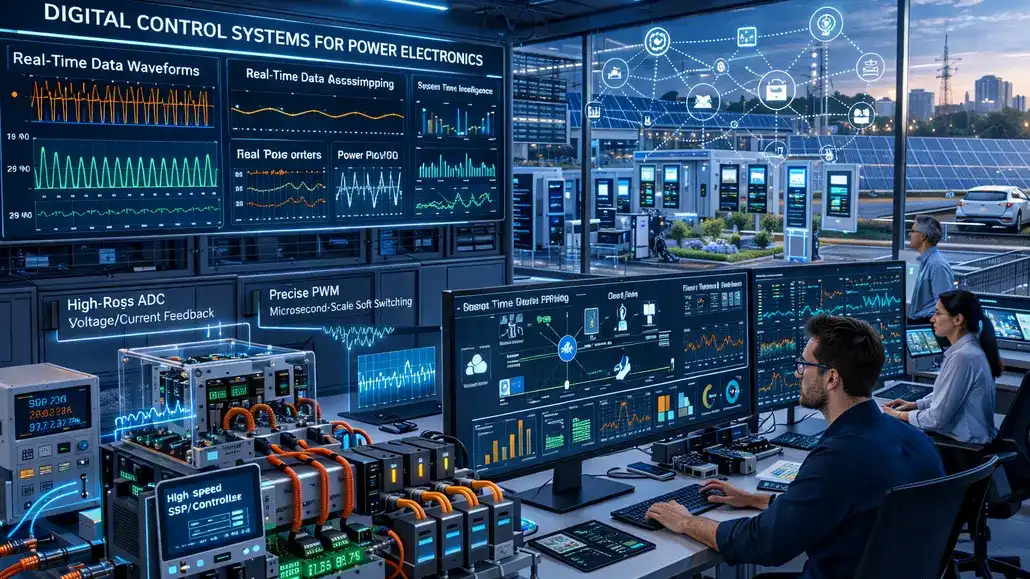
A digital control system for power electronics consists of several key stages: sensing, processing, and pulse-width modulation (PWM). The system must sense high-voltage and high-current signals, convert them into digital data, process that data according to a control law, and then generate the high-speed switching signals that drive the power transistors. To do this effectively, the digital controller must operate at speeds that match the switching frequency of the power electronics often hundreds of kilohertz or even megahertz.
High-Speed Analog-to-Digital Conversion (ADC)
The “eyes” of a digital control system are its analog-to-digital converters (ADCs). These components take the analog feedback signals such as the output voltage or the inductor current and sample them at high frequencies. For digital control systems transforming power electronics to be effective, these ADCs must have both high resolution (to ensure precision) and low latency (to ensure stability). Any delay in the sampling process can lead to phase lag in the feedback loop, which can cause the power converter to become unstable. Modern DSPs and MCUs designed for power applications include specialized, high-speed ADCs that can sample multiple channels simultaneously, providing the controller with a real-time view of the system’s state.
Digital Signal Processing and Control Algorithms
Once the feedback signals are digitized, the “brain” of the controller takes over. This is typically a DSP or an FPGA that executes the control algorithm. Unlike analog controllers, which are limited to basic PID (Proportional-Integral-Derivative) control, digital systems can implement advanced techniques like Model Predictive Control (MPC), sliding mode control, or neural-network-based controllers. These algorithms can optimize the power conversion process for multiple variables simultaneously such as efficiency, harmonic distortion, and transient response. This multi-objective optimization is a hallmark of digital control systems transforming power electronics.
High-Resolution Pulse-Width Modulation (PWM)
The final stage of the digital controller is the generation of the PWM signals that turn the power transistors on and off. To achieve precise regulation of the output voltage, the PWM generator must have very high resolution. If the PWM timer is too slow, it can create “limit cycle oscillations,” where the output voltage bounces between two discrete levels. High-end digital controllers feature PWM modules with resolutions in the hundreds of picoseconds, allowing for extremely smooth and accurate control of the power delivery.
Precision and Efficiency through Digital Control
One of the primary drivers for the adoption of digital control is the pursuit of energy efficiency. In power conversion, efficiency is often gained through the careful timing of the switching events. Digital control systems can implement “soft switching” techniques, where the transistors are turned on or off only when the voltage or current is zero, virtually eliminating switching losses. While soft switching can be done with analog circuits, it is much easier and more reliable to implement digitally, especially across a wide range of load conditions.
Non-Linear Control and Transient Response
Another area where digital control systems transforming power electronics excel is in their transient response how the system reacts to a sudden change in load or input voltage. An analog controller has a fixed response time determined by its passive components. A digital controller, however, can detect a transient event and immediately switch to a different, more aggressive control strategy to stabilize the output. This is particularly important for high-performance computing and data center applications, where the power demand can spike from idle to full load in a matter of microseconds.
Adaptive Control and Life-Cycle Management
All electronic components change over time. Capacitors dry out, inductors saturate at high temperatures, and the on-resistance of MOSFETs increases with age. Digital control systems can be programmed to sense these changes and adapt their control parameters to maintain optimal performance throughout the system’s lifecycle. This “self-tuning” capability not only improves efficiency but also extends the life of the equipment by preventing excessive stress on the components. This level of life-cycle management is a major advantage for industrial systems that are expected to operate for decades.
Communication and System Integration
Perhaps the most significant impact of digital control is the ability to integrate power electronics into the broader “Internet of Things” (IoT) and industrial automation networks. Digital control systems transforming power electronics are naturally equipped with communication interfaces such as CAN, Ethernet, or specialized power-line communication (PLC) protocols.
Real-Time Telemetry and Predictive Maintenance
By communicating its internal state temperature, current, voltage, and even estimated component health to a central management system, a digital power converter becomes an intelligent node in the network. This data can be used for real-time monitoring of energy consumption across an entire factory or to predict when a component is likely to fail. Predictive maintenance, enabled by digital control, can save millions of dollars in downtime for critical industries like semiconductor manufacturing or oil and gas processing.
Multi-Converter Coordination and Microgrids
In complex power systems, such as microgrids or large-scale server farms, multiple power converters must work together in harmony. Digital control makes it easy to synchronize the operation of these converters, allowing them to share the load equally or to provide “redundancy” if one unit fails. In a microgrid, for example, the digital controllers of the solar inverters, battery storage units, and local generators can all communicate to ensure that the local grid remains stable and efficient, even as renewable energy generation fluctuates.
The Future of Digital Power Management
The future of digital control systems transforming power electronics is focused on the integration of artificial intelligence (AI) and the move toward fully autonomous power management. We are seeing the first “AI-enhanced” power controllers that use machine learning to optimize their control laws based on real-world operating data. These systems can “learn” the specific characteristics of their load and environment, achieving levels of efficiency and reliability that are impossible with traditional design methods.
Software-Defined Power and Customization
As the hardware of power electronics becomes more standardized, the “value” is increasingly moving into the software. Manufacturers can now create a single hardware platform and customize it for a wide range of applications by simply changing the firmware. This “software-defined power” approach reduces development time, simplifies the supply chain, and allows for rapid innovation. For the end-user, this means access to power conversion solutions that are perfectly tailored to their specific needs.
Building an Intelligent Energy Future
In conclusion, digital control is the “nervous system” of modern power electronics. By providing the precision, flexibility, and intelligence needed to manage complex energy flows, digital control systems transforming power electronics are at the heart of the global transition to a smarter and more efficient energy future. As we continue to integrate more renewable energy, electrify our transport systems, and build out our digital infrastructure, the role of digital control in power electronics will only become more critical.