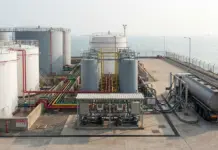












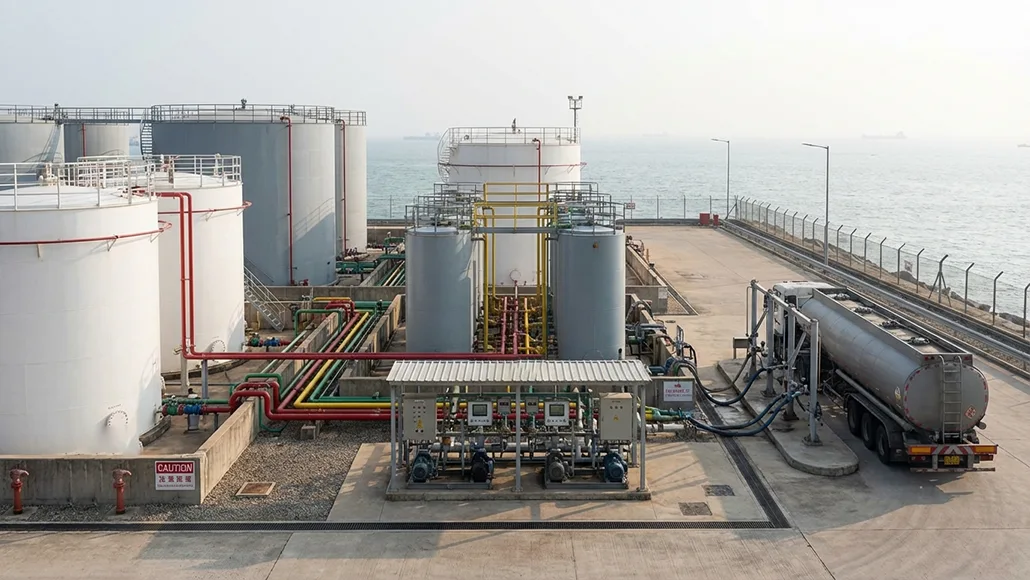
To blend marine biofuel oil and also export it, China has gone ahead and launched its first pilot program after its Ministry of Commerce went on to approve Zhoushan city so as to carry out the bonded blending operations.
The approval enables Zhoushan, which is a part of the Zhejiang Pilot Free Trade Zone, to go ahead and blend marine biofuel oil domestically when it comes to export, thereby marking a policy transition that is aimed at decreasing the dependence of China on imported biofuel bunkers and also making its position when it comes to the global green shipping fuels market more robust. This was confirmed by the Zhoushan Department of Commerce on its official WeChat account dated February 9, 2026.
As per the authorities, a dedicated regulatory framework that governs biofuel blending and mixing has been released alongside the approval, thereby clearing the way for commercial pilot rollouts. The first pilot order is all set to be completed by February end.
This move comes as the global shipping industry speeds up its transition towards much lower-carbon fuels, with marine biofuels cropping up as a near-term compliance choice under emissions rules that are tightening by the day. Singapore, which happens to be the world’s largest bunkering hub, supplied almost 1.36 million metric tons of biofuel oil in 2025, which is up 55.6% YoY, whereas China bunkered around 150,000 mt. in the same period, due to the fact that it largely relied on imports.
It is well to be noted that almost 60,000 mt of that volume got supplied at the Ningbo-Zhoushan Port, which apparently went on to become the largest bonded marine biofuel supplier of China in 2025, confirmed the customs data.
An official at the Zhoushan Municipal Bureau of Commerce went on to say that “Allowing local blending fundamentally changes the supply model,” thereby adding that the policy would indeed help the independent production as well as export of marine biofuel oil. Zhoushan is most likely to emerge as a major biofuel supply hub for China along with Northeast Asia, the official statement confirmed.
Apparently, the locally blended marine biofuel could as well decrease the costs by almost $80/mt. vis-à-vis the imported product, hence in a way enhancing the competitiveness for shipowners bunkering in the Chinese ports. Authorities went on to state that additional economic perks are also anticipated due to the extension of the domestic supply chain, which includes feedstock processing, storage, and logistics, along with financial services.
Interestingly, Zhoushan went on to supply around 8.02 million mt of bonded marine fuel in 2025, therefore potentially ranking it as the third-largest bunkering port by volume in the entire world. Market participants went on to confirm that the addition of domestic biofuel blending can, in a way, further elevate its appeal to international shipping lines, therefore looking for compliant fuels without causing any kind of disruption to the operations.
Notably, the pilot also syncs with a broader push by China to go ahead and develop green fuel hubs along the eastern seaboard. Ningbo-Zhoushan Port, in a way, has already diversified into LNG bunkering and has completed the first marine green methanol bunkering transaction of Zhejiang province in 2025, thereby signaling a multifuel strategy of transition.
It is worth noting that the marine biofuel development of China has lagged behind the global leaders because of regulatory constraints when it comes to blending and export, in spite of the ever-rising availability when it comes to waste-based feedstocks like used cooking oil. Traders remarked that the Zhoushan pilot could as well reshape the regional trade flows if it gets replicated at scale, thereby potentially reducing the dependence of Asia on biofuel blends that are Singapore-origin over the medium term.
Authorities confirmed that the pilot program will preliminarily focus on responding to the near-term market demand while at the same time refining the operational processes, with the objective of establishing a replicable management framework so as to have a much wider rollout.
Platts, which is a part of S&P Global Energy, evaluated the Singapore-delivered B24 high-sulfur biobunkers at a premium of $229/mt. over the FOB Singapore 380 CST 3.5% S fuel oil cargo evaluation that was done on February 5, 2026, climbing $5/mt. week over week.
Platts also evaluated the Singapore-delivered B30 high-sulfur biobunkers at a premium of $272/mt. over the FOB Singapore 380 CST 3.5% S fuel oil cargo evaluation on February 5, 2026 which was down $3/mt. week over week.