















The global energy landscape is currently undergoing a structural transformation as industries and governments transition from voluntary decarbonization strategies to binding regulatory mandates. At the heart of this shift is the Power-to-X (P2X) industry, which serves as a critical bridge between renewable electricity generation and hard-to-abate sectors. This Power-to-x sector market report 2026-2036 provides a comprehensive analysis of the market’s valuation, growth trajectory, and the emerging dual-demand structures that are accelerating the deployment of electrolyzers and synthesis plants worldwide.
Market definition and analysis scope
The Power-to-X market means revenue from systems and facilities that transform renewable electricity into green hydrogen and its derivative e-fuels, such as e-methanol, e-ammonia, e-kerosene, and synthetic natural gas.
Methanation systems, Fischer-Tropsch e-kerosene plants, methanol and ammonia synthesis reactors, and PEM and alkaline electrolyzers are part of the scope of this study. Engineering and procurement services for integrated Power-to-X plants are also included.
Grey and blue hydrogen produced from fossil fuels with or without Carbon Capture and Storage are excluded. Hydrogen fuel cell vehicles and standalone renewable energy producing assets (wind, solar) upstream of electrolyzers are also excluded.
Market Valuation and Growth Trajectory (2026-2036)
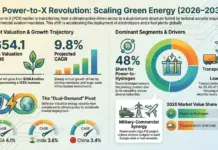
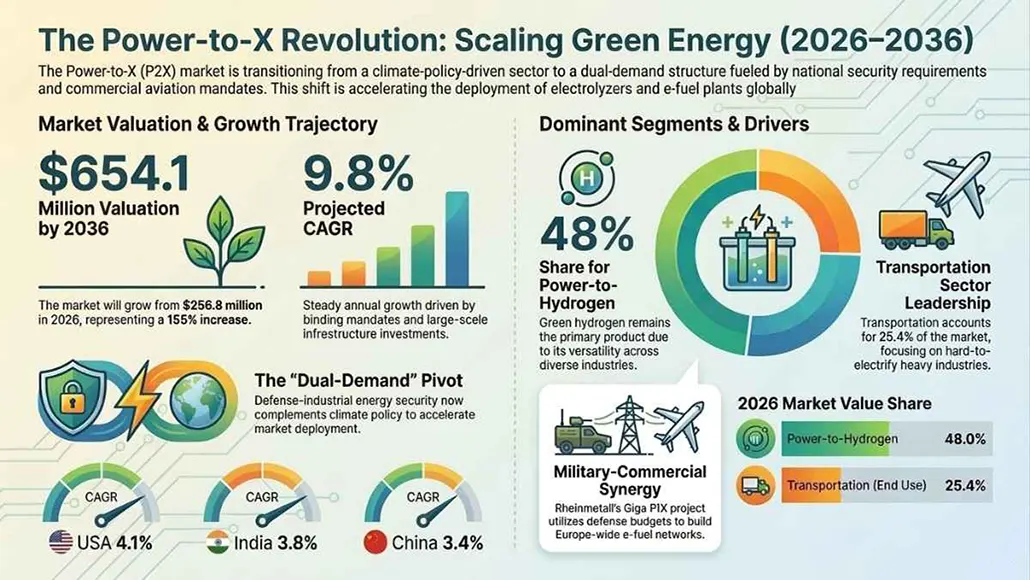
The global Power-to-X sector is positioned for significant expansion over the next decade. As of 2026, the industry is valued at USD 256.8 million. Driven by advancements in electrolysis technology and the rising demand for green hydrogen derivatives, the market is projected to reach a valuation of USD 654.1 million by 2036. This growth represents a robust Compound Annual Growth Rate (CAGR) of 9.8% during the forecast period.
Analysis of semi-annual growth patterns indicates a slight acceleration in momentum as the decade progresses. Between the base year of 2024 and 2034, the first half (H1) of the year (January to June) is expected to see a CAGR of 9.3%, while the second half (H2) (July to December) is predicted to surge at 10%. Against this prediction, the current year 2025 to 2035 period witnesses this forecast to increase to 9.4% in H1 and 10.2% in H2. These shifts reveal crucial patterns in revenue realization and suggest that the market is entering a phase of matured commercial scaling.
The Dual-Demand Pivot: Military Security and Climate Policy
A central finding in this Power-to-x sector market report 2026 is the emergence of a dual-demand structure that is fundamentally altering the market’s risk profile. While climate policy has historically been the primary driver for P2X adoption, national security requirements are now providing a secondary, often more immediate, procurement channel.
analysts identify the entry of defense-industrial groups into modular e-fuel production as a critical pivot point. One example is Rheinmetall’s Giga PtX project launched in late 2025 to build Europe-wide networks of modular e-fuel plants aimed to provide energy security for both military and civilian applications. This convergence of defense-grade procurement budgets with climate-driven mandates creates bankable offtake volumes, allowing project developers to reach final investment decisions (FIDs) on plants that previously stalled during the feasibility stage.
Key Success Factors and Market Drivers
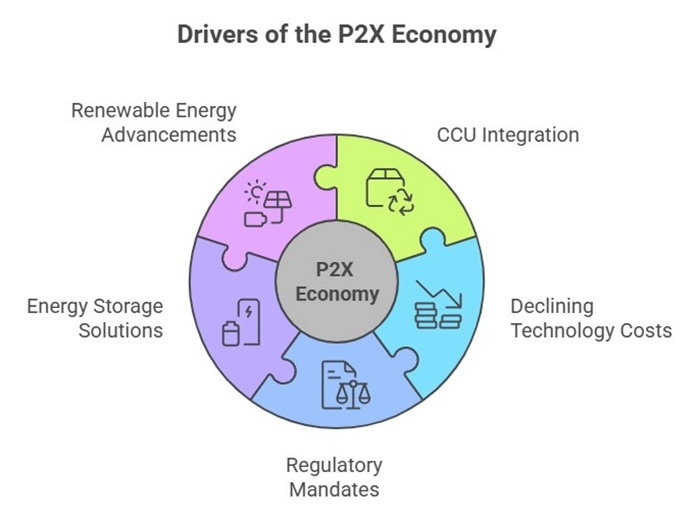
The transition to a P2X-integrated economy is supported by several critical drivers:
- Integration of Carbon Capture and Utilization (CCU): P2X solutions are increasingly incorporating CCU technologies to convert captured CO₂ into value-added products like synthetic fuels and building materials, effectively transforming waste into a commodity.
- Declining Technology Costs: The cost of electrolyzers has decreased dramatically over the past decade due to technological improvements and increased production capacity. However, a “green premium” remains, as green hydrogen production costs are currently estimated between USD 4-6/kg in most regions.
- Regulatory Blending Mandates: Regulations such as the EU’s ReFuelEU aviation mandate are forcing a commercialization timeline on developers by creating mandatory targets for e-fuel blending.
- Energy Storage Solutions: P2X addresses the intermittency challenges of renewable energy by storing surplus power as hydrogen or synthetic fuels, which can then be used to ensure a stable grid supply.
- Advancement in renewable energy and electrolyzer technologies: Lastly, a jump in renewable energy technologies has created a surplus of energy available, thus boosting the need for P2X technology to make this energy useful.
Sector-wise Forecast by End-use and Product Type
The Power-to-X market encompasses a variety of conversion pathways and output types designed to decarbonize specific industrial needs.
Product-type Sector Dynamics: Power-to-Hydrogen Dominance
Based on product type, power-to-hydrogen segment is expected to lead the market, capturing a value share of approximately 48% in 2026. Hydrogen is in high demand due to its versatility in refining petroleum, producing fertilizers, treating metals, and food processing. Furthermore, green hydrogen serves as a “bridge” to transform renewable electricity into transportation fuels. Technological advancements, such as the use of carbon nanotubes and advanced nanoparticles, are improving the efficiency of hydrogen evolution, thereby reducing production durations and increasing volumes.
End-Use Sector Dynamics: Transportation at the Forefront
Based on end-use applications, the transportation segment is projected to account for the largest market share, holding 25.4% of the market in 2026. This dominance is driven by the urgent need to decarbonize a sector that contributes significantly to global carbon emissions.
- Fuel Cell Vehicles: Green hydrogen is emerging as a clean fuel for buses, trucks, and trains.
- Existing Infrastructure: Synthetic fuels produced via P2X are compatible with existing internal combustion engines, allowing for a smoother transition without requiring immediate, massive infrastructure overhauls.
- Battery Manufacturing: Interestingly, hydrogen produced through P2X is also utilized in the manufacturing of battery cells for electric vehicles (EVs), further embedding the technology in the green transport supply chain.
Regional Market Analysis
The Power-to-x sector market report 2026 highlights significant regional variations in growth and adoption, influenced by national hydrogen strategies and existing industrial bases.
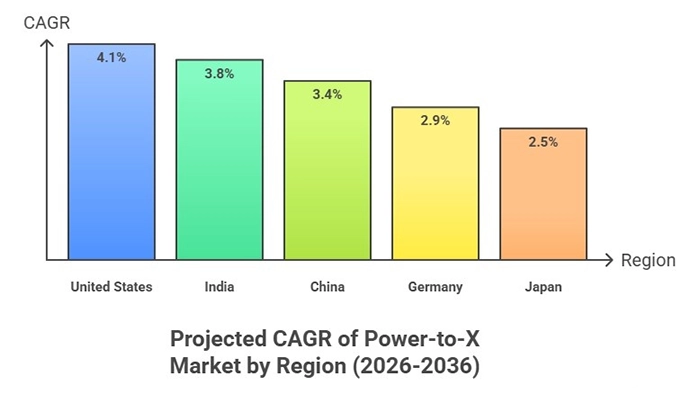
- United States: The USA is anticipated to remain the dominant force in North America and the world. The U.S. market is forecast to grow at a CAGR of 4.1%. Growth is catalyzed by federal incentives like the “Hydrogen Shot” initiative and the commitment to net-zero emissions by 2050.
- India: Projected to witness a substantial growth rate, India is expected to see a CAGR of 3.8% through 2036, driven by large-scale renewable energy projects in the South Asia region.
- China: As the world’s largest emitter of greenhouse gases, China is prioritizing P2X to meet its 2060 carbon neutrality goal. China currently leads the world in installed wind and solar capacity, providing a stable foundation for P2X applications in steel and cement manufacturing. Its forecast CAGR stands at 3.4%.
- Germany: Germany is forecast to grow at a CAGR of 2.9% through 2036. Positioned as a global leader, Germany’s market share is supported by its National Hydrogen Strategy, which allocated €9 billion for development. The country benefits from a robust industrial electrolyzer manufacturing base and a strong commitment to decarbonizing heavy industries like steel and chemicals.
- Japan: Coming next, Japan is forecast to show a CAGR of 2.5% through 2036, forming a prominent country in the Asia-Pacific region in this industry.
Conclusion
As summarized in this Power-to-x sector market report 2026, the industry is at a critical inflection point. The convergence of national security interests with climate policy is creating the necessary demand signals to move the market from small-scale pilots to industrial-level deployment. While challenges such as high implementation costs and the “green premium” persist, the declining cost of electrolyzers and the implementation of binding regulatory mandates in Europe, North America, and Asia-Pacific are expected to drive the market toward its USD 654.1 million valuation by 2036. The structural shift toward green hydrogen and derivative e-fuels ensures that the rising Power-to-X industry will remain a cornerstone of the global net-zero transition.